


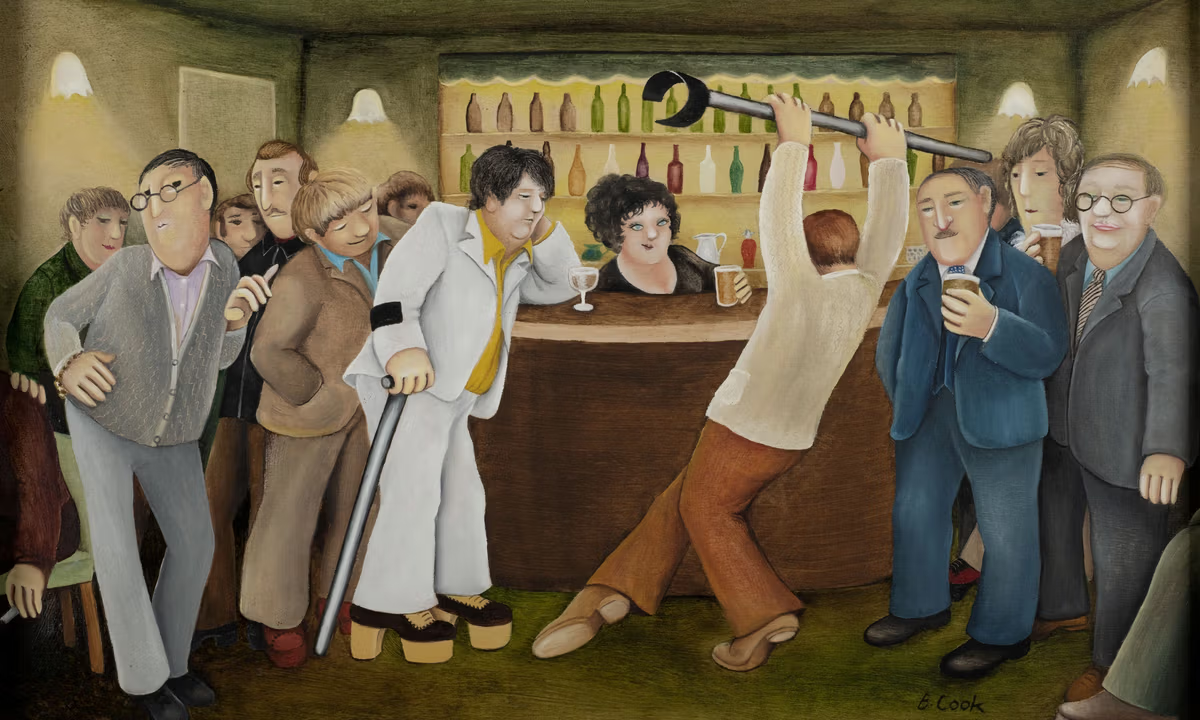
The late UK artist Beryl Cook— long derided in fashionable circles for her popular depictions of plump, fun-seeking people now emblazoned on countless calendars and mugs—is undergoing a renaissance, with two new concurrent shows in Plymouth, where Cook lived for most of her life.
A new show at Plymouth’s The Box gallery, Beryl Cook: Pride and Joy, until 31 May, places the late artist in the established Western art canon, tracing her links to figures such as Rubens and Amedeo Modigliani. Marking the centenary of Cook’s birth, the exhibition celebrates her association with the Western English port city. It features more than 80 paintings alongside sculptures, textiles plus a personal archive of photographs, sketches and letters.
“We’re not just telling Beryl Cook’s personal story but approach her work as art historians [would]. That just hasn’t really been done before—that kind of deeper contextualisation of her work and her career,” Terah Walkup, the exhibition curator, tells The Art Newspaper. The exhibition takes Cook’s themes and influences seriously, after decades of critical neglect.
Self-taught Cook “painted individuals and communities who were overlooked or marginalised, whether they were working class, LGBTQ or older women, as agents of their own joy, which attests to her enduring appeal”, writes Walkup in an accompanying booklet.
Her depictions of Plymouth’s gay bars and nightlife in the less tolerant 1970s reflects Cook’s deep affinity with the LGBTQ community. “[Her] paintings of the Lockyer Tavern, whose back bar was a well-known safe space especially among gay men, serve as a significant visual record of history in Plymouth,” writes Walkup.
Cook’s under-the-radar work spans historic LGBTQ milestones, from the 1967 Sexual Offences Act to the introduction of the controversial Section 28 legislation in 1988. “Her archive could also very much be an LGBTQ archive as well,” adds Walkup.
The show excels in placing Cook’s work in an art historical lineage, highlighting her admiration for Old Masters such as Peter Paul Rubens whose Three Nymphs with a Cornucopia (around 1625-28) features. Rubens’s celebratory representations of “shapely bodies” have led to comparisons with Cook’s practice, according to the accompanying caption (the late comedian Victoria Wood described Cook as “Rubens with jokes”).
Another historic painting—Wedding Dance in Open Air by Pieter Brueghel the Younger (1607-14), on loan from the Holburne Museum in Bath—depicts a raucous rural wedding in Flanders. The Flemish painter’s ability to document joyful social gatherings inspired Cook; among the hundreds of art history books in her studio was one on Brueghel. Works painted in the style of Modigliani and the Polish 20th-century painter Tamara de Lempicka also attest to Cook’s interest in her artistic predecessors.
Her other heroes include the artists Stanley Spencer and Edward Burra, the recent subject of an exhibition at Tate Britain which demonstrated how the 20th-century British artist also challenged artistic conventions. Cook struck up a friendship with Barbara Key-Seymer, an associate of Burra, writing to her weekly.
“Going through her library was an absolute treat—there were hundreds of books, everything from kitsch [elements] to 1960s books on drag. It’s an extraordinary reference library. There were lots of books on Stanley Spencer, many of these were gifts from Barbara and [the critic] Edward Lucie-Smith,” says Walkup.
“You can see in her letters how much she’s thinking about the way these artists approach painting. Above all, she wanted to paint like Burra and Spencer; she herself was very self-deprecating, saying ‘I could never paint like them.’”
Meanwhile a parallel exhibition at Karst gallery in Plymouth, Discord and Harmony (until 18 April), includes works by artists such as Olivia Sterling, Rhys Coren and Flo Brooks who “like Cook, champion community, individuality and moments of joy among people too often overlooked by canonical art history”, says a text, highlighting again how an artist once frowned upon is fast becoming an important touchstone.
“A tendency among cognoscenti to deride Cook’s art remained de rigueur as recently as 2007 when the last big British show of her work, staged at Baltic in Gateshead a year before her death, was savaged by a critic in The Guardian,” wrote Alastair Sooke in The Telegraph.
But this attitude is changing; The Guardian’s review of the new Cook show stresses that her art is “full of actual, genuine love. And it happens over and over in intimate paintings of her family. It’s lovely without being saccharine and gross.”
The UK Government Art Collection and the National Portrait Gallery have both acquired works by Cook (Window-Dresser 2, 1994, is on loan from the GAC). Now the two exhibitions in Plymouth further reinforce Cook’s new status as an art pioneer.
