


It’s hard to think of a scholar who has had a bigger impact on the art of our times than Saidiya Hartman. The Columbia professor is best known for her method of writing history that she calls “critical fabulation,” a way of using theory and speculative storytelling to fill silences and omissions left in the archives. Specifically, it’s a way of painting a picture of people who were prevented from leaving straightforward material traces, often those who were oppressed or enslaved.
Hartman’s homages have been many. Last year, Simone Leigh curated an exhibition titled “Critical Fabulation” at the Art Institute of Chicago, and in 2020, a group of artists—including Garrett Bradley, Arthur Jafa, and Cameron Rowland—celebrated her at MoMA PS1. In 2023, one of MoMA’s permanent collection galleries was themed “Critical Fabulations,” too. And that’s just to name the most explicit citations: Her way of working can be seen in everything from research-based practices, to work on colonial archives, to speculative experiments merging fact and fiction.
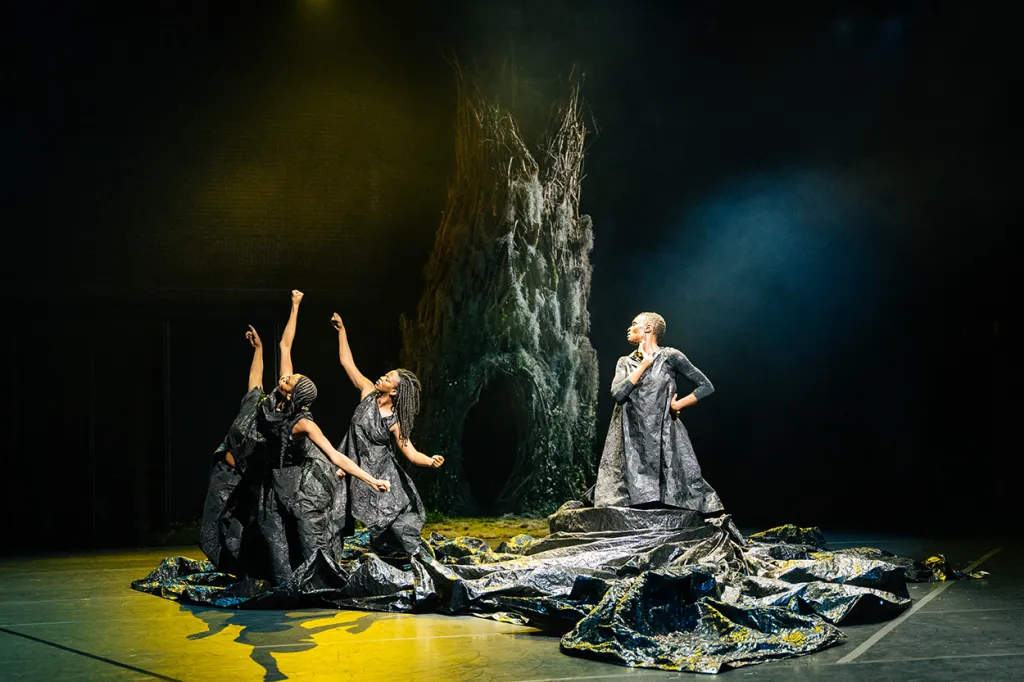
Now, for the first time, Hartman is helming an artwork of her own. In October, she debuted a performance she wrote titled Minor Music at the End of the World, a three-part work that imagines the end of white supremacy. It is deeply collaborative, featuring cinematic elements by Arthur Jafa, sculptures by Precious Okoyomon, and sounds by Peter Born. Cameron Rowland is credited as the “Attendant of the Archive,” and André Holland and Okwui Okpokwasili are the lead performers. Recently, Minor Music had a run in Venice where, thematically, it echoes the Biennale’s main show, titled “In Minor Keys.”
After seeing it there, I sat down with Hartman for a ranging conversation about her writing and Minor Music; she also shared a museum’s wild misuse of her ideas, and teased her next book.
The performance is based on your 2020 essay “The End of White Supremacy,” which responds to W. E. B. Du Bois’s The Comet. What prompted you then to revisit his short story year?
In 2020, The Comet felt terribly relevant. It was the short story’s 100th anniversary: It was written at another horrendous point in US racial empire. Du Bois started imagining: how are we going to get through to the other side of racial capitalism and colonialism? The only way he could envision that happening was the literal end of the world.
The summer I wrote that essay, millions of people around the world were demanding change, and his vision struck a deep chord. So much of the pessimism and the despair that fueled the piece has even greater purchase now. The forces of domination, racism, and Empire are stronger than they have been—and more naked.
“Naked” is a great way to describe it. How did the essay then become a performance?
In 2021, Bernard Schwartz, the head of the Unterberg Poetry Center at the 92nd Street Y, invited André Holland to read the essay. It was the first dramatic performance of my work; until then, I was the only person allowed to do readings! And suddenly, it was no longer mine. André is an incredible actor. I joke that he can make Marx’s theory of primitive accumulation sound like poetry. That flipped the switch about its possibilities.
Arthur Jafa (AJ), André, and I thought we should try to do something with this. We thought about making a film or, at least, a filmed reading of the work.
Then I spoke with Okwui Okpokwasiliabout developing the work… The Comet explores the possibility of a transformed world through the figure of interracial romance, but it has these very flat, empty portraits of both the black woman and the white woman in the story.
Precious Okoyomon invited Okwui and I to come to Rome to rehearse and develop the piece. Gavin Brown, the gallerist of Precious and AJ, said: What could be better than the end of white supremacy performed against the ruins of Western civilization?
The collaboration was supported by the Hartwig Art Foundation, and then HAF commissioned me to develop Minor Music at the End of the World, with this incredible cast of artists and performers. Claudia Rankin recommended Sarah Benson as a director, because she’s not afraid of lots of language and ideas. Minor Music is performative, but it’s not a play.
Saidiya Hartman
Photo Steven Gregory
So much of your writing involves filling out the worlds and textures of others, whose lives were perhaps not captured in the archive. What was it like to experience something similar happening with a text of yours?
I would say it feels like a way to get words off the page, and those words acquire a texture and meaning that exceeds me as they are spoken and embodied and actualized by others.
It opens with a 40-minute monologue. André Holland plays the narrator alongside The Comet’s cast of characters: the male messenger, the beautiful white woman, the president of the bank, the white mob. The second movement is based on new writing, “Dead River,” an unpublished essay I wrote with Okwui in mind. The third movement is a variation of Arthur Jafa’s AGHDRA (2020). When “The End of White Supremacy” first appeared in BOMB in 2020, it included three stills from AJ’s film in progress. He and I were both thinking about Blackness and the Anthropocene, and AGHDRA was a strong visual articulation of both the end of the human world, and the possibility for Blackness at the end of the world.
Your idea of critical fabulation has been so generative for so many artists, it’s exciting to see it evolve into also collaborations with those artists. Are there things you’ve learned from working with artists that have been generative for you in return?
My way of working with the archive is very indebted to artists, as much as it is to scholars. For historians, the archive might establish signposts for a route, the who, what, where, when, why. For artists, the archive is also matter for making a story, a film, a painting. For Walid Raad’s piece in the Venice Biennale, he worked with just one sentence along the lines of: When Yasser Arafat was head of the PLO, he could sleep no more than two nights in the same room. hen, the artist imagined what all those rooms might have looked like.
That belief in the imaginative and the speculative is so critical. For me, where the archive is incredibly limited—often the person I’m interested in leaves no trace, never speaks in the first person, or speaks only under the conditions of coercion—the question becomes: How do I work with the extant material traces to tell a radically different kind of story? How can I utilize an archival trove of polyvocal utterances and make it feel like an orchestration of thought over the course of centuries, as I do in Minor Music—asopposed to just my singular framing of the end of the world?
I hope people in the audience get to feel that sense of time. It’s really sedimented and entangled.

View of Saidiya Hartman’s 2025 performance Minor Music at the End of the World.
Have you encountered artworks you might consider perhaps “uncritical” fabulations, or a misuse of something like your idea?
Yes, by an institution in Germany. They were literally displaying the bones of Herero people inside this ethnographic museum, and they wanted to use “critical fabulation” when rehabilitating that colonial museum. No. Critical fabulation is opposed to that project—the accumulation that makes possible the museum collection, the violence necessary to capture and catalogue the human specimen.
Olúfẹ́mi O. Táíwò has this term “elite capture” [see: Elite Capture: How the Powerful Took Over Identity Politics (And Everything Else)]. This was an elite capture, in order to enable a colonial ethnographic museum that literally contained the bones of the Herero. I thought… did you read what I wrote!? The archive is a mortuary, and the literal presence of bones exemplifies the violence of such repositories. A huge, resounding, loud, no!
It’s also worth distinguishing critical fabulation from fiction. Fiction is critically important, but for people who are committed to nonfiction, it’s often because we believe that real life is stranger than fiction. The things people endure and make happen and create under the most brutal and extreme circumstances can seem unbelievable. I research and write to understand such lives.
In the book I’m writing now, there’s a character who died imprisoned in the Soviet Union, and I found their death certificate. I can’t even read it, but just to have it as a document is so critical: a different aspect of that character came into view for me. Documents and materials, as well as intuition and rumors, help me to figure out the story. I write with the sense that I am not going to know everything that happened, and bereft of steely certainty, but I do my best to account for everything I can.
Absolutely. May I ask what your new book is about?
In a way, I feel like every book is exploring the same question! In Wayward Lives, there is a sentence in the prologue where I say that I’m examining “a revolution in a minor key.” This new book is looking at a revolution in a major key, at the Bolshevik Revolution and its impact on black people’s lives. I heard someone describe Marxism as second to Christianity (at least in the West) in affecting people’s belief about how the world might be transformed. So, at this moment when there are brutal regimes of power all over the world, I’m asking: What is our imagination of radical transformation? And I’m thinking about how revolution plays out in a very intimate and local and embodied way. The relationship between the structural and the everyday, the lived experience, continues to be of importance in my work.
