


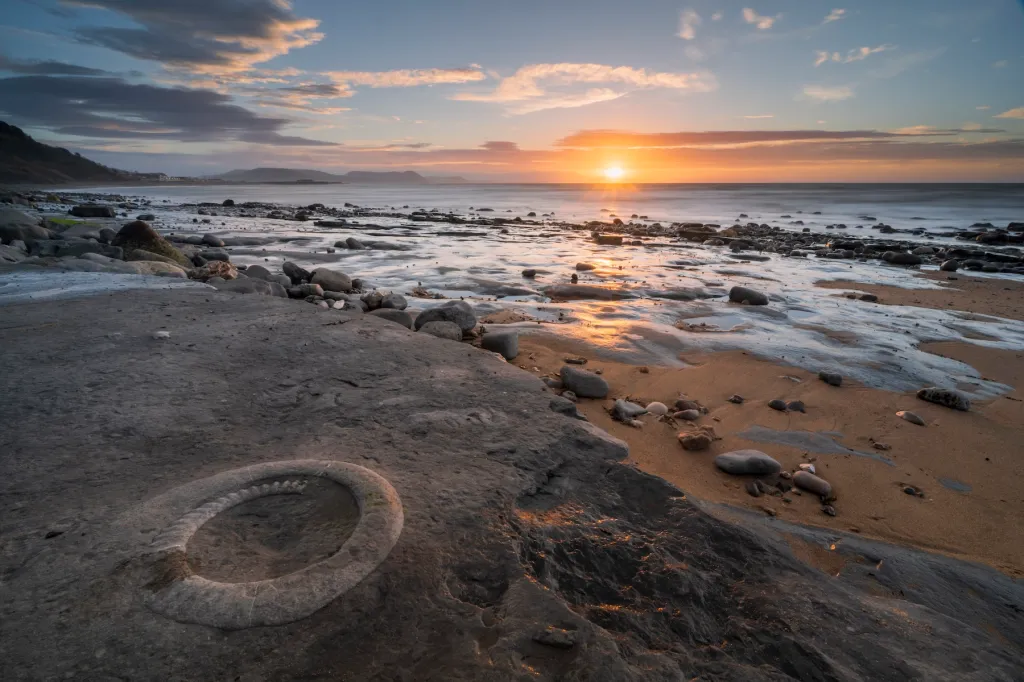
A “stunning” British collection of 318 Jurassic-era fossils has been sold to the Natural History Museum Abu Dhabi, the Guardian reports, in what some have described as a loss to the nation. The trove was collected by UK fossil hunter Chris Moore along the Jurassic Coast, a UNESCO world heritage site in southwest England that is rich in fossils dating from 200 million to 245 million years ago. They include ichthyosaurs, fish, and crustaceans, among other creatures, some of which could be new species.
The collection was initially offered to the Natural History Museum in London and to Amgueddfa Cymru (a natural history museum in Wales) for what is said to have been an eight-figure sum. Both museums passed, citing a lack of funds. In first making the collection available for purchase to those museums, Moore was following the area’s fossil-collecting codes, which specify that scientifically important specimens must first be offered to UK-registered institutions for a period of six months before they can be sold elsewhere.
Fossil hunting is hardly a new pursuit. Long before paleontology was a recognized scientific field, the ancient Greeks and Romans were unearthing the bones of Ice Age mammals and displaying them in temples and museums. The Guardian notes that English fossil hunter and dealer Mary Anning (1799–1847) made spectacular discoveries along the same stretch of coastline frequented by Moore, including the first complete skeleton of a plesiosaur—a marine reptile that lived during the Jurassic period.
But the world’s appetite for fossils has exploded in recent years, with social media awash with videos of fossil hunters and prices for perfect specimens soaring. In 2020, a T. rex skeleton was sold to the Natural History Museum Abu Dhabi for a record-breaking $32 million; this year a second T. rex fetched $50 million at Sotheby’s. With price tags far beyond the reach of the average museum, many of these rarities end up in private collections, including those of celebrities like Leonardo DiCaprio and Russell Crowe.
While some countries, including Mongolia and Brazil, consider fossils to be property of the state, this is not the case in the UK, leading to conflicting opinions about how fossil collecting and sales should be regulated. Some experts argue for keeping the status quo, saying a ban on selling to other countries would mean that important specimens would remain undiscovered or be illegally extracted and sold on the black market.
Others, including Erin Maxwell, an expert on Early Jurassic marine vertebrates at the State Museum of Natural History in Stuttgart, disagree. “Fossils represent part of the natural [or] cultural heritage of the region and country from which they originate,” she told the Guardian, though she did note that “the loss is somewhat offset by the fact that these fossils are going to a museum rather than into the collection of a wealthy individual.”
For countries like England where fossils are not state owned, Maxwell added that there were other options. “I think it is important for the state to have the right of first refusal on acquiring the collection on an at-cost basis prior to export—rather than the currently grossly inflated market price,” she told the Guardian. “However, if the state declines, then sale to a foreign museum is a best-case scenario.”
For his part, Phil Davidson, a paleontologist at Charmouth Heritage Coast Centre in Dorset, agrees that the priority should be keeping key specimens in public collections, but “All the researchers I have talked to have said the same thing: the location of where the museum collection is housed is secondary.” He also stressed the importance of keeping collections from a single geological formation, as Moore’s is, together.
With this position, at least, the Natural History Museum Abu Dhabi—where Moore’s collection went on view in November 2025—appears to concur. Noting that during the Lower Jurassic period, England’s Dorset coast was roughly at the same latitude as North Africa, a spokesperson from the museum told the Guardian, “If we are to tell a 4.2-billion-year story of the evolution of life on Earth, all museums must travel both spatially and temporally with their collections.”
