


For years, the trophy object of choice for the ultra-wealthy was relatively predictable: the Picasso, the Rothko, the rare Patek Philippe watch, maybe a Basquiat large enough to dominate the living room of a newly purchased penthouse, or, more recently, Air Jordans worn by the legend himself at a championship game. But lately, another kind of status symbol has been muscling its way into auction catalogs, gallery exhibitions, and billionaire wish lists: dinosaurs.
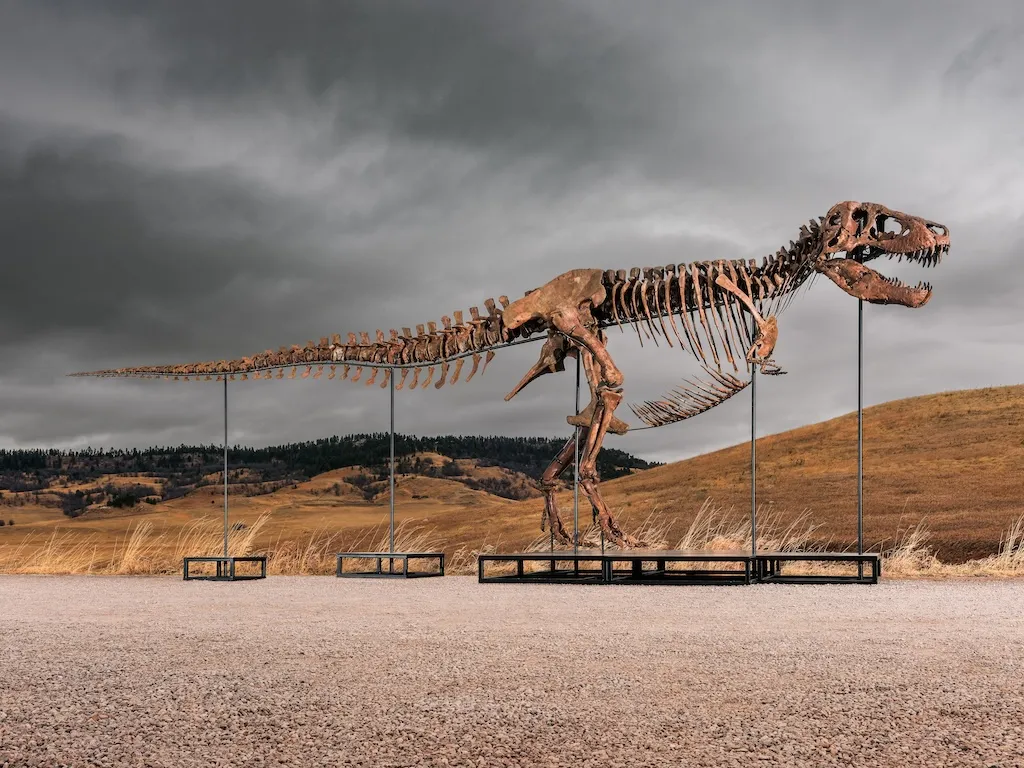
This summer, Sotheby’s will offer “Gus,” a 67-million-year-old Tyrannosaurus rex skeleton estimated at $20 million to $30 million, the highest estimate ever placed on a dinosaur fossil. The specimen, excavated over several years in South Dakota, stretches roughly 38 feet long and stands more than 12 feet tall. Sotheby’s is billing it as one of the largest and most complete T. rex specimens ever discovered.
On its own, that might sound like another attention-grabbing auction headline in an art market that increasingly runs on spectacle. But “Gus” arrives on the crest of a much larger wave. Dinosaurs are no longer occasional curiosities tucked into natural history sales. They are becoming luxury objects in their own right, appearing not only at Sotheby’s and Christie’s, but at contemporary art galleries, private museums, and increasingly in the homes of younger ultra-wealthy collectors.
Earlier this month, the downtown New York gallery Amanita opened “Land Before Time: Three Dinosaurs and a Gondola,” an exhibition pairing three Maiasaura fossils with a sculpture by John Chamberlain. The show felt less like a natural history display than a contemporary art exhibition, complete with careful lighting, minimalist staging, a massive crowd on opening day, and the unmistakable suggestion that a dinosaur skeleton might belong beside blue-chip sculpture.
That overlap between the art world and paleontology would have seemed strange not long ago. Now it feels oddly inevitable.
“I think that it’s gotten to the point where clients who are at the ultra-high-net-worth level have started to branch out into other collectibles,” said Mari-Claudia Jiménez, a partner and head of Withers Art and Advisory, who previously served as chairman and president of Sotheby’s Americas. “They bought the best Magritte, the best Picasso, the best Rothko. And now they’re like, ‘Well, what is the best of other things that I can get?’”
In other words, the dinosaur has become the next frontier trophy object.
Collectors are not looking for just any fossil. They want the biggest Tyrannosaurus rex, the most complete skeleton, the specimen with the best preservation and provenance. The psychology is not so different from that which drives any other luxury market.
“They’re not interested in buying a pedestrian dinosaur. They want the best dinosaur. They don’t want the Rolex Submariner that every tech pro has,” Jiménez said, “they need to have the Patek with four hundred complications that only they need one of.”
Part of what separates a museum-grade dinosaur from a mediocre one comes down to science and preparation. Cassandra Hatton, Sotheby’s vice chairman and global head of science and natural history, told ARTnews that lower-quality examples often suffer from distortions, poor fossilization, or heavy-handed restoration. Some are composites assembled from multiple dinosaurs or replica bones to create the illusion of a more complete skeleton.
Hatton said fossils can also be damaged by poor excavation practices or improper preparation. “I’ve seen things improperly excavated and the fossils ruined,” she said. “I’ve seen things improperly prepared and the fossil was ruined.” In some cases, she added, preparators have even misidentified bones while assembling skeletons.
By contrast, Sotheby’s has emphasized that “Gus” is a single specimen rather than a composite, prepared with extensive scientific documentation and mounted according to rigorous paleontological standards.
Not every dinosaur currently entering the market meets those standards. One source with deep roots in the paleontology market, who requested anonymity because of the sensitivity of the subject, told me that many fossils now appearing in smaller galleries and auction houses are specimens that struggled to find buyers through traditional natural history channels. According to the source, some are composites or heavily restored examples being repositioned for art collectors who may be less familiar with the scientific side of the market.
Dinosaurs also possess something contemporary art increasingly struggles to offer: universal legibility. Almost anyone, regardless of age or background, understands the appeal of a T. rex skeleton towering over a room. It doesn’t require wall text, theoretical framing, or a curator explaining why it matters.
“Dinosaurs are just cool,” Jiménez said. “Every kid wants to have a pet dinosaur.”
That childhood fascination appears to be colliding with a new generation of wealth. According to Jiménez, many buyers entering the market are younger collectors, often between their 30s and 60s, who grew up during the explosion of dinosaur culture in the 1980s and ’90s, when Jurassic Park, natural history museums, and sports fandom became deeply embedded in popular culture.
“These are things that people grew up with,” she said, comparing the trend to the surge in sports memorabilia collecting. “It’s almost like a cultural phenomenon more than anything else.”
The sums involved have become staggering. In 2020, Christie’s sold “Stan,” another T. rex skeleton, for $31.8 million. Four years later, Sotheby’s sold “Apex,” a Stegosaurus fossil, for $44.6 million, setting a new auction record for a dinosaur. Last year, Sotheby’s sold a juvenile Ceratosaurus for $30.5 million after estimating it at just $4 million to $6 million.
At the same time, dinosaurs have started drifting into spaces traditionally occupied by contemporary art. Phillips sold its first dinosaur fossil in 2025. Joopiter, Pharrell Williams’s auction platform, brokered the sale of a Triceratops skeleton earlier this year. Amanita and Sotheby’s both seem to present fossils less as scientific artifacts than as aesthetic objects worthy of gallery walls and collector interest.
Still, the market remains more complicated than the headlines suggest.
Hatton argues that part of the recent boom comes from increased transparency in a market that historically operated behind closed doors.
“What has not always been there has been the transparency,” Hatton said. “The number of clients who’ve come to me saying, ‘I’ve wanted to buy something like this for a long time, but I didn’t know what questions I should be asking,’ is enormous.”
That’s important because many buyers historically entered the market without understanding how to evaluate quality, provenance, or restoration.
“A lot of people have this conception that you dig a hole and pull a skeleton out of the ground,” Hatton said. In reality, she explained, preparing a major specimen can take years of excavation, mineral analysis, conservation work, and scientific study.
The distinction matters because the line between scientific artifact and luxury object remains shaky. Paleontologists have for years worried that major fossils disappearing into private collections could limit research access or inflate prices beyond what museums can afford. Supporters of the market counter that private money often finances the excavation, preservation, and study of fossils that might otherwise remain buried indefinitely.
Either way, the market has clearly evolved beyond niche collecting. Dinosaurs now occupy the same cultural ecosystem as blue-chip art, rare watches, and trophy real estate: objects that function simultaneously as investments, status symbols, conversation pieces, and experiences.
After all, a dinosaur is difficult to ignore. You don’t quietly own a T. rex. You build a room around it. And in a luxury culture increasingly driven by spectacle, immersion, and social theater, that may be exactly the point.
