

Close Menu
  • News
  • Stocks
  • Bonds
  • Commodities
  • Collectables
    • Art
    • Classic Cars
    • Whiskey
    • Wine
  • Trading
  • Alternative Investment
  • Markets
  • More
    • Economy
    • Money
    • Business
    • Personal Finance
    • Investing
    • Financial Planning
    • ETFs
    • Equities
    • Funds

Subscribe to Updates

Get the latest markets and assets news and updates directly to your inbox.

Trending Now

As the Country Turns 250, Why Won’t Its Museums Meet the Moment?

June 7, 2026

Sotheby’s Quietly Tried to Sell Arne Glimcher’s Pollock for $50 M.—It Didn’t Go as Planned

June 6, 2026

Following Federal Order, Kennedy Center Begins Removing References to Donald Trump

June 6, 2026
Facebook X (Twitter) Instagram
The Asset ObserverThe Asset Observer
Newsletter
LIVE MARKET DATA
  • News
  • Stocks
  • Bonds
  • Commodities
  • Collectables
    • Art
    • Classic Cars
    • Whiskey
    • Wine
  • Trading
  • Alternative Investment
  • Markets
  • More
    • Economy
    • Money
    • Business
    • Personal Finance
    • Investing
    • Financial Planning
    • ETFs
    • Equities
    • Funds
The Asset ObserverThe Asset Observer
Home»Art Market
Art Market

Stonehenge’s Altar Stone Was Hauled 430 Miles From Northeast Scotland, New Study Argues

News RoomBy News RoomJune 5, 2026
Share
Facebook Twitter LinkedIn Pinterest Email

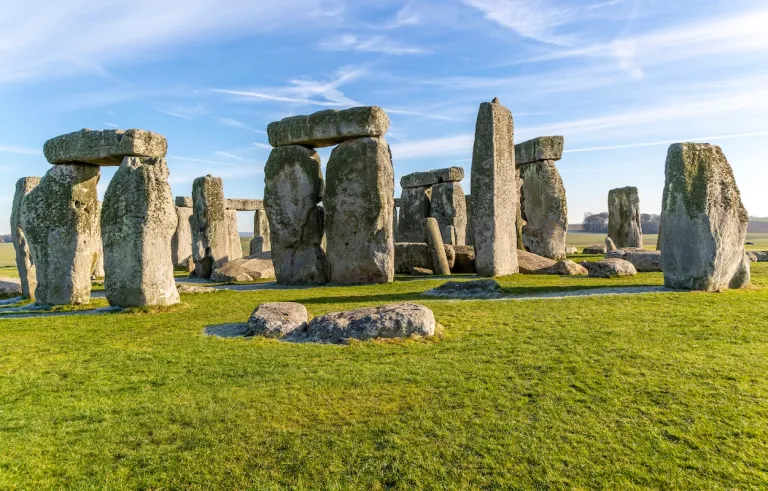
Once thought to have originated in Wales, like the rest of the 4,500-year-old monument’s bluestones, Stonehenge’s altar stone has recently been traced through geological fingerprinting to Scotland. The question of how the megalith made the 435-mile journey from there to Salsbury Plain in England is now the focus of a study by scientists at Curtin University in Australia in collaboration with experts from Sheffield Hallam University, the University of Sheffield, Wessex Archaeology, and the University of Bristol in the United Kingdom.  Their findings were published June 4 in the Journal of Quaternary Science.

Stonehenge was built in stages by Neolithic and Bronze Age peoples between around 3,000 BC and 1,500 BCE. It consists of an outer circle and inner horseshoe of sandstone trilithons with inner arcs of smaller bluestones. The altar stone at its heart is thought to have been placed there during the second period of Stonehenge’s construction, between 2,620 and 2,480 BCE.

Geological evidence has confirmed that the monument’s sandstone boulders came from the Marlborough Downs, 20 miles away, while its smaller dolomite bluestones were quarried in the Preseli Hills in southwest Wales, 180 miles to the northwest. The average sarsen (sandstone block) at Stonehenge weighs 25 tons; the average bluestone ranges from 2 to 5 tons, and the largest weighs 40 tons.

Until recently, there were competing theories as to how the stones traveled such long distances, with some positing that humans moved them by land or by sea and others suggesting they were deposited by glaciers during the Ice Age.

Earlier this year, we reported that the Curtin University team had ruled out glacial transport of Stonehenge’s bluestones, concluding that they were almost certainly carried to their present location through human labor alone. Now, building on their previous research, the Curtin and Sheffield Hallam University scientists postulate that the movement of the altar stone may have involved a combination of human and glacial transport.

After studying ancient ice flows, the researchers believe that a glacier carried the altar stone from the Orcadian Basin in Northeast Scotland to Dogger Bank—a prehistoric landmass connecting Britain to mainland Europe now submerged under the North Sea—during Britian’s last ice age between 33,000 and 11,700 years ago.

“Our modeling shows glaciers may have transported rocks part of the way during the last Ice Age—potentially as far as Dogger Bank in the North Sea—but not into southern England,” says co-lead author Dr. Anthony Clarke, from the Curtin’s School of Earth and  Planetary Sciences, “meaning the stone would still have needed to be moved hundreds of kilometers by people.” He adds, “Transporting a stone of this size over such a long distance would have required planning, coordination and a deep understanding of the landscape—not to mention tremendous determination.”

Sheffield Hallam University’s Dr Remy Veness, co-lead author of the paper notes, “What is exciting about these findings is that they could imply that the people of Doggerland attached cultural significance to the Altar Stone long before it was incorporated into Stonehenge. . . . [The stone] must have been significant enough [for people] to be willing to move [it] at least twice; first to save it from being submerged by rising sea levels at the end of the last ice age and then again to its final resting place on Salisbury Plains.”

Share. Facebook Twitter Pinterest LinkedIn Tumblr Email

Keep Reading

As the Country Turns 250, Why Won’t Its Museums Meet the Moment?

Sotheby’s Quietly Tried to Sell Arne Glimcher’s Pollock for $50 M.—It Didn’t Go as Planned

Following Federal Order, Kennedy Center Begins Removing References to Donald Trump

Mexico Demands a Halt to an Auction of Mexican Artifacts in Colorado

National Park Service Orders Removal of Quotes at Bunker Hill After Visitor Complains of ‘Woke’ Ideology

Remembering Julio Le Parc, a pioneer of kinetic art – The Art Newspaper

Police Investigate Suspected Arson at Boston Museum of African American History

Inaugural Medina Triennial transforms small village in upstate New York – The Art Newspaper

Comment | Farewell, Los Angeles’s ‘punk’ Box gallery – The Art Newspaper

Recent Posts
  • As the Country Turns 250, Why Won’t Its Museums Meet the Moment?
  • Sotheby’s Quietly Tried to Sell Arne Glimcher’s Pollock for $50 M.—It Didn’t Go as Planned
  • Following Federal Order, Kennedy Center Begins Removing References to Donald Trump
  • S&P 500 sees $1.8 trillion wipeout, Nasdaq tallies biggest point drop on record. Here’s what investors need to know about Friday’s selloff.
  • Mexico Demands a Halt to an Auction of Mexican Artifacts in Colorado

Subscribe to Newsletter

Get the latest markets and assets news and updates directly to your inbox.

Editors Picks

Sotheby’s Quietly Tried to Sell Arne Glimcher’s Pollock for $50 M.—It Didn’t Go as Planned

June 6, 2026

Following Federal Order, Kennedy Center Begins Removing References to Donald Trump

June 6, 2026

S&P 500 sees $1.8 trillion wipeout, Nasdaq tallies biggest point drop on record. Here’s what investors need to know about Friday’s selloff.

June 5, 2026

Mexico Demands a Halt to an Auction of Mexican Artifacts in Colorado

June 5, 2026

National Park Service Orders Removal of Quotes at Bunker Hill After Visitor Complains of ‘Woke’ Ideology

June 5, 2026
Facebook X (Twitter) Instagram
© 2026 The Asset Observer. All Rights Reserved.
  • Privacy Policy
  • Terms
  • Press Release
  • Advertise
  • Contact

Type above and press Enter to search. Press Esc to cancel.