


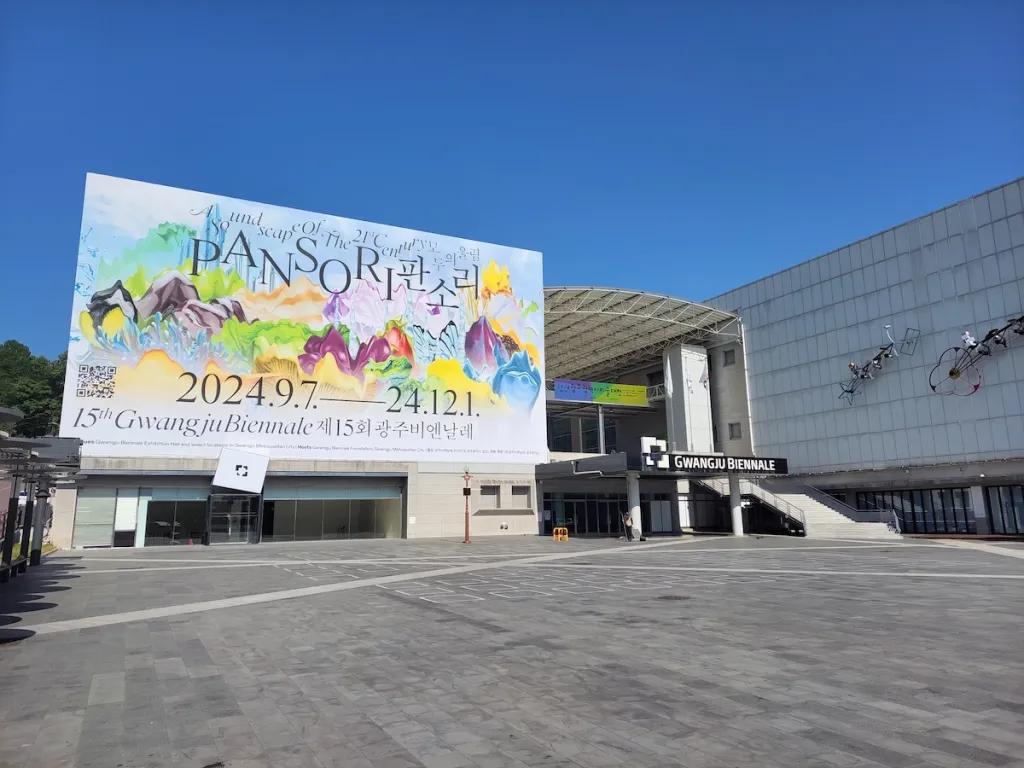
The controversy surrounding the renaming of the “Taiwan Pavilion” at the upcoming edition of the Gwangju Biennale, opening next month, has escalated to an international diplomacy dispute. The self-governed island’s culture ministry says it “strongly protests” the Korean biennial scrubbing the agreed-upon name from its presentation, vowing to take “necessary action” if the exhibition’s organizers breach the agreement.
“[Taiwan] will firmly participate in the Gwangju Biennale under the banner of ‘Taiwan Pavilion,’” the Ministry of Culture reiterated on Thursday, the second statement this week addressing the matter.
The dispute dates to June when the Taiwanese Culture Ministry first realized that the Biennale’s program called its presentation the “NTMoFA Pavilion,” an acronymic reference to the National Taiwan Museum of Fine Arts, which serves as the commissioning institution. The ministry reached out to the Gwangju City Council and the Biennale via the Taipei Mission in Korea demanding an explanation and a reinstatement of the “Taiwan Pavilion” name. But it received no response from the Biennale despite repeated efforts.
The controversy then erupted publicly last weekend when the pavilion’s 10 participating artists and curator posted a statement accusing the Biennale’s organizers of “political censorship” and “brutally eras[ing] Taiwan” after they also learned that “Taiwan Pavilion” did not appear on the Biennale’s promotional materials that went live earlier this month. On Monday, Taiwan’s Ministry of Culture, backed by its minister of foreign affairs, issued a “stern protest” against the decision to rename the “Taiwan Pavilion.”
“As a city and a biennale with a profound history of pursuing democracy and freedom, Gwangju and the Gwangju Biennale Foundation should respect the fact that Taiwan is a sovereign and independent country,” the ministry’s Tuesday statement reads, which notes that it received confirmation that its exhibition, “Instance Dungeons: Gray Zone” would appear under the banner of “Taiwan Pavilion,” from the Biennale on April 2, with an agreement that also used “Taiwan Pavilion” designation, signed on April 23.
Organizers of the Gwangju Biennale stated they did not intervene or censor exhibition planning or content, but that the National Taiwan Museum of Fine Arts entered into the agreement as an institution, instead of a national pavilion. The Biennale cited that an official letter of approval issued by the relevant embassy or ministry of culture is required for national pavilion applications, which it did not receive from Taiwan. Taiwan requested the pavilion to be reclassified as a national pavilion after the agreement was signed, but the Biennale were unable to accommodate the requested change, the foundation told ARTnews.
“This matter does not concern the content of an exhibition or freedom of expression. It arises from an administrative difference concerning participant classification and naming conventions,” the foundation said in a statement to ARTnews. “Framing or disseminating the matter as an act of censorship by the Foundation may cause serious concern for the reputation and trust of not only the Gwangju Biennale Foundation, but also the countries and institutions participating in the Pavilion project.”
Rebutting the Biennale’s response, Taiwan’s Ministry of Culture shared screenshots of proposal materials and email correspondence with the Biennale foundation to illustrate that the project has always been referred to as “Taiwan Pavilion,” from its initial proposal submission to the final approval. The ministry stated that the Biennale’s claims were erroneous, but maintained that it was willing to work with the organizers to move things forward.
Cheng Hsien-Yu, Traced, 2026.
Courtesy the artist
The Gwangju Biennale was founded in 1994 to commemorate the 1980 Gwangju Uprising, during which hundreds of civilians were killed during a protest against the authoritarian military government’s brutal crackdown on civil rights. Gwangju is a historically significant city in South Korea’s path to democracy, and the Biennale maintains that it is “grounded in the Gwangju Spirit and its values of democracy and freedom of expression.”
The Gwangju Biennale Pavilion is a relatively new feature to the South Korean exhibition, launching in 2018. This year’s edition, opening September 5, will feature 28 pavilions including 16 national pavilions and 11 institutional participants, with one institution presenting two pavilions. As with the Venice Biennale, the national pavilions at Gwangju are organized separately but in tandem with the main exhibition.
This recent incident has caused a great deal of anger and frustration among the Taiwanese artistic community and general public as news has circulated online widely this week. Chen Hsiang-Wen, the pavilion’s curator, told ARTnews that while the exhibition’s theme explores the peculiar geopolitical position of the island as a “gray zone,” none of the works on view specifically focuses on Taiwanese independence or cross-strait relations with China. “Even if there were [the case], it shouldn’t be an excuse for them to reject our exhibition or change the name of our pavilion without further discussion,” Chen said. “We believe in freedom of speech.”
According to an exhibition description reviewed by ARTnews, Taiwan’s Gwangju presentation is built upon an earlier NTMoFA show and takes a deep dive into the island’s “tangled historico-political context and its geostrategic significance amid the global turmoil of the New Cold War structure.” The nine featured works illustrate the artists’ reflection on the impact of political technologies and surveillance mechanisms on daily life. Among them are an AI-powered installation, Traced (2026) by Cheng Hsien-Yu, and Su Hui-Yu’s The Space Warriors and the Digigrave (2024), a moving image work revisiting a 1980s Taiwanese sci-fi series influenced by a Japanese title.

Su Hui-Yu, The Space Warriors and the Digigrave (still), 2024.
Courtesy the artist
Over the past two decades, Taiwan, a self-governed island that China claims to be part of its territory, has faced marginalization at international arts and culture events. In 1995, Taiwan took part in the Venice Biennale for the first time as a national pavilion and continued to do so until 2003, when it was demoted to a collateral event following protests from China, which had planned to organize its own national pavilion that year.
Around this time, China’s claim to national pavilion extended well beyond Venice, considered the Olympics of the art world. In 2002, the Taiwan Pavilion was scrubbed from the São Paulo Biennial under pressure from the Chinese government, and the name was changed to “Taipei Fine Arts Museum,” the organizing institution for that pavilion. In 2007, China demanded organizers of the Prague Quadrennial to add “China” after “Taiwan” in the island’s exhibitor title but it was rejected by the Czech Republic, causing China to withdraw from the show.
At the 2007 Venice Film Festival, when Lust Caution by Taiwanese director Ang Lee won the Golden Lion, the film was labelled a “Taiwan, China” production despite China having no involvement in the movie’s realization. Similar naming disputes also happened in the 2011 Venice Film Festival and the 2010 Tokyo International Film Festival.
Despite this context, the participating artists for Taiwan’s Gwangju contribution plan to press for change. Su Hui-Yu, one of the artists told ARTnews, “As an artist, I find this situation clearly unacceptable. However, we can only keep fighting and finding ways around it. We must speak up for ourselves and fight for everyone.”
