


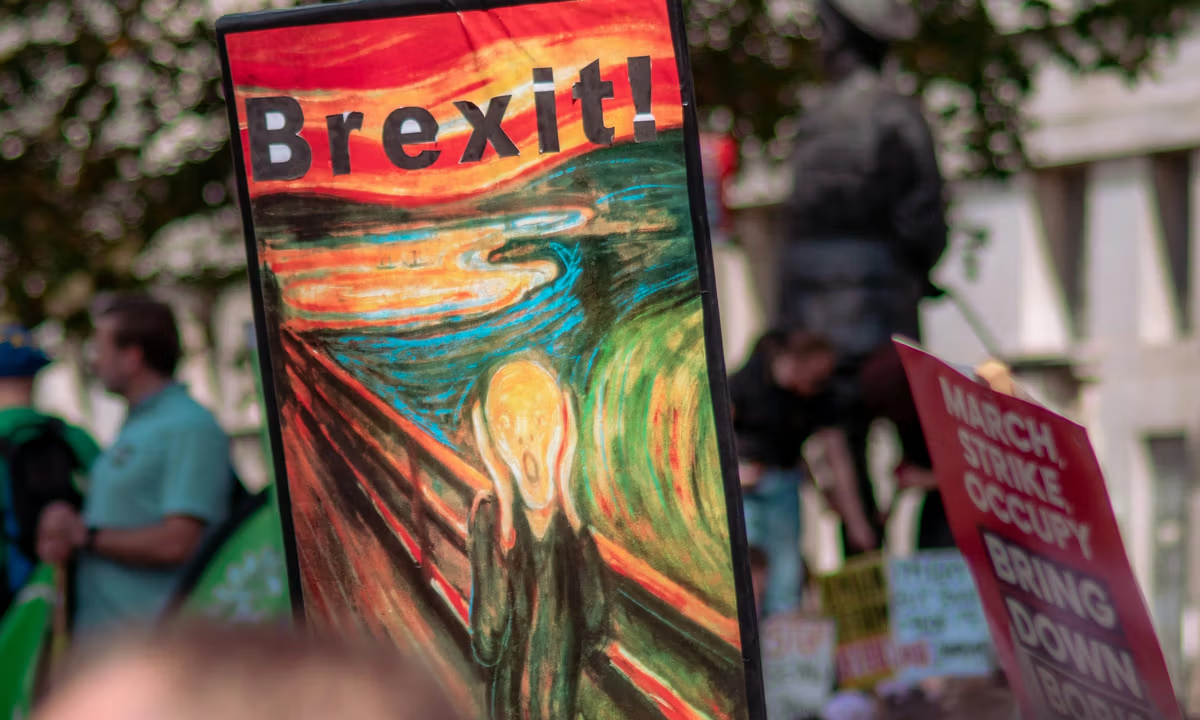
The tenth anniversary of the Brexit referendum this month—if nothing else—might prompt us to reflect on the impact of the UK’s withdrawal from the EU on art and cultural heritage laws. The ‘regulation bonfire’ that was threatened and feared never did transpire, at least not in the art world. The more apt imagery might be of an eco-friendly burner running on the lowest setting.
For instance, the most onerous EU rules for the art market, the anti-money laundering regulations, have been retained, although legally they didn’t need to be. This has led to plenty of regulation and guidelines for the art market, with disproportionate costs and compliance demands piled onto the more vulnerable professionals at the lower end of the market. Of course no one wants illicit money flowing through the art market, but evidence that this was indeed taking place in the EU was very scarce prior to adoption. The bureaucratic machinery nevertheless churned out the Fifth Anti-Money Laundering Directive in 2018, much to the chagrin of many in the art market.
The seemingly innocent acronym ‘GDPR’ no doubt sends shivers down the spine of many at auction houses and museums across the UK. These data protection requirements come from EU regulations dating from 2016. While they have not been dropped since Brexit, last year’s Data (Use and Access) Act did manage to tailor the obligations somewhat for the UK.
The UK has also kept the EU scheme for resale royalties. The Artist Resale Right offers a cut to artists from secondary market resales of their works. It certainly wasn’t the ‘disaster’ forecast by art market voices when introduced in 2006, largely because it has been well managed in the UK and includes a royalty cap, meaning that the cost to the market is not exorbitant.
Another retained intellectual property rule came from the Copyright Duration Directive of 1993, which extended copyright protection for most works from life of the artist plus 50 years to life plus 70 years. The end result is that works by the likes of Picasso and Barbara Hepworth are still in copyright for another 20 years, whereas they would have already been in the public domain by now under the old rules.
Most pre-existing EU regulations repealed by the UK were fairly harmless, jettisoned without much impact either way. These included the Directive on the Return of Cultural Goods, barely used since its first iteration in 1993. Its principles have nevertheless been echoed in the Trade and Cooperation Agreement between the EU and the UK, so its spirit is not entirely gone. Also repealed are regulations stemming from the Directive on Orphan Works, which afforded a narrow right for cultural institutions to digitise a subset of their holdings. The UK has its own licensing system for dealing with orphan works in any event. Also chucked out were the EU Regulations on the Export of Cultural Goods, originally from 1992, fairly redundant rules since member states such as the UK already had their own national export rules to preserve their own national treasures.
As for the controversial EU Regulation on the Introduction and the Import of Cultural Goods, which was adopted just prior to Brexit, the UK pulled out—but only by half. Due to the Regulation’s inclusion in the Windsor Framework, it continues to apply to Northern Ireland, but not the rest of the UK. The end result produces a great irony: a British arm’s-length body, Arts Council England, applies EU import rules for the transport of goods within the UK (between Great Britain and Northern Ireland). Such was the price of peace, it seemed.
Other post-2016 EU initiatives have not been followed or mirrored by the UK. These include the Digital Single Market Directive, which created broader copyright liability for internet service providers and also included some rather obscure copyright provisions for out-of-commerce works. The EU’s so-called ‘AI Act’ of 2024 (actually a Regulation), which provided a scheme for balancing the interests of copyright owners with those of AI developers, is hardly a panacea to the challenges of AI. However, it achieves a good deal more than anything proposed by the UK Government, which has dithered in this area.
To conclude, as a result of Brexit, the UK has now retained the nuisance of certain EU laws (eg AML), abandoned those that were of little import (eg Orphan Works), been forced to implement EU restrictions within its own territory (eg Introduction of Cultural Goods) and kept the generally appreciated royalty right (Artist Resale Right). Whereas the impact of each may be debated, there has not been much method behind the actions, whether to chop or not to chop. Perhaps what is needed most – and this goes well beyond laws and regulations—is a larger policy vision for the UK art sector in the post-Brexit world.
