


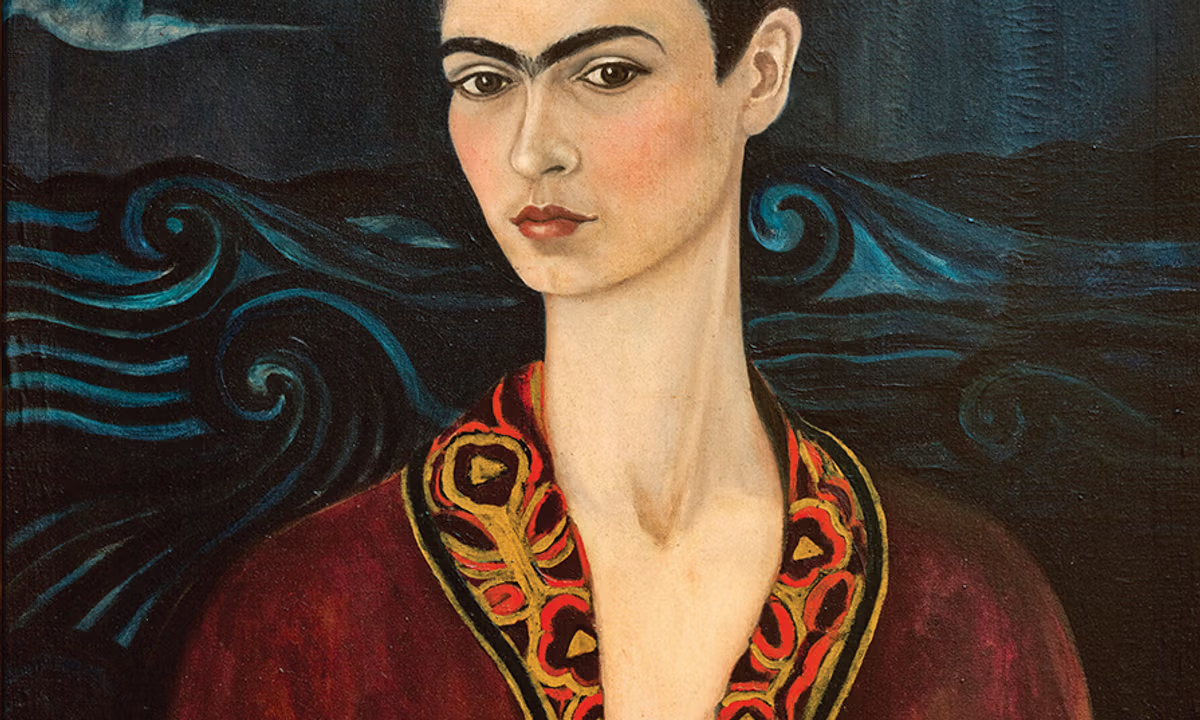
Frida Kahlo’s face and art are recognised worldwide, but that was not always the case. “How and why did this evolution happen?” asks Mari Carmen Ramírez, the lead curator of the exhibition Frida: The Making of an Icon at the Museum of Fine Arts, Houston (until 17 May), in this accompanying catalogue. Both examine Kahlo’s posthumous rise to fame, her enduring influence on artists, and the commercial afterlife of her persona.
This profusely illustrated volume is structured into thematic sections in which Kahlo’s legacy is unpacked, including her connections to social and artistic movements. Eleven essays, mainly by scholars, develop these themes: some build on decades of research, while others open new lines of enquiry. Much of the catalogue challenges common assumptions about Kahlo. While this approach may read as historiographical—in which Hayden Herrera’s 1983 biography, translated into over 25 languages, is key—Frida: The Making of an Icon carefully threads the nuances, contradictions and interests that inform the Kahlo phenomenon, tracing its reach across sectors.
A plural icon
This aligns with Ramírez’s thesis, where she considers Kahlo a plural icon who has been transformed, appropriated and embodied by diverse movements, all identifying with her art and multifaceted yet vulnerable persona: the avant-garde artist, the independent flapper, the self-taught painter, the mestiza (woman of mixed heritage), the political activist, the enamoured wife, the bisexual partner, the transgressor and the physically challenged painter.
One misconception, Kahlo’s connection to Surrealism, is debunked in Jaime Moreno Villarreal’s contribution, focusing on Kahlo’s 1939 stay in Paris, where she rejected Surrealist intellectualism. In this depiction, her husband Diego Rivera—often demonised, and in whose shadow Kahlo lived—emerges as an ambivalent figure who supported Kahlo’s practice. This is also where Kahlo made a statement: she changed her artistic name from Frida Kahlo de Rivera to Frida Kahlo.
The critical review of the movements that contributed to Kahlo’s rise to fame is also persuasive. Although 1970s feminists are credited with reigniting interest in her, the book dives deeper into the aftermath. For instance, Cecilia Fajardo-Hill explores how early white feminists may have inadvertently created the image of Kahlo as an exotic martyr. In contrast, brown feminists focus on her strength and resilience, underscoring issues of justice, class and race. And here a question that Ramírez posed early on lingers: was Kahlo a talented painter beyond her iconic status? This is seldom asked about male artists impacted by tragedy like Vincent van Gogh.
Adriana Zavala and Angélica Becerra explore the overlooked contributions of the Chicano/Chicana (Americans of Mexican descent) movement to Kahlo’s reinterpretations, uncovering key figures like Amalia Mesa-Bains (born 1943). They recount a landmark 1978 homage to Kahlo in Galería de la Raza in San Francisco, which featured a Day of the Dead altar. For her part, Charlene Villaseñor Black analyses the implications of Kahlo’s skin browning by some Chicano/Chicana artists, which heightened her mestiza identity. In these reinterpretations, Kahlo’s home, Casa Azul in Mexico City, loomed in the background.
Appropriation as identity
The catalogue also explores Kahlo’s self-image. James Oles examines Kahlo’s shift to elaborate Indigenous attire in the 1930s, especially her Zapotec Tehuana dresses. He addresses cultural appropriation within a broader post-revolutionary context, noting that other prominent women wore these garments before Kahlo. What set her apart was the daily use of them, blurring the line between private life and public persona. These sartorial politics continue to echo today;Oles cites Mexico’s president Claudia Sheinbaum, recently named among the “best dressed” by The New York Times, and her Indigenous-inspired wardrobe.
In another novel approach, Gannit Ankori and Circe Henestrosa dissect Kahlo’s connection to physical disability through the decoration of corsets and prosthetics, revealing how her “radical creativity” involved the parallel concealment and representation of her ailments, while engaging with taboo subjects. They also trace how this representation extended to symbolic, unexpected objects, such as Mesoamerican figures.
Berenice Olmedo’s 2018 sculpture Efélide reimagines the spinal corset Kahlo wore as a result of a devastating bus accident in 1925
© Berenice Olmedo courtesy of the artist and Jan Kaps, Cologne
Together, this 400-page publication traces a genealogy of artists influenced by Kahlo, whose interpretations shaped future generations of Chicano/Chicana and LGBTQ+ artists. This is evident in the work of the Chicana Mesa-Bains, the Mexican Nahum B. Zenil and the Chilean duo Yeguas del Apocalipsis. Mentioned throughout the volume—and more prominently in the full-colour images—is a trove of artists who have embodied Kahlo or reinterpreted her art. The selection is eclectic and demonstrates Kahlo’s reach across disciplines ranging from painting and photography to performance: some, like Mexico-born Los Angeles-based artist Marcos Raya, are more direct; others, like Guatemalan Regina José Galindo or Mexican Berenice Olmedo, are subtler yet poignant. The volume also contains interviews, including with leading Mexican feminist artists Mónica Mayer and Magali Lara.
Within its breadth and reach the catalogue captures the spirit of Kahlo-inspired group participation projects such as the Brazilian artist Camila Fontenele de Miranda’s photography series Everyone Can Be Frida (2012-20). Motivated by the international impact of the 2002 Salma Hayek biographical film, Fontenele produced 5,800 portraits of people—across ethnicities, genders, classes, sexualities and ages—embodying and reinterpreting Kahlo. In a similar vein, the catalogue includes images from the Dallas Museum of Art’s Guinness World Record-breaking event in 2017, when more than 1,000 people dressed as Kahlo.
Kahlo kitsch
Another fresh approach comes from Arden Decker’s analysis of Kahlo memorabilia, which creates a “taxonomy” of licensed products, knockoffs and artisanal works featuring the artist. Decker shows how a 1939 Nickolas Muray photograph became Kahlo’s most replicated image, rather than any of her paintings. She also traces the conflicts that surround Kahlo’s trademark involving the descendants of the artist’s sister, Cristina. In 2025 Mara Romeo Kahlo, Mara de Anda Romeo and Frida Hentschel Romeo opened Museo Casa Kahlo or Casa Roja in Cristina’s family home in Coyoacán. Next month, they will publish the museum’s first publication, Casa Kahlo: Frida Kahlo’s Home and Sanctuary (Rizzoli Electa).
Frida: The Making of an Icon coincides with other publications such as El Listón y la Bomba. El arte de Frida Kahlo (Lumen, 17 September 2025), an essay by Mexican scholar Helena Chávez Mac Gregor, who revisits Kahlo by analysing her paintings through a theoretical but also deeply personal lens beyond the artist’s celebrity and biography. Chávez challenges preconceptions by stressing that Kahlo insisted on reaffirming life right up to her very last painting. And in summer this year, when Frida: The Making of an Icon travels from Houston to Tate Modern, London, the latter will publish a new catalogue featuring curatorial essays by Ramírez, Tobias Ostrander and Beatriz García-Velasco alongside contributions by ten exhibiting artists, including Kiki Smith, Nahum B. Zenil, Berenice Olmedo, Regina José Galindo and Nalini Malani.
All this reaffirms Kahlo’s stature while pointing to the sustained effort to reread her legacy, rooted in the emotive connection her work forges with audiences. Beyond fame, something universal—reflective of the human condition—seems to be at play.
• Frida: The Making of an Icon, by Mari Carmen Ramírez (ed). Yale University Press, 400pp, 400 colour illustrations, $65/£50 (hb), published 20 January
