


In the beginning, there was a lot of work to do.
In the Mesopotamian creation myth, the Anunnaki, the Big Gods, and the Igigi, the Little Gods, drew sticks to decide who would do the hard labor of digging the channel that would become the Euphrates river. It was the Igigi who drew the short stick. For 3,600 years they worked, crying out to the big gods for relief but never being answered. Nusku encouraged his fellow Igigi to rebel by setting fire to their tools and surrounding the house of Ellil, an Anunnaki leader and their foreman. Nusku and the Igigi told Ellil that for too long their pain had been ignored and that something had to change. Ellil brought this message to his fellow Anunnaki, who decided that Nusku and the Igigi should be killed.
But Ea, the god of wisdom, offered a different solution: create mankind to take on the Igigi’s labor. Ea summoned the womb-goddess Belet-ili to create man from clay, divine spit, and the heart of the rebellious Nusku. When the task is done she says, “[We] have slaughtered a god together with his intelligence. I have relieved you of your hard work, I have imposed your load on man.” By sacrificing Nusku, it is said, a “ghost came into existence.” And thus Nusku’s heart beats on in every human being so that he is never forgotten—and so that one day, mankind might also rebel.
That story played in my mind as I walked through “New Humans: Memories of the Future,” the inaugural exhibition at the recently renovated New Museum. Across four floors and 273 works, the show felt like a continuation of the epic story of labor that began over 4,000 years ago. If the creation of a new labor force once required the sacrifice of the worker-god to animate worker-humans, pieces from this exhibition show artists working to interpret how the worker-human has been continuously sacrificed to animate our new worker-machines.
This narrative is most clearly laid out in a section of “New Humans” titled “Mechanical Ballets,” referencing Bauhausler Oskar Schlemmer’s Das mechanische Ballett (1923) and Das triadische Ballett (1922). Both of these ballets feature dancers wearing stiff, geometrically inspired costumes that obscure their bodies and constrain their movements. These dances came at a time in Germany when artists were wrestling with the scars of World War I and the intensification of the developing industrial economy. Sent to war, and then the factories, artists conjured visions of human life reduced to mere machinery.
F.W. Bogler, Kurt Schmidt, and Georg Teltscher, Reconstruction of Das mechanische Ballett (The Mechanical Ballet), Theater der Klänge, Düsseldorf, 1923/1987. Restaged by Jörg U. Lensing, Udo Lensing, and Ernst Merheim at Bauhaus Dessau in 2009.
Courtesy New Museum/Oliver Eltinger
Down the hall from “Mechanical Ballets” stands John Heartfield and George Grosz’s 1920 sculpture The Middle-Class Philistine Heartfield Gone Wild (Mechanical Tatlin Sculpture). Built around a tailor’s dummy, the work represents a population remade, perhaps too willingly, from an object of warfare into a tool of commodity production. A revolver and military paraphernalia stud the dummy’s chest, a pair of plaster dentures serve as a perverse fig-leaf, a leg is replaced with a rod, and a single shining lightbulb crowns the whole hybrid mess in place of a head. The work’s abundance of prosthetics reflects a nascent vision of the hybrid man—part human, part machine—no doubt inspired by the amputees flooding back from the front.
A work that is crucial to contextualize this era is the play R.U.R. (Rossum’s Universal Robots) by the Czech playwright Karel Čapek. As wall text for “Mechanical Ballets” explains. it was Čapek who first came up with the name “robot” from the Czech robota, which translates to “forced labor.” In Čapek’s play, artificial humans are designed by the scientist Rossum, who made the most efficient version of the worker possible so that it should be cheap to produce and maintain, enormously intelligent, but lacking a soul. But as these robots are allowed to become more emotionally complex, they rebel, wiping out the majority of humanity. Instead of serving their gods, they kill them. We might read into the differences between the Mesopotamian creation myth and Čapek’s play, the historical process of class consciousness at work.
Yet there is another question being posed by R.U.R. and the art of the 1920s more broadly: as workers sacrifice their humanity to become more efficient in the factory, is the human being changed into something else (i.e., the cyborg), or are these efforts feeding the creation of another being entirely (i.e., the autonomous robot)? Should we take the robots of Čapek’s play to be a metaphor of the working class, or do they really represent a different kind of life form?

George Grosz’s 1920 sculpture The Middle-Class Philistine Heartfield Gone Wild (Mechanical Tatlin Sculpture) on view in “New Humans” at the New Museum.
Shanti Escalante-De Mattei
Let’s skip forward a hundred years or so to see how these questions have developed as capitalism has produced new modes of production which, in turn, mold new kinds of subjectivities.
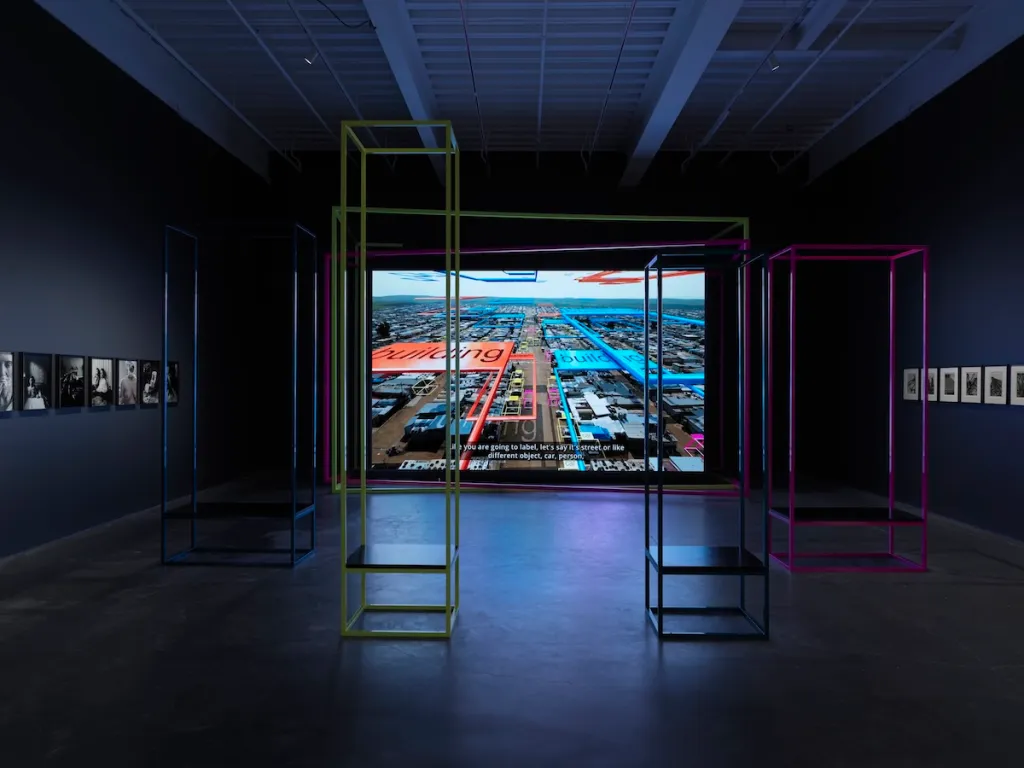
In one of the newest works on view in “New Humans,” German artist Hito Steyerl tackles the hidden labor of A.I. in the 2025 video work Mechanical Kurds, which tells the story of Kurdish workers who participate in Amazon’s Mechanical Turk (MTurk) workforce.
Amazon named this program after a chess-playing automaton that made its debut at Vienna’s Schönbrunn Palace in 1770. Dressed like a stereotypical “Turk,” the supposed machine toured Europe and North America for 80 years before it was revealed that it was actually operated by a grandmaster covertly stowed in a compartment below the board. MTurk, as per Amazon’s website, is “a crowdsourcing marketplace” that allows companies to access a distributed, global workforce that completes “microtasks.” MTurk is often used for the image-labeling tasks that are necessary for training AI. In Steyerl’s film, she interviews Kurdish workers in northern Iraq’s Domiz refugee camp who have taken on these microtasks. They express an ambivalent but basically positive attitude about the program.
“It was an income. Even if it was not a good one it was something,” one woman says, lamenting that most of the microwork had dried up already.
Still from Hito Steyerl, Mechanical Kurds, 2025.
Courtesy the artist and Andrew Kreps, New York. Commissioned by the Jeu de Paume, Paris, and New Museum, New York
The video shows the unpaved streets of Domiz as Steyerl’s subjects describe labeling objects in images and videos from around the world. They guess where these places might be—e.g., Switzerland, China, and the US—and the AI imagery morphs to provide a facsimile of each place. They think they’ve been helping design self-driving drones and tuk-tuks (three-wheeled motorcycles), but they’re not sure. This ambivalent speech is contrasted with the severe consequences of AI when Steyerl interviews an Iraqi journalist who was the subject of a drone attack, along with two colleagues who did not survive. Yet Steyerl returns to the hope that the refugees have for AI. As one man flies a toy drone, surrounded by children, his voice echoes out, “The future, the future, the future, it is all the same—another world.”
Neither serving the gods nor rebelling against them, Steyerl paints a haunting picture of what seems like the last task of automation: a bit more of the ghost needed to animate the machine is extracted from human cognitive labor. Then the project flees to its secret laboratories, leaving the refugees of Domiz to continue the task of survival in some other way.
If the artists of the postwar period were coping with the brutality of how capitalism was changing what it meant to be human, it seems we are now in a profoundly different time, when artists are trying to understand who we are, as AI and automation seem to make workers increasingly obsolete. The labor not yet automated is fragmented, meaningless, and nearly ready for AI takeover. I mean, who even calls themselves a worker anymore?
Take, for example, Kristin Walsh’s Engine No. 15 (2025). A sleek aluminum sculpture, its shape recalls a component of a machine, perhaps found in a car or in a factory, yet it is a completely closed system. Little matchsticks lie flat on its surface, and then suddenly pop up and jitter across its surface, only to fall again, in seeming exhaustion. In the wall text, Walsh describes the matches “as actors on a stage, laboriously set up to basically perform no function.” It’s like the sculptural rendition of David Graeber’s Bullshit Jobs.
An echo of these matches lies in Human Mask (2014), a haunting video work by Pierre Huyghe, set in Fukushima after the destruction wrought by the tsunami and then the breakdown of the nuclear reactor. In a partially collapsed restaurant, a monkey wearing a grey dress and the white mask of a young woman with long black hair bides her time. It rains. The kitchen of the restaurant is crawling with maggots, the damp eats away at the tatami mats and wallpaper decorated with a design of a forest landscape. The monkey sits, swinging its leg. In another scene, it knocks a glass off a table. It walks into the kitchen and finds food. It twirls in the middle of the dining area until it gets dizzy and collapses. Huyghe sourced the monkey from Tokyo, where it had been trained to work as a server in a restaurant. Is this the future? Abandoned by the work that shaped us, abandoned by gods and robots both, will we act out the phantom vestiges of our skills in the ruined margins of the world?
But look at how I speak of this future: as something coming. Being an irrelevant subject in the production of capital is an increasingly common positionality—and this is especially true for people who have been displaced by war or whose national economy has been significantly reordered by neoliberal reform. The conditions in Domiz are not scary as a sign of what the future might be like for everyone. It is scary that that kind of displacement provides the exact kind of population needed for microwork today. A tech optimist might read this form of labor as a necessary and basically painless offering needed to make that creature which can take on our human labors, as the Annunaki once did for the Igigi. But let’s not avoid the obvious: who do you think wrote that old story? Seems to me like yet another history written by the victors.
