


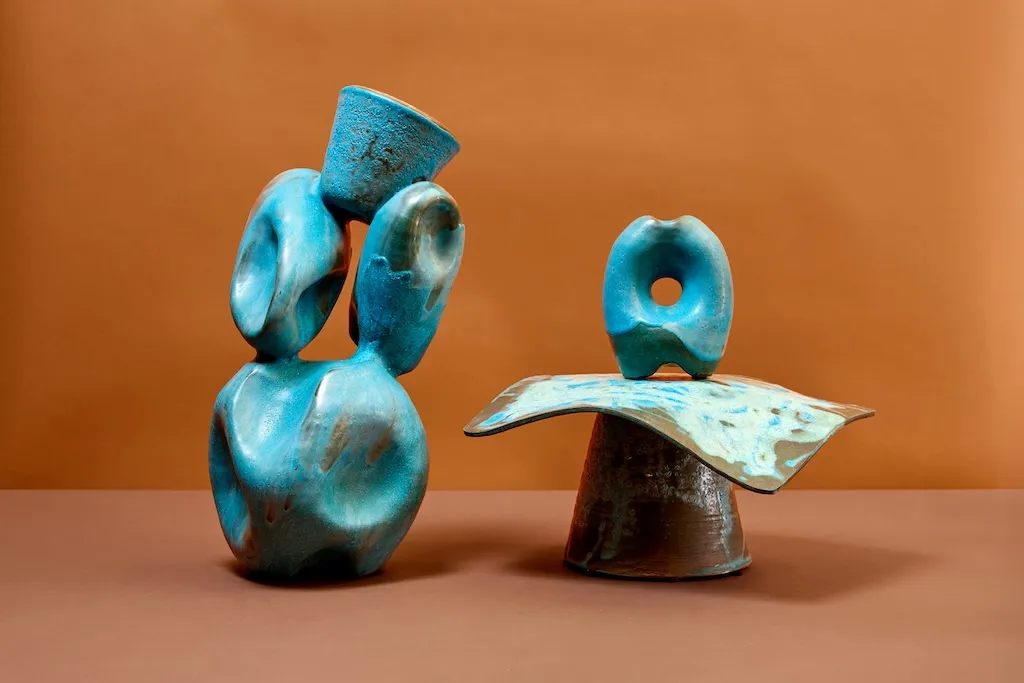
David Haskell spends his days running New York Magazine. Twice a week, he goes to the Brooklyn Navy Yard and throws clay.
The editor in chief of one of the country’s most influential magazines has spent the last dozen years quietly building a second life as a sculptor. Now, that work is the subject of his first solo exhibition, Boom Beach, at Donzella Ltd., a design gallery tucked away on the fifteenth floor of the New York Design Center at 200 Lexington Avenue.
Haskell is exactly what you’d expect the editor in chief of New York Magazine to look like. When I visited the gallery, he was dressed in brown leather chukka boots, a pinstripe suit with peak lapels, and a striped button-down worn open at the collar. A thin gold chain peeked out from beneath the shirt. He carried himself with the kind of easy confidence. If there was any anxiety about presenting his first solo exhibition, he didn’t show it.
When I visited the gallery recently, Haskell was doing what artists always do when they’re standing in front of their own work: touching it. “See this?” he said, running his hand over a ceramic form that looked part vessel, part rock formation. For most visitors, touching the art would be unthinkable. For Haskell, the pieces still seemed fresh from the studio.
The show includes 68 works made over the last several years, mostly ceramics, along with a handful of bronzes and glass sculptures. Nearly everything begins on the wheel before being punctured, stretched, stacked, folded, or otherwise pushed into shape. The forms are abstract, but not in a way that feels academic. They look more like objects weathered by time and gravity.
Installation view of “Boom Beach” at Donzella Ltd. Photo by Eric McNatt.
ERIC MCNATT
Haskell returned to ceramics as an adult in 2013 after working with clay as a teenager. What began with planters for unusual desert plants gradually evolved into sculpture. A dozen years later, he still works the same way: Tuesday nights and Saturday afternoons in a studio at the Brooklyn Navy Yard. “I wish I had more time in the studio,” he said. “But in exchange, it feels like there’s a purity to the project.”
Unlike most artists, he isn’t dependent on sales, commissions, or gallery schedules. If anything, he envies artists who can devote themselves fully to the studio. At the same time, he recognizes the freedom that comes from not needing the work to support him. He can spend months exploring an idea without worrying whether anyone wants to buy the result.
Asked which artists helped shape his thinking, Haskell points first to Isamu Noguchi, particularly the sculptor’s ability to move effortlessly between functional and non-functional objects. He also cites Barbara Hepworth and Henry Moore, artists whose monumental forms managed to feel organic rather than imposed. Unlike many contemporary artists, however, Haskell is quick to downplay theory. He never attended graduate school for fine art and describes the work less as an intellectual project than a personal exploration of form.
Then there are the connections to his 9-5 life at New York Magazine: Haskell doesn’t see much separation between editing and making sculpture. As we walked through the exhibition, he repeatedly described both practices in musical terms. When he edits a long feature, he said, he’s listening for rhythm and structure, the way one section echoes another and a thought introduced two thousand words earlier returns at precisely the right moment. “There’s a musicality,” he said. “The end of the third section actually references something you did two thousand words ago, but slightly pushes it forward. It just clicks.”
The same logic applies in the studio. Many of the sculptures begin as simple wheel-thrown forms before being cut apart, reassembled, stacked, pierced, or stretched into increasingly complex arrangements. What looks spontaneous is often the result of careful adjustment, balance, and timing.

Install view of “Boom Beach” at Donzella Ltd. Photo by Eric McNatt.
ERIC MCNATT
As we talked, two designers from Thom Filicia’s studio wandered into the gallery to ask about the show’s largest bronze sculpture. It was a reminder that Haskell’s work has already found an audience in the world of collectible design. Prices range from under $2,000 for smaller ceramic works to around $15,000 for the largest bronzes.
The exhibition’s title comes from a stretch of coastline on an island in Maine that Haskell has visited for years. “It’s named after a stretch of coastline on an island in Maine,” he told me later. “It has an incredible collection of rocks that have been shaped by the rough sea.” Once he said it, the connection seemed obvious. Many of the sculptures feel organic, as if they had been shaped by water rather than hands.
Of course, there is another question hanging over the show. Haskell isn’t just an artist. He’s also one of the most recognizable editors in American media. In recent years, the art world has become increasingly skeptical of celebrities and public figures who decide to become artists. The results are often, to put it politely, anywhere from underwhelming to plagiaristic. Just look at Ed Sheeran “Pollock-esque” drip paintings. Haskell’s response is refreshingly straightforward. “I am comfortable with what anyone thinks,” he said. “It doesn’t really matter to me how it’s received.”
That answer gets at what makes Boom Beach interesting. This doesn’t feel like a side hustle, a branding exercise, or an attempt to add another line to a résumé. It feels like what it is: a long-running private practice that slowly became public.
For twelve years, Haskell has been showing up, throwing clay, making mistakes, fixing them, and going back again the following week. The exhibition is simply the evidence.
“Boom Beach” is on view through June 30.
