


In Paris’s 20th arrondissement, there is a park, of sorts, where the city’s greatest revolutionaries go to rot. Some are the real deal: On May 28, 1871, over a hundred Communards were shot dead right here as dreams of a Socialist utopia crumbled around them. Other legends were made not on barricades, but on the stage—or the page. Oscar Wilde, for example, reposes beneath a hulking deity whose iconoclastic castration, back in 1961, did little to restrain pilgrims seeking to smear red lips across his stony physique. Proust’s is a surprisingly succinct slab—simple, black, nonchalant—while Apollinaire’s is a rusticated obelisk, phallic and craggy, branded with the ghost of a cross. The women’s quarters are more modest: It is hard to imagine Isadora Duncan, arms outstretched and tunic flying, confined to such a small stone plaque; Colette fairs a little better, her red-veined resting place the size of a cushy twin bed. The avant-garde is dead, and it is buried in Père Lachaise.
Wind your way back through gravelly paths and you’ll see a squat grey tombstone. It is near here that we find the unnamed narrator of Deborah Levy’s My Year in Paris with Gertrude Stein reflecting, early in the book, that she is “working too hard” for the titular woman lying beneath it. For months, the narrator has been living in Paris as she tries, and fails, to finish an essay on the self-declared “creative literary mind of the century.” Though Stein brings her no small amount of malaise, the narrator feels it is her “destiny to defend her.”
Gertrude Stein poses in front of Picasso’s 1906 portrait of her in her Paris apartment, n.d.
AFP via Getty Images
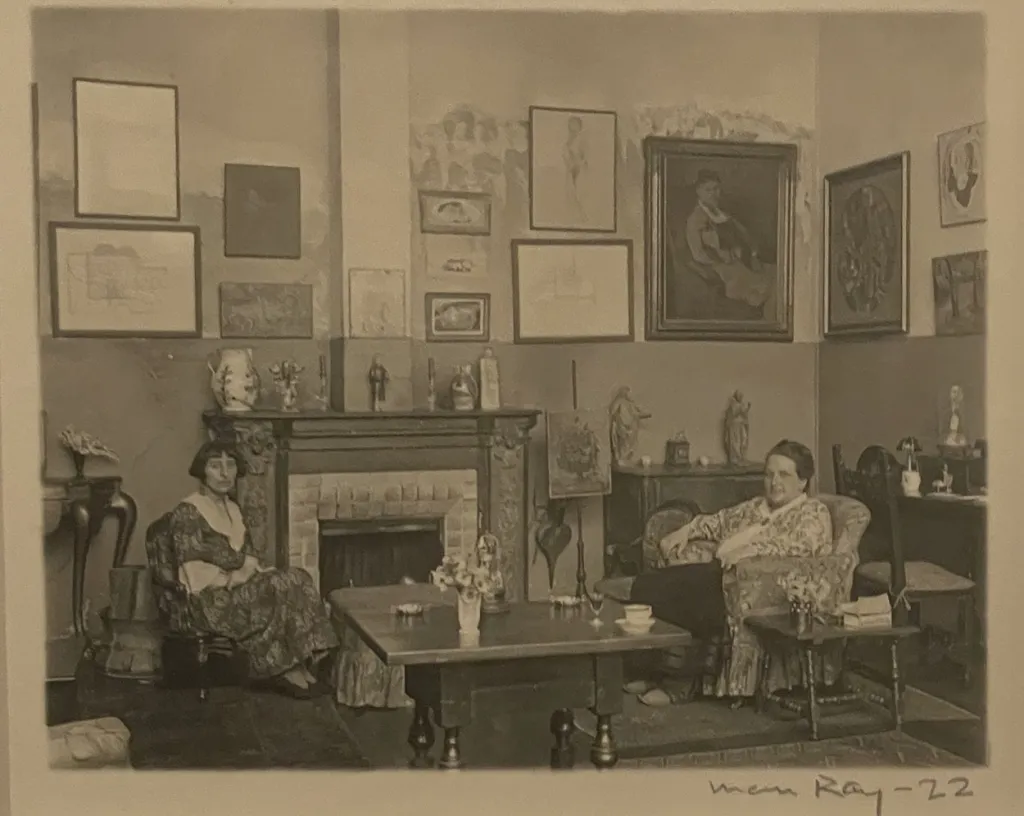
Defend her from what? Known for prose that resisted norms of easy intelligibility, and for a life that flouted expectations about how a woman should look and love, her tombstone might have read the “Typhoid Mary of Prose Style,” the “High Priestess of the Cult of Unintelligibility,” and “The Ogress of the rue de Fleurus”—to borrow from the epithets collected by her most recent biographer, Francesca Wade. The last is reference to the apartment Stein kept with the woman she called her wife, Alice B. Toklas, in which they hosted some of the most famous names in twentieth-century art and literature: Pablo Picasso, Ernest Hemingway, Ezra Pound.

Farrar, Straus and Giroux
Yes, remarks those catty modernists made about their host could be less than savory, but Stein wasn’t bothered. She surrounded herself with greats, and she saw herself on top: “Think of the Bible and Homer think of Shakespeare and think of me,” she encouraged her audience.
Lingering in a downpour at Père Lachaise, our narrator makes a less canonical comparison. Brandishing an “oozing baguette,” she “devour[s] it there and then amongst the dead.” (Call it: a Moveable Feast.) No match for its slippery interior, the bread’s “salty grey rind, like ash, had cracked from the sheer life force of this fast-flowing river of cheese. If the rind was the frame, this Brie like Gertrude Stein had burst through it.” It was Stein’s project, according to Levy, to “break through the conventions of genre,” but I would wager that the 20th-century master of the quizzical comparison would not stand for a set piece buttressed by such a sloppy simile.
The avowed velocity and vitality of Brie aside, this was not the first, nor the last, time in My Year in Paris with Gertrude Stein that I was struck by an assertion so bald, or a metaphor so incontinent, that I wondered whether it was written in earnest. There are blanket statements about modern art that I would not forgive from even the uninitiated undergraduate: “Cubism had made the invisible visible. That’s what it takes to be modern. To see it first.” Or, in answer to the question of what “modernist art […] had lost”: “Representation. Naturalism. Nostalgia. Obedience. Conformity. Certainty.” Stein may have found commas, as Levy suggests, “servile,” but this pile of periods progresses in the kind of cocksurity that she suggests Modernism has already killed off, its staccato bravado a technical flourish compensating for a lack of argument.
And yet, the fragile surety of that parataxis is stylistically undercut by the nebulous musings attached to one exceptionally promiscuous metaphor. Streams trickle into, and eventually flood, My Year in Paris, justified by one historical kernel: Stein, we learn, took classes at Radcliffe College with the psychologist William James, who coined the term “stream of consciousness” in 1890. Mirroring the unmoored days of the narrator’s expat year, the narrator pictures “streams […] flowing through the nineteenth century into the twenty-first and all over the place.” All over the place is appropriately indefinite, for in the pages that follow, streams don’t just run through “modernism” but also “under the mowed and manicured golf courses on which men swing their clubs in the twenty-first century.” Their currents pull in unsuspecting poets (“somewhere in a field alongside the streams in the nineteenth century was Walt Whitman”), unwanted clothes (“Thankfully her corset was now floating down one of the streams of consciousness”), macroeconomic shifts (“Industrialisation is also floating in the streams of consciousness”), and one hapless cat. These figurative streams are a little too klepto for my taste, but their eclectic purloining feels of apiece with the indiscriminate rush of the act in which the narrator often catches herself: “scrolling, scrolling, scrolling.”
I am not so precious as to demand plot from literary fiction—Stein, after all, wanted to save language from its teleological subservience to meaning—but My Year in Paris reads like one long lazy river. Levy’s books can cut; this one merely oozes. With its grand suppositions about the nature of Modernism juxtaposed against metaphors acting as alibis for a facile associationism, it is difficult to see what My Year in Paris is trying to do—much less resist.
It was something of a relief, then, to pick up Prudence Bussey-Chamberlain’s debut novel Bone Horn, a fast-paced penny dreadful in which the gambit is given on the opening page: What was Toklas hiding behind those razor-sharp bangs? An unnamed academic-turned-private-investigator (she was after more flexible hours) goes on the hunt for her literal horn. The discovery could change the face of Modernism, or it could just change the face of a member best known for being ventriloquized in Stein’s misleadingly titled Autobiography of Alice B. Toklas. Digging around for evidence, our narrator must dodge lusty archivists (a stash of gloves in Yale’s Beinecke Library is repurposed for handling things more sensitive than documents), dom cops (there is Tender Buttons, and then there is “TITS”: “Tighten. Investigate. Tighten. Secure”), and needy—and possibly homicidal—academics. Returning once again to—where else?—Père Lachaise, we find our detective at the duo’s double grave googling questions like “Do academics ever kill one another?”
Googling seems to be this Sherlock’s greatest strength: bought books go unread and archival boxes remain shut as the narrator pinballs from tab to tab. “Is this your investigative style? Just google it?” one archivist asks, incredulous. Perhaps this is why, despite the expected drama (“People have died in pursuit of the horn”) and crime show allusions, this search can feel as aimless as Levy’s streams, and no more thrilling. It is just not that interesting, it turns out, to follow a detective’s scroll of consciousness—or a writer’s.
It is perhaps surprising to learn that among its most devoted readers, the genre of detective fiction could count Gertrude Stein, said to have gone through a mystery a day. Perhaps the author attempting to rewire language found a formulaic plot comforting; perhaps she just enjoyed a puzzle as tough as her prose-poems. And yet, what her writing had in common with the whodunit is a sense of careful composition combined with a resistance to immediate understanding. My Year in Paris, by contrast, trades on an elusiveness that can feel, at times, like a cover for objectlessness, while the propulsion of Bone Horn doesn’t outlive its pulpy premise. I was left wondering whether Stein really needed a white knight from beyond the grave. Her case closed with the casket: “Dead is dead,” she wrote, “but that is why memory is all and all the immortality there is.”
