


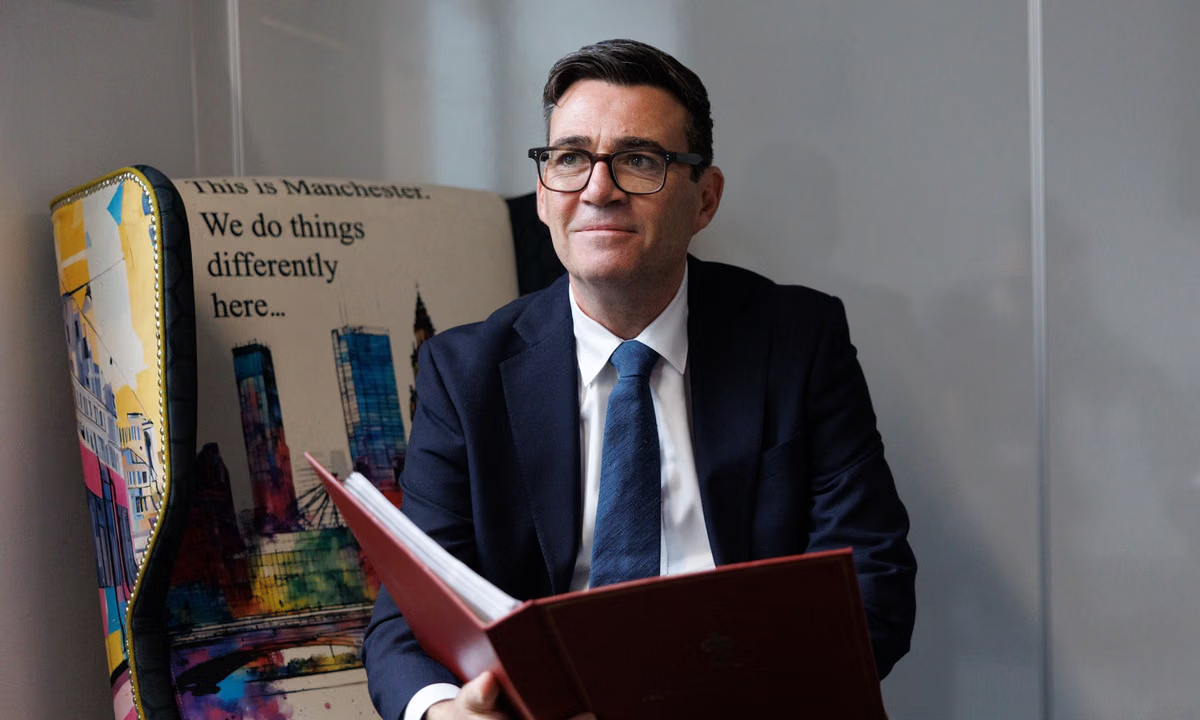
The UK Prime Minister Andy Burnham has backtracked on sending the Parthenon Marbles to Greece despite previously calling for the artefacts to be returned permanently to their country of origin.
Burnham, who became prime minister in July, recently told The Financial Times: “Ultimately [returning the Marbles is] an issue for the British Museum, isn’t it?” He added: “Legally that’s where that issue rests, but I’m all in favour of using British cultural diplomacy. That’s something that I’m hugely in favour of.”
Burnham had previously stated though that he supports returning the Parthenon Marbles to Greece, a position possibly signalling a more open approach to restitution under his premiership.
During the reopening of the Manchester Museum in February 2023, Burnham, then the mayor of greater Manchester, was asked if George Osborne, the chair of the British Museum, should give the sculptures back. He replied: “Yes, George Osborne should give the Elgin Marbles back.” That same month, Burnham reiterated the position on X: “Send [the Marbles] back, no strings. And let’s use culture to change how Britain is seen around the world.”
Following Burnham’s appointment as prime minister, The Art Newspaper contacted the Department of Digital, Media, Culture and Sport (DCMS) about whether Burnham stood by his remarks. The department responded: “Decisions relating to the care and management of the museum’s collections, including loaning objects, are a matter for the trustees of the British Museum.”
The British Museum says it is prevented from returning the marbles by a piece of legislation, the British Museum Act 1963. In 2002, Burnham was one of seven members of parliament to introduce a private member’s bill entitled the Museums Bill which, according to the British Committee for the Reunification of the Parthenon Marbles, proposed amending the 1963 act. The bill was eventually dropped.
The left hand group of surviving figures from the East Pediment of the Parthenon, held in the collection of the British Museum Photo: © Andrew Dunn
The marbles have been housed in the British Museum since 1817, arriving there after being removed from the Parthenon temple on the Acropolis in Athens by the Scottish nobleman Lord Elgin, the then ambassador to the Ottoman court. In 2022, George Osborne said there is a “deal to be done” over sharing the Parthenon Marbles with Greece, which has long claimed ownership of the antiquities.
In another key development, the British Museum’s director Nicholas Cullinan told The Financial Timesthat the deal that brought the Bayeux Tapestry to the UK might pave the way for a loan of the Parthenon Marbles to Greece. The long-awaited display of the Bayeux Tapestry, an embroidery depicting the 1066 Norman invasion and the Battle of Hastings, will open in the museum’s Sainsbury Exhibitions Gallery on 10 September (until 11 July 2027).
“Every example of a relationship or cultural history is different, so there isn’t a cookie-cutter template,” Cullinan said. “That said, you would hope the fact that it took several goes to pull off the Bayeux Tapestry loan might provide a glimmer of possibility to move forward [on the Marbles]… I would hope that some tangible progress can happen. It would be a wonderful thing.” He also warned of “unintended consequences” if the British Museum Act 1963 were amended.
The agreement between France and Britain for the loan of the Bayeux Tapestry was finalised and signed in July 2025 at the British Museum in a special ceremony attended by the then UK Prime Minister Keir Starmer and President Emmanuel Macron of France.
Macron said at the event that France has historically been reluctant to loan the Tapestry. “[For] decades I have to confess, we did our best not to be put in this situation to make the loan of the Bayeux Tapestry,” he said.
