


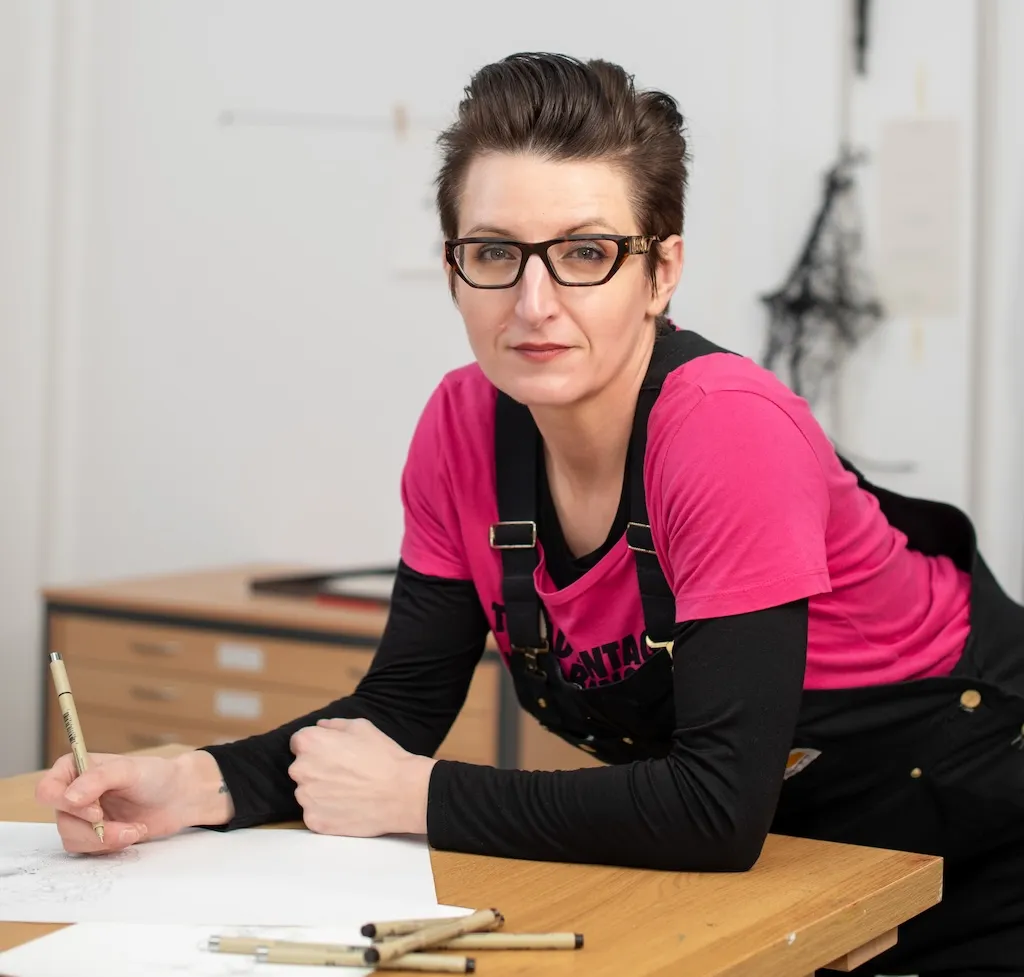
Victoria Helena has built a career most artists could never imagine for themselves. Before founding Artist Money Matters, a new artist-first financial consultancy launching this month, she spent two decades working in finance and studio administration while maintaining her own sculptural practice. The result is a rare fluency in both balance sheets and the psychic reality of making art. We spoke with Helena about why artists avoid money conversations, what they most often get wrong in contracts, and why financial literacy has become an issue of economic justice in the arts.
You’ve described yourself as both an artist and a former CFO. That’s not a common combination. How did that happen?
I’ve always had a foot in both worlds. I grew up around money in a very practical way. My mother was a single parent and a bartender, and I watched her count cash at the end of every shift. Later, when I was in school, accounting ended up being my math credit, and it just clicked. It was logical. It was calming. Everything added up.
At the same time, I was always making work. I trained as a sculptor and eventually completed my MFA at the Royal College of Art. What became clear over time was that artists were constantly coming to me with questions they weren’t getting answered elsewhere. Not just “how do I file taxes,” but “can I afford to say yes to this show,” or “is this contract normal,” or “why do I feel like I’m drowning even though my career looks successful.”
Is that what led to Artist Money Matters?
Yes. It started informally years ago. Friends, classmates, colleagues. By the time I finished at the RCA, I had basically become the person everyone asked before they signed anything. Artist Money Matters grew out of that need. Artists are being asked to make increasingly high-stakes financial decisions in an art economy that’s volatile, opaque, and often extractive. Yet they’re expected to do so without independent, informed support.
A lot of artists bristle at talking about money at all. Why do you think that is?
There’s a deep psychological component. Money is tied up with shame, fear, and identity, especially for artists. We’re taught the starving-artist myth early on, and we’re also taught that caring about money somehow compromises authenticity. That creates a double bind. You’re supposed to be vulnerable in your work but silent about your survival.
When I start working with someone, the first thing we often talk about isn’t numbers at all. It’s their relationship to money. Their family’s relationship to money. Their peer group’s attitudes. Once you understand that, the practical conversations become much easier.
What are the most common mistakes you see artists make as their careers start to grow?
Not knowing what they’re allowed to ask for. That shows up everywhere. In contracts. In budgets. In institutional invitations. Artists are often offered opportunities framed as prestigious or career-making, but the financial terms are vague or unrealistic. If you don’t know what it actually costs to produce your work, it’s very easy to agree to something that quietly puts you into debt.
Payment terms and intellectual property are the two things I tell artists to look at first, every time. If payment terms are clear and written down, you don’t have to wonder when you’re getting paid. And if they’re not clear, that’s already a problem.
You’ve worked with everyone from emerging artists to large, established studios. How does that change your approach?
The principles are the same, but the scale is different. I’ve worked with individual artists just getting their footing and with complex studios operating internationally. In recent years that’s included artists and studios like Random International, whose practice operates across institutions and large-scale public commissions, and Radhika Khimji, who is navigating a moment of rapid career acceleration.
Emerging artists need foundations. Systems that let them check in once a month rather than panic every week. Mid-career artists often need help restructuring as their studios grow and their income becomes more complex. Established studios usually come to me when something has already gone wrong and they need a reset.
You frame this work as a form of economic justice. Why?
Because financial illiteracy isn’t accidental. When people don’t understand money, they’re easier to exploit. Artists, in particular, are asked to absorb risk while others capture value. Artist Money Matters is deliberately structured as an independent, fee-for-service consultancy. No commissions. No percentage cuts. No incentives tied to sales. That independence matters.
If artists understand their financial reality, they’re better equipped to protect their work, negotiate fairly, and build careers on their own terms. That shouldn’t be a privilege. It should be basic infrastructure.
You’re also publishing a book under the same name. How does it fit into this project?
The book mirrors how I work. The first part looks at the psychology of money. The second covers accounting fundamentals in plain language. The third is about putting it all together in the real world. Contracts, negotiations, reciprocity, long-term planning.
Not everyone can afford a consultant, and I’m very aware of that. The book is meant to be something artists can pick up and use immediately, without feeling talked down to or overwhelmed. It’s about giving people tools, not telling them what success should look like.
If an artist takes away just one thing from your work, what do you hope it is?
That clarity is not the enemy of creativity. It’s what allows you to keep going. Art is a long game. If you want to make work for decades, you need systems that support that ambition rather than quietly undermining it.
