


Andy Burnham may be only weeks away from becoming the UK’s next prime minister. Given he is fresh from serving as the mayor of Greater Manchester, the region’s cultural sector offers one of the clearest records of how he thinks about the arts.
During his eight years as mayor Burnham’s most visible cultural legacy has been the arrival of Factory International, which produces the biennial Manchester International Festival and operates the £240m cultural venue Aviva Studios, which opened in 2023. But those working across the city argue that the more revealing story is not one building, however ambitious, but the way culture has been threaded through debates about wellbeing, identity and transport.
Professor Kirsty Fairclough, the professor of screen studies at Manchester Metropolitan University and a member of the Greater Manchester Music Commission set up under Burnham, says he has been “one of the first metro mayors in England to treat culture not simply as an economic sector but as part of a broader civic strategy”.
“Manchester has always had extraordinary cultural assets but Burnham has helped position them as central to the city region’s story rather than peripheral to it, ” she tells The Art Newspaper.
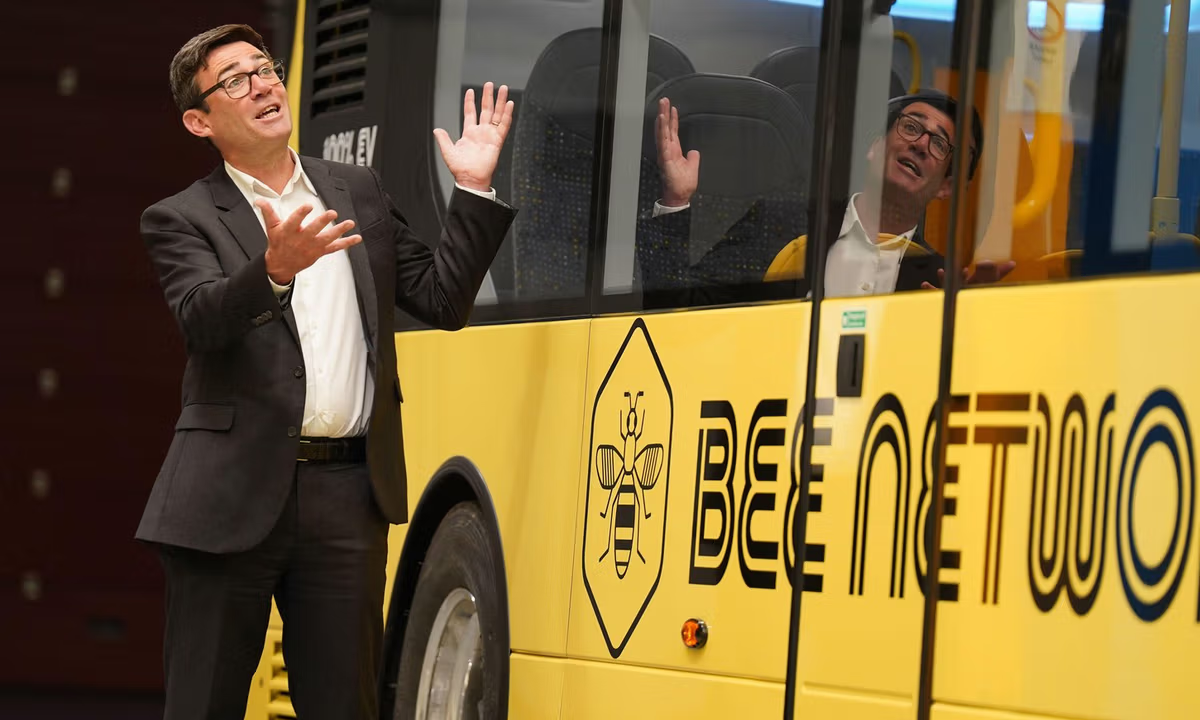
Burnham has certainly leaned into that inheritance. His championing of the worker bee symbol, now amplified through the Bee Network bus system, has helped bind older ideas of labour, resilience and solidarity to a more contemporary image of Manchester as creative, connected and self-confident.
Fairclough says the bee, an emblem of Manchester since the 19th century, has become “more than a symbol of resilience; it has evolved into a shorthand for collective identity, collaboration and civic confidence.”
For Julia Fawcett, the chief executive of The Lowry in Salford, the significance of Burnham’s mayoralty has been the elevation of culture into the city-region’s strategic bloodstream. Fawcett says he has “consistently recognised culture as a vital part of Greater Manchester’s success, not simply as a cultural asset, but as a driver of economic growth, place-making, wellbeing and civic pride”.
She adds that embedding culture alongside “regeneration, skills, health and education” has helped create the conditions for organisations and events to thrive across the region.
That approach has been visible in programmes such as the Greater Manchester Town of Culture scheme, which has shifted attention away from the city centre and towards the region’s boroughs and towns often excluded from the dominant Manchester story. The scheme has become a modest but symbolically important part of Burnham’s devolution argument: that cultural confidence should not be monopolised by London, nor even by Manchester city centre.
At Manchester Museum, the acting director Georgina Young says Burnham has helped create “a real sense of collective pride” across Greater Manchester’s cultural scene. “The city was already a cultural success story,” she says, “but he’s backed that success, provided visible support to the creative industries and focused on how culture enriches lives”.
Young points in particular to an emphasis during Burnham’s tenure on “creative health, active aging and wellbeing”, which she says museums and other institutions have used to develop new initiatives with communities. She recalls Burnham quietly visiting the museum during the Covid-19 pandemic to meet students at PINC College, a specialist creative college for neurodiverse young people.
“That provides a sense of his priorities,” she says, “but the focus on how culture drives growth and places the city on an international stage is just as strong”.
Aviva Studios remains the unavoidable monument in Burnham’s story. For supporters, it signals a city with the confidence to stage work at international scale. For sceptics, it risks becoming another flagship project whose benefits do not automatically reach the wider ecosystem of artists, freelancers and smaller organisations.
Fairclough argues that this is now the central test. “Major institutions can generate international profile, tourism and inward investment,” she says, “but their long-term success depends on strong relationships with freelancers, grassroots venues, independent artists, community organisations and SMEs across the region.”
That tension is echoed, more bluntly, by the Manchester mosaic artist Mark Kennedy. He recalls working on a charity auction piece for the former Manchester City footballer Vincent Kompany’s Tackle4MCR homelessness campaign, where he exchanged pleasantries with Burnham and felt “there was genuine hope”. But he is wary of the city’s cultural establishment, which he describes as “a box ticking circus”, and says he has “never felt comfortable or really a part” of it.
Burnham’s cultural record will not only be about whether institutions feel supported, but whether artists outside formal networks feel included. Kennedy’s view is that Manchester’s culture has become “a plastic version of what it was 30 years ago”, and he warns that a national Burnham agenda could reproduce the same problems at scale. “Personally, I think Andy should finish what he starts instead of being giddy for the pudding,” says Kennedy. “He’s like Starmer but more Uniqlo.”
“Keep listening”
Burnham has been successful at using culture as a language of place: the bee, the boroughs, the flagship venue. Young says the museum sector would want a Burnham government to “pull the focus beyond London” and “keep listening”.
This is echoed by Fairclough: “One lesson from Greater Manchester that could be valuable nationally is the importance of devolving cultural decision-making. Regional leaders are often better placed to understand local creative ecologies than central government. If that approach were combined with long-term investment and greater stability for the cultural sector, it could help address many of the structural challenges facing arts organisations across the UK.”
That may be Burnham’s most transferable idea. His Manchester legacy will not be judged only by Aviva Studios or the Bee Network, but by whether he has shown that culture can be treated as a public good: something that builds places, not just brands them.
