


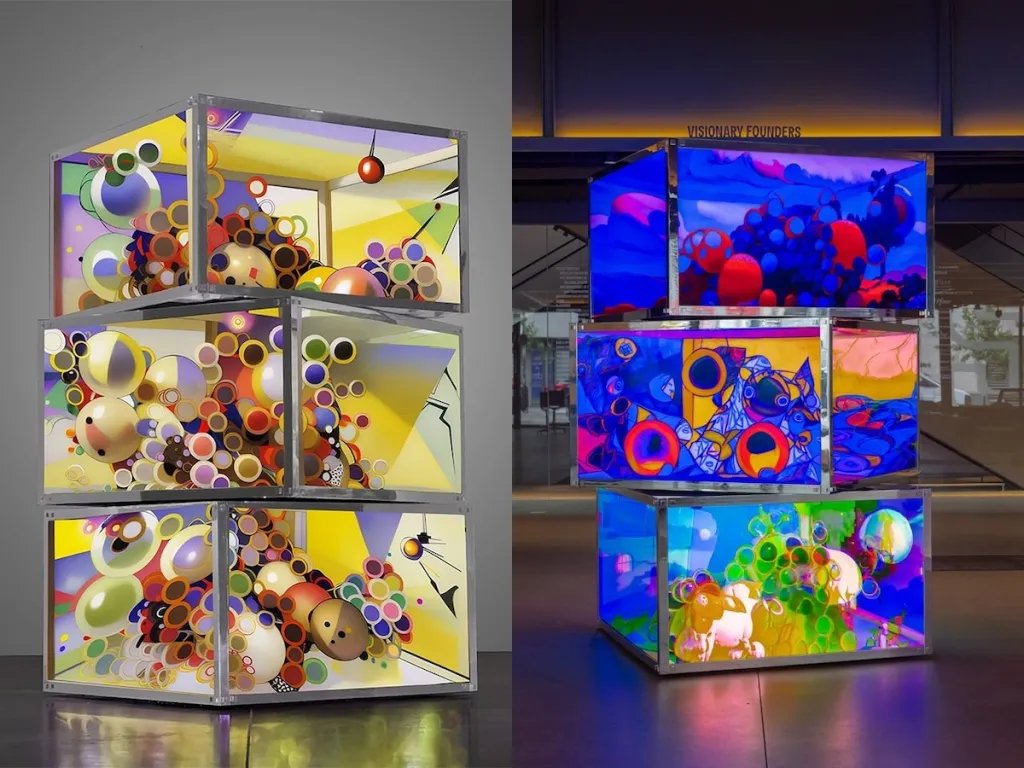
A Beeple artwork set to appear at Wisconsin’s Madison Museum of Contemporary Art next month has rankled locals who object to the way that the piece uses AI to analyze artworks in the institution’s collection.
An open letter about the piece, titled Diffuse Control (2025), calls into question the ethics of allowing Beeple to scrape images of artworks from the museum’s holdings, seemingly without permission from many of the artists or their representatives. Visitors to the museum will be able to create and buy images displayed on the work’s screens, the museum has said.
“Diffuse Control is completely devoid of any critical engagement, incapable of human understanding, and the only intent keeping it upright is Beeple’s intent to sell you an AI generated print for $75 before you walk out of the building,” the letter reads. Published at the end of August, the letter has gained more than 600 signatures, many of them from locals.
Diffuse Control, a stacked structure featuring screens displaying digital orbs, appeared at the Shed in New York and the Los Angeles County Museum of Art in 2025. In the case of the latter presentation, the museum allowed Beeple to draw on what a release described as “a rotating selection of artworks from LACMA’s permanent collection,” including a Paul Gauguin painting and a set of Turkish tiles from the 1580s.
Neither institution ever released a full list of the artworks scraped by Diffuse Control, whose concept appears to be a clear reference to Refik Anadol’s much-publicized piece Unsupervised (2022), which used AI to reimagine works owned by the Museum of Modern Art. Anadol’s work was largely reviled by art critics, less for ethical reasons than aesthetic ones. Ben Davis and Jerry Saltz both compared it to a lava lamp.
The Madison Museum of Contemporary Art has stated the piece’s Wisconsin iteration will use works by Francisco Goya, Rosa Bonheur, James McNeill Whistler, Gertrude Abercrombie, Utagawa Hiroshige, and Barbara Rossi, among others. Many of the artists listed worked before the 20th century, and many of their works are in the public domain. But some were active more recently and produced pieces that are typically subject to copyright law.
“By volunteering work from their collection without the artist’s consent MMoCA has overridden these artist’s agency and compromised their legacies,” the letter states. “These artists have had their work transformed into consumerist spectacle with the intention of selling prints and boosting Beeple’s prestige. Art institutions must not input art from their collection into AI models without permission from the original artist.”
In the release for the Wisconsin presentation, museum director Paul Baker Prindle sought to situate Diffuse Control within a legacy that includes Vera Molnár and Harold Cohen, two artists who used algorithms to dictate the creation of drawings. The letter calls his statement “a deflection, not an answer to the commonly expressed ethical concerns surrounding generative AI usage in art.”
The letter calls for the museum to release the full list of artworks scraped for the Beeple piece. “If a work can’t show its receipts, MMoCA shouldn’t show the work,” it concludes. A spokesperson for the museum did not respond to ARTnews’s request for comment.
The point of the letter, its unidentified writers note, is not “to fearmonger over computers in art, or to say that digital art is inherently wrong.” But several signatories went on to label Diffuse Control “anti-art” in their comments.
Beeple, who first gained fame for an NFT that set off a boom in the art world when it sold for $69 million, did not respond to request for comment. Yet the Wisconsin-born artist also appeared to obliquely respond to the letter on social media, writing on X on Monday night, “‘that’s not art’ has never aged well.”
