


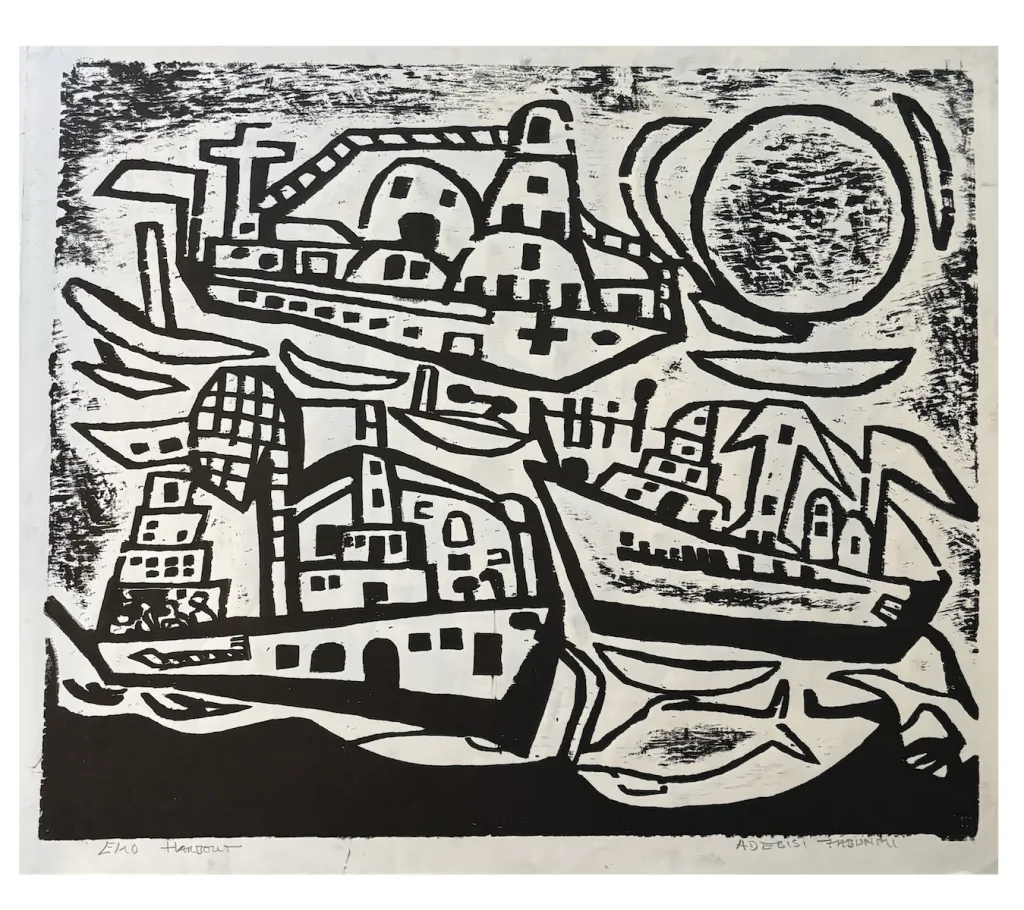
In Osogbo, a city in southwestern Nigeria, an unexpected art movement arose in the 1960s. Born out of experimental art workshops at a local theater complex, it gave young creatives room to start and explore their own art practices free from the burdens of everyday life. While European cultural figures helped facilitate what would come to be known as the Osogbo School of Art, the artists themselves defined the creative vision on their own terms, producing works that highlighted both their individuality and Yoruba heritage.
Despite having no formal training, the Osogbo School artists went on to be shown at major institutions across the globe, including the Institute of Contemporary Arts (ICA) in London, Goethe-Institut in Lagos, Neue Münchner Galerie in Munich, Otis Art Institute in Los Angeles, and Studio Museum in Harlem. They are also included in Tate Modern’s “Nigerian Modernism” exhibition, co-curated by Osei Bonsu and Bilal Akkouche, which opened last October and runs through May 10. Yet the movement itself and how it came about remain less well-known outside of its home country.
Undated photograph of Duro Ladipo at Mbari Mbayo, Osogbo
Image courtesy of the Center for Black Culture and International Understanding (CBCIU), Osogbo.
In 2025, I traveled to Osogbo, about three hours from Lagos, to find out more about the school and its impact over the 60-plus years since its founding. On a busy road, a gray building with decorative reliefs stands apart from its neighbors. Carved into the wooden entrance door is the image of a lavishly dressed man, breathing fire and holding a maraca in one hand and an axe in the other. Formerly known as the Mbari Mbayo Club, the site is now a memorial to the Nigerian playwright, actor, and theater director Duro Ladipo, who died in 1978 at age 46. It is here that the Osogbo School was born.
Mbari Mbayo and the house beside it were home to several of Ladipo’s theater productions. Over time, actors and other young locals ventured into visual art, attending workshops in painting, printmaking, textile design, and more. According to Joseph Gergel, director of Kó, a Lagos gallery where key works from the Osogbo movement were shown last November, many of the artists who emerged from these workshops went on to become “global superstars.” “By the seventies, they were some of the most recognizable names in Nigerian art globally,” he said.

Asiru Olatunde, Untitled, n.d.
Image courtesy of kó, Lagos.
On a Monday afternoon, Tunde Omojola, a photographer and the traditional ruler of a nearby town, shows me around Ladipo’s former compound, some of which he rents as his home. He tells me that as a young boy, he lived nearby and would often visit to watch the plays Ladipo put on. “Each day there were theater activities in the morning and evening, and then in the afternoon some of the workers would go to Mbari Mbayo to create art before returning,” Omojola said, noting that while he was not a part of the movement, he admired what took place there.
Ladipo founded Mbari Mbayo alongside Ulli Beier, a German academic who came to Nigeria in 1950 to accept a post at the University of Ibadan. Beier initially moved to the country with Austrian artist Susanne Wenger, his first wife. The pair, alongside British artist Georgina Betts Beier, who became Ulli’s second wife, would become integral figures in creating the workshops that encouraged a new generation of artists.
Jimoh Buraimoh, Untitled, 1976
Image courtesy of kó, Lagos.
Beier and the Guyanese painter Denis Williams held the first workshop at the club with local youth in 1962; another, the following year, was led by the American painter Jacob Lawrence. By 1964, Georgina had begun conducting the workshops, which often took place over several days, and which many artists have cited as integral to the development of their practice.
Jimoh Buraimoh, one of the key artists to come out of the Osogbo School, explained that Georgina encouraged each artist to develop his or her own individual style. “You can see that none of us resembles each other, and that’s the beauty of Osogbo,” he said. Buraimoh initially joined Ladipo’s theater group as a lighting technician and actor; two years later, in 1964, he attended his first workshop with Georgina.
Twins Seven-Seven, Weaver, 1970
Image courtesy of kó, Lagos.
Buraimoh said he began with a more traditional form of painting but later incorporated beads into his practice. “After our theater rehearsals in the morning, we’d have a break at 12 o’clock before returning at five, and within that time I’d often go to the palace where I’d see the crown of the king,” he said. “The crown fascinated me, so I asked if I could do something with beads.” Today, Jimoh is widely known around the world for his large bead murals.
Much like Buraimoh, many of the artists coming out of the Osogbo School are known for their own unique form of artmaking. Painter, sculptor, and musician Omoba Taiwo Olaniyi Oyewale-Toyeje Oyelale Osuntoki, known professionally as Twins Seven-Seven, stood out for his mixed-media pieces on cloth and wooden panels, often exploring Yoruba mythology and culture. Initially a drummer and actor, Muraina Oyelami developed a technique using rollers to create landscapes, cityscapes, and portraits. Trained as a blacksmith, Asiru Olatunde manipulated copper and aluminium to create repoussé metal plates depicting biblical and Yoruba cultural scenes.
Image courtesy of kó, Lagos.
Muraina Oyelami, Flock of like minds (Octopus), 1975
One of the biggest names to come out of Osogbo is artist and gallerist Nike Davies-Okundaye. Since the 1960s, the textile designer has been known for using traditional dyeing techniques in her work. As you walk around Osogbo, her influence is inescapable, from her Nike Centre for Art and Culture, offering free training in traditional Nigerian textile designs, to her sculpture-filled guesthouse and two gallery spaces.
Yet Davies-Okundaye does not consider herself a part of the Osogbo School, despite often being described as such today. She acknowledges that the Osogbo movement influenced her practice, especially pointing out Susanne Wenger and Georgina Beier as important figures. However, “I still want to let you know that everything I did was a self-effort,” she said. She explained that misogyny was rife in the 1960s, so she never attended the workshops, and when some of the male artists in the movement heard of her practice, they stole her materials and work. “I am only just getting back some of the embroideries that were taken away from me,” she said, describing how she worked by candlelight in the middle of the night in order to avoid being caught making art.
Image courtesy of kó, Lagos.
Nike Davies-Okundaye, Goje Player, 1962
At the 2025 edition of Art X Lagos, considered West Africa’s leading art fair, a talk was held on the Osogbo Art School, offering an international audience insight into an integral part of Nigerian art history. “When one thinks about what they have achieved, what their work yielded in an era where a career in the arts was not as forthcoming or as prevalent as it is today, their achievements are really remarkable,” the fair’s founder, Tokini Peterside-Schwebig, said.
For many, Osogbo was not only a school but an experiment in the power of making collectively. “We made different [types of] artworks, yet we were still together—we created a friendship,” Buraimoh said, noting that the relationships among the artists was the Osogbo School. “The movement was to let the art continue, even when the person who taught us left in 1966.”
Image courtesy of kó, Lagos.
Rufus Ogundele, Soccer God, 1994
