


I winced when I got a press release for a new Georgia O’Keeffe documentary to be released “around Mother’s Day.” What does one have to do with the other? The artist, as the talking heads in Georgia O’Keeffe: The Brightness of Light know well, was never a mother at all.
And yet, an expert appears in the film to say that, surely, she wanted to be one. It was her husband, Alfred Stieglitz, who declined. His daughter, from his first marriage, had succumbed to postpartum depression that left her institutionalized for the rest of her life. He didn’t want to go through that pain again. The evidence presented for O’Keeffe’s wanting children is simply this: she was a woman in her early 30s, a time when many women found themselves longing to have babies.
But O’Keeffe, of all people, was hardly most women. “I’m going to live a different life from you girls,” she told her classmates. “I’m going to give up everything to make art.” She did.
So why O’Keeffe for Mother’s Day? Because we are still so bad at celebrating women on any other terms? Because she painted flowers?
Georgia O’Keeffe in her New Mexico home.
Courtesy Montreal Museum of Fine Arts
The last thing we need is another Girl-Boss-Georgia, and happily, the film, available via Apple TV on June 1, is elsewhere more nuanced than that. It is for O’Keeffe-heads and the O’Keeffe-curious alike, full of texture and trivia. But even as one art historian acknowledges that “she has become almost more important as a symbol than for her actual work,” the film oscillates between circumventing this trap and walking right into it.
Artist documentaries are hard to pull off, but O’Keeffe is a perfect candidate: Her biography and her art are equally thrilling, and totally inseparable. Director Paul Wagner nails two things in particular: O’Keeffe’s complicated relationship with Stieglitz, and her hatred of those vulvate readings of her paintings. The two have everything to do with one another.
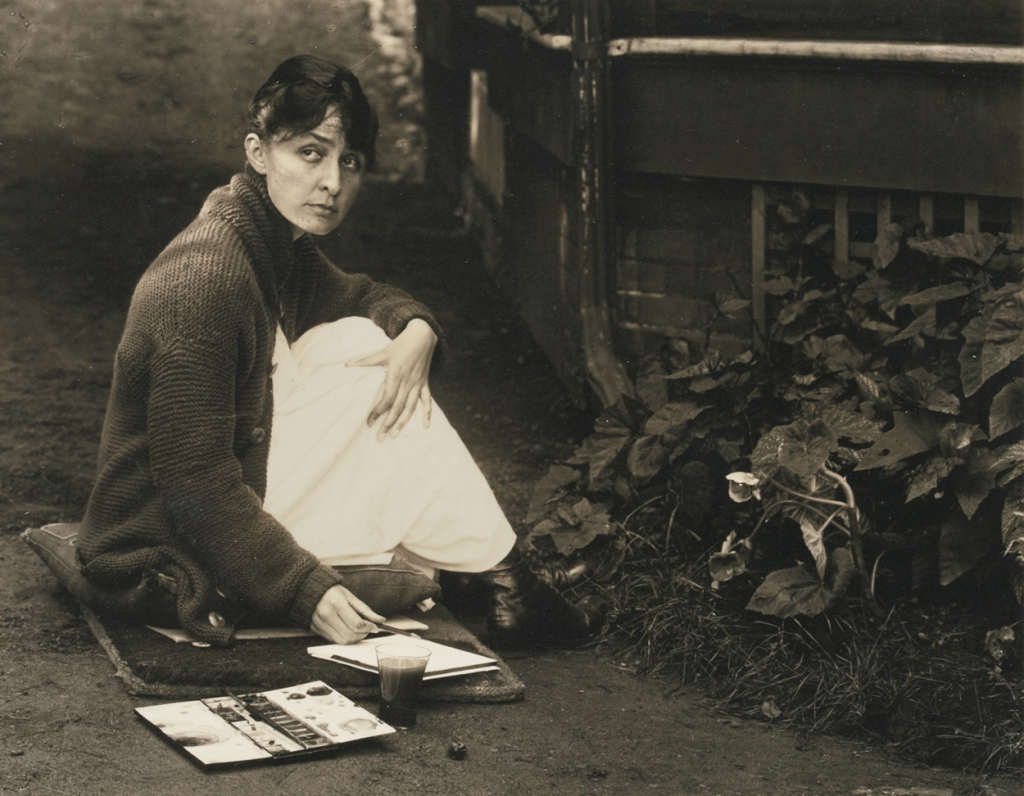
Stieglitz was her gallerist, her lover, her artistic sounding board—and, eventually, her husband. Early on in their relationship, he photographed her nude. Dozens of images, stunning and sensual, showcase her stern, one-of-a-kind beauty. They were a sensation.
Then, shortly after showing those images he began taking in 1917, before women could vote, Stieglitz hung a show of her work at his space, 291. First the nudes; then the art—one colored all readings of the other. Even worse, he mistakenly hung a vertical view horizontally, such that an undulating scene of reflections in Lake George looked labial. One critic, Stieglitz’s friend, certainly saw it that way: “These are a woman’s great and painful and terrible orgasms,” he wrote of the hills and trees.

Georgia O’Keeffe: Lake George Reflection, ca. 1921-22.
O’Keeffe was dismayed and asked that the nude photos never be shown again. Soon thereafter, she abandoned abstraction, lest there be too much room for interpretation. She stayed stylized: She’d been taught to paint what she saw, but found the advice “so stupid.” Still, flowers—with their curves and folds and prominent reproductive organs—allowed vulvate readings to dog her to this day. This is the curse of a woman openly enjoying her sexuality: She gives them an inch and they want a mile. Or is it that the male gaze is but a mere inch deep?
Soon, she and Stieglitz were living large on the top floor of what was then the tallest residential building in the world. They wore matching black capes as they took New York by storm, an art world “it couple” if there ever was one. They exchanged handwritten erotic letters that often reached 30 pages, putting sexting to shame. (Snippets read aloud punctuate the film.) And he remained her exclusive dealer, a fortuitous collaboration; the sales from one of her shows got them through the Great Depression.
Time went on, and Stieglitz, in his 60s, began seeing Dorothy Norman, then 22. O’Keeffe, humiliated, complained of that age-old male fetish for youth: “But Georgia, you don’t need me anymore,” he moaned. And she didn’t. Proving as much, she went off to New Mexico; he never visited once.
Out West, we see the Georgia we know and love: surreal-ish pelvis paintings and stylish adobe homes. Here, I winced once more. An unseen narrator speaks of her last unassisted painting in 1972: The Beyond, an ominous horizon closing in as her macular degeneration turns to blindness. The story stops there. What she made after that is brushed off—as if blind artists could not make something wonderful.
Georgia O’Keeffe: Untitled (From a Day with Juan),
1976/77.
© Georgia O'Keeffe Museum/ Artists Rights Society (ARS), New York
Anyone who has seen the current Whitney Biennial, starring Emilie Louise Gossiaux, knows well that they can. And as it happens, O’Keeffe and Gossiaux arrived at similar drawing techniques independently, enlisting ballpoint pen on newsprint to draw indented lines they could feel with their fingertips. Besides, one of O’Keeffe’s blind-era paintings, From a Day with Juan II (1977), hangs in MoMA, a stamp of approval if there ever was one.
The film ends with O’Keeffe becoming an icon amid the feminist movement of the 1970s, and it handles the friction between her generation’s feminism and theirs with real care. O’Keeffe’s was a feminism of rugged individuality, which for her had been hard-won. But what of her late years, her blind years, her inevitable dependencies? If the feminist movement allowed us to revisit her life and work half a century ago, should not this golden age of disability justice invite us to appreciate her anew?
The irony is that the film still cannot resist flattening O’Keeffe’s into a symbol despite its best intentions.
