


Starfish, scorpions, swallows, and sheep—once you look, animals are everywhere in Surrealist paintings. These and many other creatures are the focus of Desmond Morris’sThe Surrealist Menagerie: Strange Beasts & Fantastic Visions, a new book that combines Morris’s longtime study of zoology (he had a doctorate from Oxford) with his own participation in the Surrealist movement. Morris died this April at the age of 98, and his work leaves us with a lingering question: Why did the Surrealists, in their efforts to plumb the depths of the human psyche, continue to turn to animals?
Morris’s book focuses only on the representation of real animals; cataloguing mythic and hybrid creatures would take another volume entirely. He identifies over 750 instances of animals featured in Surrealist artworks, 168 of which are pictured in The Surrealist Menagerie. The book is organized into sections ranging from broad categories (“The Invertebrates”) to the surprisingly specific (“The Elephants”).
Morris’s career was dedicated to demonstrating that humans have more in common with the rest of the animal kingdom than we tend to admit. In 1967, he made claims to humans’ apelike nature in his bestselling work of popular science, The Naked Ape. That book and subsequent publications stirred controversy as he doubled down on our essential animality as a species (and on some decidedly human, decidedly dated sexual politics).

Roger Van de Wouwer: Tartuffe’s Hairshirt, 1961.
©The Estate of Roger Van de Wouwer
With his final book, however, Morris refuses to draw conclusions, letting the ambiguity of Surrealists’ meanings stand. He wrote elsewhere that “Surrealists dislike having their work analysed.” In place of analysis, The Surrealist Menagerie provides a panoply of alternately delightful and disturbing creatures, generating unexpected pairings through its focus on the animal. An owl crouching at the base of Max Ernst’sMarlene (Woman and Child), 1941, finds a fellow in Morris Grave’sLittle-Known Bird of the Inner Eye (1941), works made in the same year but that may not otherwise have been considered together. Both artists, Morris points out, were working in the context of World War II, and the owl’s ability to both burrow and take flight may have appealed to feelings of entrapment and a desire to escape. Salvador Dali dominates the volume, as he often does in discussions of Surrealism, with 33 featured works, but there are a number of lesser-known and women artists included, especially the work of Leonora Carrington.
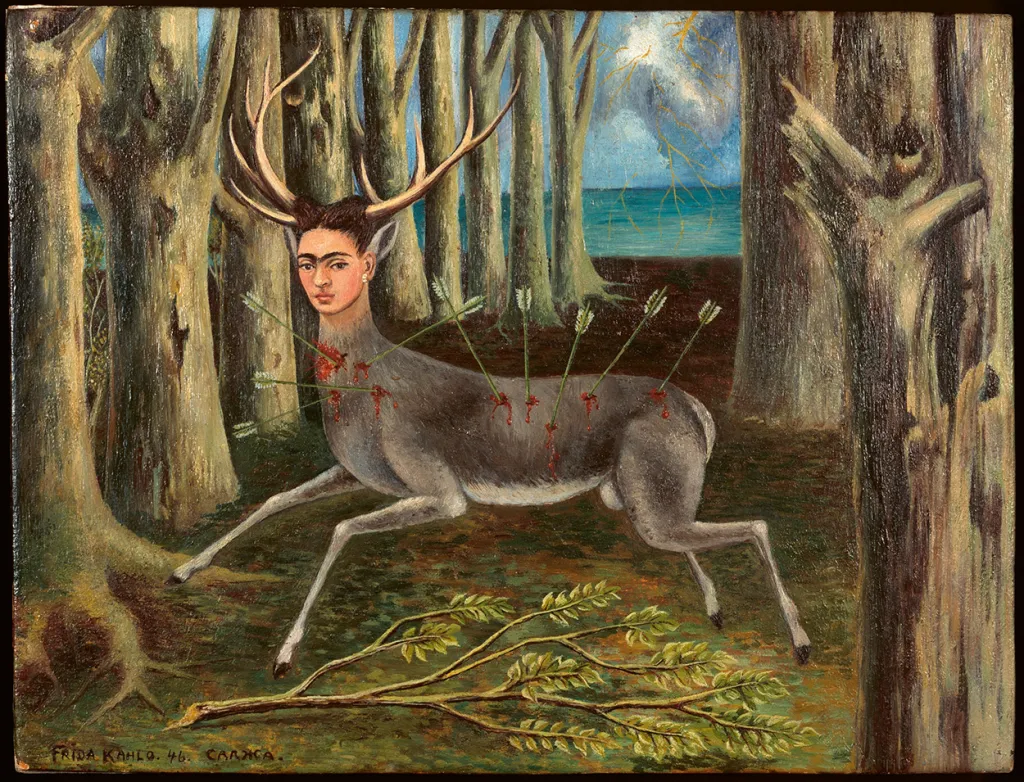
Art historians have been less reticent to assign meaning to the zoological Surreal. Kirsten Strom suggests that all the animal references point to the latent influence of Darwin, whose work dissolved perceived boundaries between the human and the animal and would prompt Freud to develop his own theory of psychic evolution. Animals could offer liberatory models to throw off bourgeois conventions, returning Surrealists to primal ways of being. Ernst, who once declared himself born from an egg his mother had laid in an eagle’s nest, used birds as totemic animals, appearing as an avian avatar in works like Loplop Introduces Loplop (1930). Other Surrealists, meanwhile, seemed to take from animals a license to exploit other (generally female) bodies, as in Clovis Trouille’sJustine(1937), in which both a naked female figure and a lion are bound and captive. The Surrealists were not a univocal movement, and it is striking the degree to which female artists were more likely to represent hybrid identification with their animal selves: Frida Kahlo appears intertwined with monkeys or as a wounded deer, Leonor Fini painted women cozied up with cats, and Carrington’s scenes imagine convenings with ferrets and foxes.
Frida Kahlo, Me and My Parrots, 1941.
Carrington in particular models what some have termed an ecofeminist approach, one that does not appropriate animals for the artist’s own self-revelation but instead develops kinship across species. Carrington’s association with a hyena in Self-Portrait (Inn of the Dawn Horse) (ca. 1937–38) and her personal relationship to horses are well documented but, through her writing, Carrington makes clear that her aspirations go beyond the autobiographical. In her 1974 novel The Hearing Trumpet, a nonagenarian vegetarian heroine named Marian rebels against patriarchal institutions. Navigating a changing climate, Marian develops interspecies alliances on a quest for the holy grail. Ultimately, she envisions a planet populated with cats, werewolves, bees, and goats, hoping for “an improvement on humanity.” In the work of the female Surrealist, it is women’s solidarity with animals that creates the possibility for a more humane world.
