


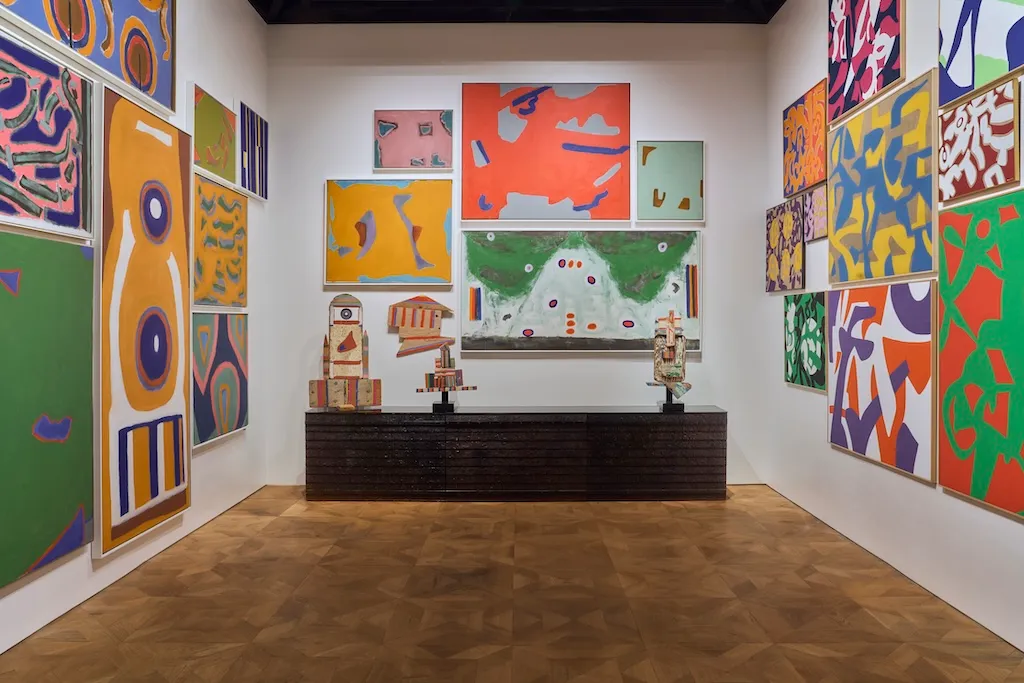
The Peter Marino Art Foundation occupies the former Rogers Memorial Library, a charming historic building in Southampton, New York, that its namesake has transformed into something much stranger inside.
This summer, the iconoclastic architect and collector has placed portraits by Robert Nava alongside those by Y.Z. Kami; abstractions by Betty Parsons and Carla Accardi share a wall. Nearby is a magnificent room filled with Tiffany silver, while a luscious, red-painted space is filled with Viennese paintings and objets d’art from the 1900s. Elsewhere are bits and pieces from Marino’s collection: a Rashid Johnson here, a Sanford Biggers there, a slew of Eugène Atget prints over yonder. There are more than 500 works at the foundation, and that’s just a fraction of what Marino has acquired over the years.
Part of the joy of walking through Peter Marino’s private museum is that there is quite literally stuff everywhere. Marino doesn’t treat the building as a series of hermetically sealed exhibitions, instead art from one century flows into work from several centuries later. Ferdinando Tacca’s 17th-century bronze, Hercules Capturing the Cerynitian Stag, for example, is flanked by photographs and prints by Andy Warhol. Peppering the room are carved wooden reliquaries from Central Africa, 19th-century ceramics by Théodore Deck, and Les Lalanne’s designs. The hang is constantly in flux; if Marino thinks an object belongs in another room because it will look better there, he simply moves it.
The Gold Gallery at the Peter Marino Foundation featuring silk screens by Andy Warhol (hanging on back wall).
Photo Jason Schmidt
During my visit, the Velvet Underground’s first record played softly through the speakers, and I got the sense that I was strolling through Marino’s mind. “It’s kind of a little bit of an amalgamation of all the things that he loves,” Curtis Clarizio, Marino’s chief of staff, told me as we walked through the foundation on a recent rainy morning.
Now 77, Marino has been collecting since he was 22, and his tastes have always extended well beyond the art of the moment. “Art history is about 5,000 years and some people today are only interested in work made in the last three years,” Marino told me later in the day at his palatial Southampton home. “That’s not really collecting for me.”
A collection, he explained, should equally include contemporary art, bronzes, antiquities, rare books, ceramics, arms and armor and design. A point of inspiration are European collections accumulated over generations, where hundreds of years of art coexist because they simply kept growing. On the foundation’s second floor, for example, the room devoted to Viennese objets d’art is next to one devote to all things Tiffany: silver, flatware, tea sets, hammered pitchers, vases, tankards, candlesticks— installed at different heights on mirrored or highly polished metal plinths.

The Vienna Room at the Peter Marino Foundation.
Photo Jason Schmidt
Marino also has a penchant for seeing affinities in the work of two artists who paths likely never crossed, as is the case with his two-person exhibition of Parsons and Accardi. In the foundation’s Cathedral Gallery, he has installed the two artist’s paintings in a dense, salon-style hang, where large abstractions sit beside more modestly scaled ones. The juxtaposition of the gallery’s double-height, vaulted timber ceiling with its warm parquet floor adds to this play in scale, giving this chapel-like space an intimate, domestic feeling.
Walk through another door and the mood changes again. A wood-panel floor and black wall is the setting for a sparsely hung display dedicated to Kami’s quiet, meditative dome paintings that mimic the ceilings of Byzantine churches and mosques.
While Marino has worked with some of the world’s top collectors, from Bernard Arnault to David Martinez, his taste is one that doesn’t hew at all to market trends. Marino pays attention to prices, certainly, but has little interest in being told what he ought to want. “I don’t really care what other people think,” he said. When dealers tell him an artist is “really hot,” he dismisses it as sales talk. “They should be selling shoes.”
A painting by Robert Nava at the Peter Marino Foundation.
Photo Jason Schmidt.
That comment made me think back to a room at the foundation devoted to Robert Nava, a market darling who had a show at Pace Gallery in New York that didn’t strike a chord with me. At Marino’s, I found myself surrounded by a funny menagerie of animals and mythical creatures: a lion here, a dragon there, a castle further along. The installation has the feeling of creatures moving around the room, as if in a carousel. These pictures don’t take themselves too seriously, and neither does anything at the foundation.
How Marino approaches a new acquisition might have something to do with. His own test to decide on whether to purchase an expensive artwork is simple: He gives himself a week. If it keeps crossing his mind “every morning, noon and night,” that’s an indication he should buy it. “I like to take my time.”
