


Mutte Ahmed Qasem Dammaj is the newly appointed culture minister in Yemen’s internationally recognised government in the south of the country. Yemen faces rampant looting, unguarded heritage sites, and a society weary after more than a decade of war. But in an interview with The Art Newspaper, Dammaj remains positive—in part, because positivity is an asset in itself.
“When I’m reading news about Yemen, it shows the bad situation, but not the reality—not our heritage, not our culture,” he says. “We are a very rich country in terms of music, poems, novels, history, historical sites. When I say we are trying to bring back resources, that means not just money, but also the narrative. Yemen is in a very critical situation. We need the voice of the world.”
A man and his daughter translate ancient South Arabian script © Brent E. Huffman
For Dammaj, like an increasing number of Yemenis, cultural heritage is a means of challenging international perceptions that see the country as written-off or hopelessly war-torn. He points to the events that continue unnoticed externally, such as a recent culture summit in the Hadhramaut, the inland oasis valley that borders Saudi Arabia; a culture week in Aden; and a heritage conference in Taiz, held on World Heritage Day (18 April). The cinema in Aden, which dates from the 1930s, is reopening soon, and Dammaj is actively courting private investment.
“It’s difficult to expect someone struggling to make ends meet to dedicate significant time to restoring and preserving their own historical monuments and buildings,” Samira Abdel Mawla Qaed Al-Qabati, an archaeologist and the director of planning at the General Authority of Antiquities, tells The Art Newspaper. “We care about heritage because we believe that survival isn’t just about food and drink; it’s also about preserving the spirit, intellect and identity what make us Yemeni.”
One of Dammaj’s first tasks is securing international agreements with countries to which Yemeni artefacts have been trafficked illegally. He is in negotiations with Germany, the US, Switzerland and France, but because the agreements are intergovernmental, he must first persuade his own government that these contracts are a priority for them. And the museums in Yemen must be secure enough to welcome the objects—a large ask when, as he says, the budget for the museums department in his ministry is less than $1,000 a month. Goodwill aside, it could be a long time before the artefacts return home.
Since Yemen’s civil war began in 2014, the country has faced missile strikes and on-the-ground fighting that have indiscriminately targeted civilian and military locations. Widespread poverty has increased the incentive towards smuggling from Yemen’s many unguarded heritage sites.
“I’ve worked in lots of different places—Afghanistan, Pakistan, China and African countries—but Yemen is the perfect storm of terrible threats to cultural heritage,” says the film-maker Brent E. Huffman, who helped organise the heritage conference in Taiz. “Because of its isolation, the lack of funding, the lack of oversight, the lack of international awareness, the threat of climate change, of looting, of war—all these things are happening at once at all sites.”
Taiz, known as Yemen’s cultural city, bears the visible scars of its decade-long siege. Rough and uneven barricades of rubble physically wall off territory held by the two main rival factions in Yemen, the Houthis and the southern government, in an echo of the Berlin Wall.
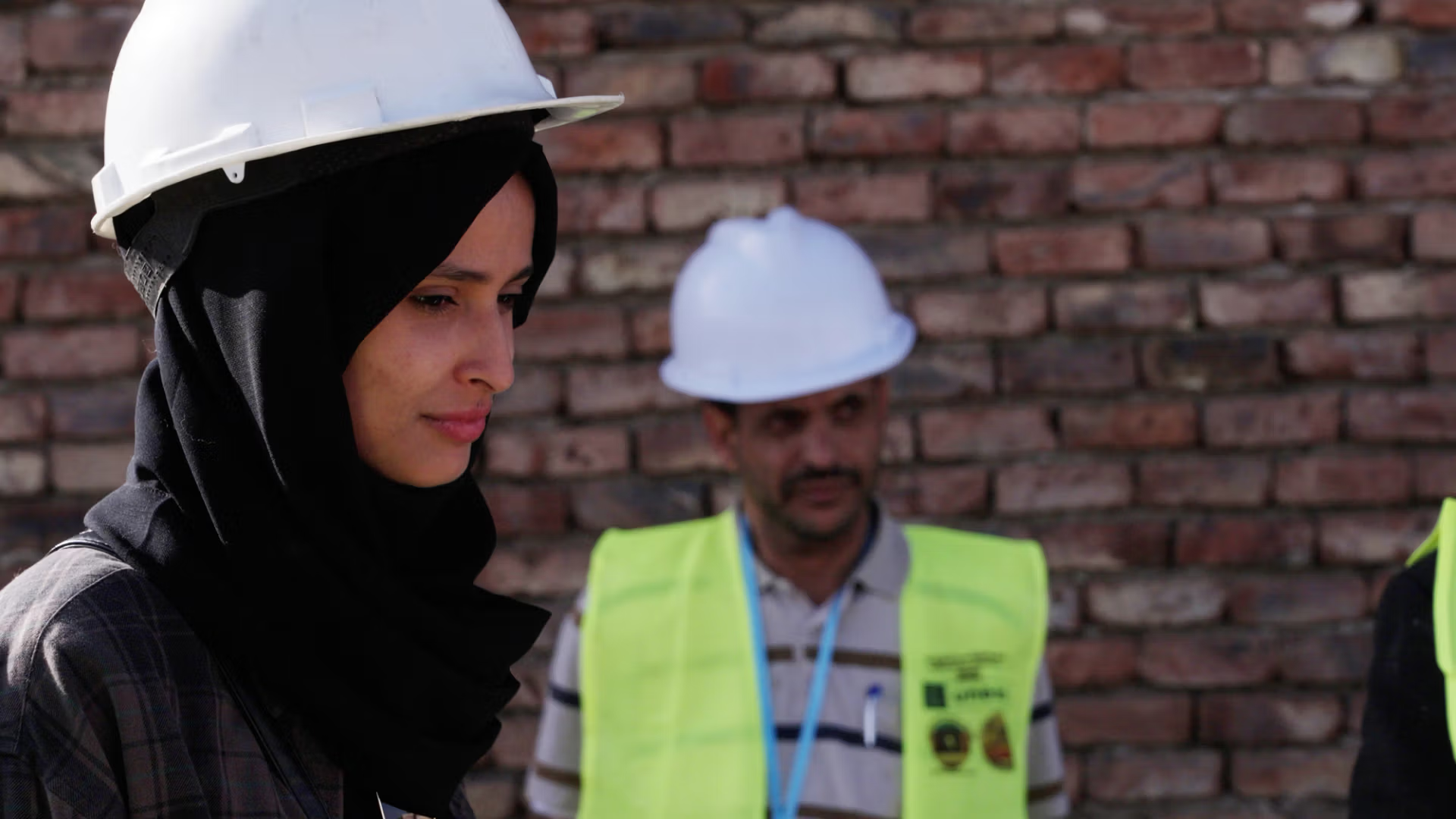
Noha Awn, a Yemeni engineer and cultural heritage specialist © Brent E. Huffman
The harm the city sustained is extensive: in 2015, two Saudi coalition airstrikes badly damaged Al Qahira Castle, the magnificent 12th-century fortification that overlooks Taiz. (Al-Qabati is now overseeing the reconstruction efforts.) The contents of the National Library were burned, and one of the city’s ancient domes, the 16th-century shrine of Sheikh Abdulhadi al-Sudi, was destroyed. Barely anywhere in the country has been spared, with damage to the city of Aden, the Hadhramaut, and devastation across the Unesco World Heritage site of Sana’a in North Yemen.
Marib Governorate, to the east of Sana’a, was home to the Sabaean Kingdom, a regional power that lasted from around 1000BC-800BC to AD275—and lives in popular imagination via Queen Sheba, believed to have been one of its rulers. The archaeological remains of the kingdom’s temples, settlements and fortifications have still not been fully excavated. They are now guarded by chainlink fences bearing visible holes; exposing them to looting, conflict and environmental conditions.
And while heavy fighting subsided after a 2022 UN-brokered ceasefire between north and south Yemen, north Yemen continues to be targeted by Israeli bombing campaigns in retaliation for Houthi support for Gaza.
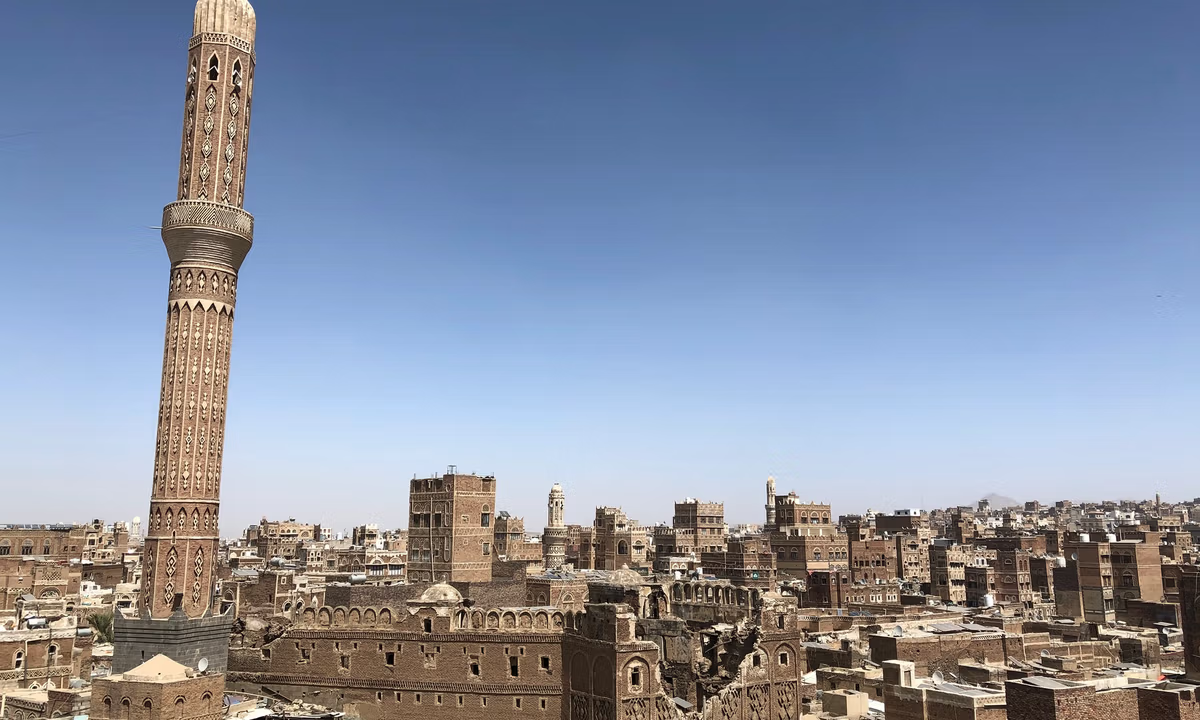
In September 2025, Israeli air strikes damaged the National Museum and other areas in Sana’a, killing dozens of people. Among the sites hit was the Salah ad-Din neighbourhood and its seventh-century mosque, which has an iconic, ornately patterned minaret from the Ottoman era. The eastern side of the mosque was damaged, creating weaknesses that now threaten the entire structure if they are not addressed. This damage has not yet been reported in any English-language media, as far as The Art Newspaper can determine. Media fatigue around the war in Yemen and strict Houthi controls have meant that very little information leaves the country.
“Airstrikes tear at the very fabric of history in Sana’a and tremors shatter the structures of its ancient minarets,” Noha Awn, a cultural heritage specialist in Sana’a, tells The Art Newspaper through a translator. “But we also stand before a wall of silence and helplessness. The suffering of Yemenis today lies not only in the scale of the destruction, but also in the suppression of truth and the inability to convey the Yemeni reality to the world.”
Women key to preserving cultural heritage
Awn was the sole participant from north Yemen at the April conference, travelling 160 miles south to reach Taiz through military checkpoints. The two-day event, organised by the Madrid-based NGO Heritage for Peace and Yemen’s General Organization for Antiquities and Museums (GOAM), brought together participants in the field to share information about paths forward for Yemeni heritage.
Like Awn and Al-Qabati, a large number of the participating heritage professionals were women. Women have traditionally been confined to office jobs in Yemen, but following Unesco programmes in the early 2020s aimed at balancing the gender divide in the workforce, women have begun overseeing labourers and collaborating with architects and engineers in the field.
“Due to the lack of other support, women have emerged as the means of passing on information to the next generation,” says Huffman, who is focusing on the part played by Yemeni women in heritage for his newest film. “Whether these are intangible cultural practices that are ongoing, or new practices that the women are learning, the women I’ve encountered in this project are thinking of the next generation. Not just in Yemen, but in many places, women are often the ones keeping these things alive.”
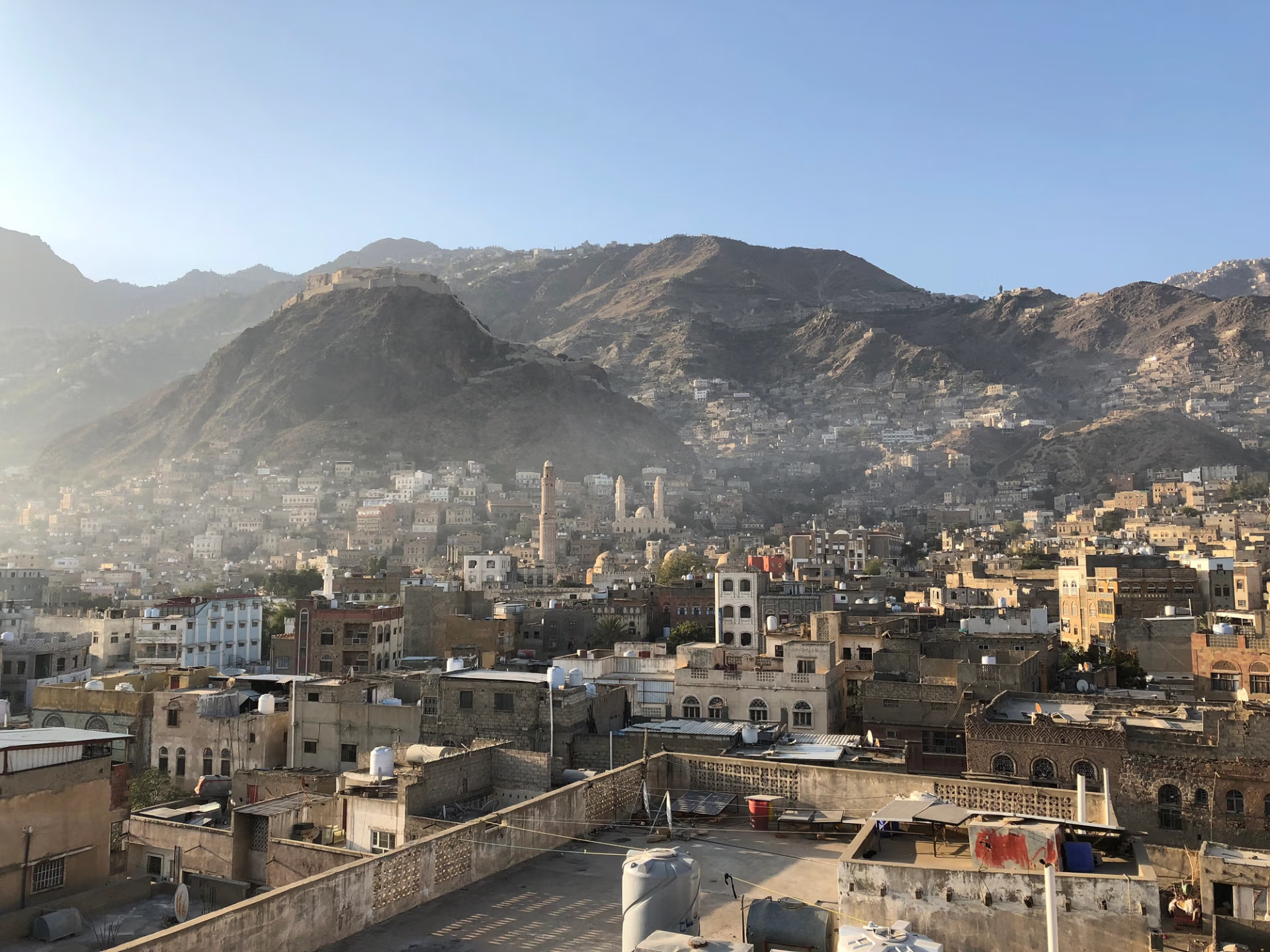
Taiz, the cultural capital of Yemen and home to Al-Qahira castle, which was bombed in 2015 © Brent E. Huffman
An engineer by training, Awn is rehabilitating traditional Yemeni structures such as the marna’a, a means for accessing water that was once common in every neighbourhood. The large-scale structure consists of a raised ramp, with a well alongside it. A rope is tied to an animal—usually a camel or a cow—and as it walks down the ramp, it retrieves the water from deep in the earth. The water spills into drains and pools in a trough for people to use.
“The marna’a is one of the historical landmarks that distinguishes Yemen, apart from its houses and buildings,” Awn says. “It is an archaeological landmark that had significant functional value in ancient times and is part of our identity and collective memory.”
Climate change challenges on two fronts
Controlling water resources is a continuing problem for Yemen from a humanitarian standpoint. Yemen’s vulnerability to climate change comes from two angles. Desertification has made winds stronger, accelerating the pace of erosion of wall carvings and edifices. On the other hand, Yemen has also seen torrential rains, which have eaten away at its mud-brick architecture.
“The flooding is destroying the infrastructure of heritage sites and mud houses,” Awn says. “They’re being restored by people who don’t have a lot of experience and knowledge of how to rehabilitate the architecture. People use whatever material they want—like modern materials such as cement that do not work and could make things worse.”
Another major concern is the lack of education among the local populace. Internationally led projects often focused on capacity-building in the country, but NGO presence has dwindled in recent years. This is in part due to the conflict, and in part due to external events. USAID was a major donor to Yemen, sending $620m to the country in 2024 alone, according to the UN ($580m of which was for humanitarian assistance). That department was dismantled by the Trump administration in 2025.
Unesco, the chief player in Yemeni cultural heritage, also faces challenges. Last December, ten UN personnel were detained by the Houthis in north Yemen, making UN operations there “untenable”, the agency said. According to Unesco’s website, the agency is still operating across the country, but The Art Newspaper understands from sources on the ground that activity has ceased in north Yemen. Unesco did not respond to repeated requests for clarification.
And for Yemenis working in heritage, they are in a race against time, not only against the degradation of existing sites, but also in their bid to retain the people who might be taught to restore them.
“In Yemen, there are those who have experience but have not received sufficient education. There are workers in the field of restoration who perform work that is close to that of an engineer, but they can barely read and write,” Al-Qabati says. “As a result of the country’s current situation, the decline in living standards, and the high poverty rate, most young people are either seeking to emigrate to improve their income or pursuing studies to obtain a job with a better salary.”
