Albariño is lovingly known as ‘the wine of the sea’ in its birthplace, the rain-lashed Atlantic coast of north-west Iberia. Locals have enjoyed it with seafood dishes for centuries, but Albariño is no longer a well-kept Spanish secret.
This popular grape has emerged as one of the wine world’s great success stories, and it’s now thriving everywhere from Portugal and California to New Zealand and even England.
Why is International Albariño Day on August 1?
The date is a nod to the grape’s spiritual home. Every year, the Galician town of Cambados hosts the Fiesta del Albariño, a week-long festival of tastings, concerts and fireworks that culminates on the first Sunday of August.
This festival now draws crowds of around 150,000 people, but the party has surprisingly humble origins. In 1953, two local growers challenged each other to a friendly contest to decide whose wine from the previous vintage was the best.
Bernardino Quintanilla was a Vigo-based lawyer who tended a small Albariño vineyard that produced just a handful of bottles. His friend, Ernesto Zárate, was a local landowner and a far more experienced winemaker in the Salnés Valley.
Quintanilla, Zárate and seven other growers presented their wines at a dinner in a friend’s garden. The menu was suitably absurd: 28 kilos of lobster, six chickens, piles of crabs, nine bottles of Champagne and 32 litres of local red wine to wash down the Albariño they were supposedly there to judge.
After the blind tasting, the votes were tallied, and neither man won. The victor was José Rodiño, a farmer from the neighbouring town of Carballal, who wasn’t nearly as wealthy as his competitors. A rematch took place the following year, and this time Zárate won, with Quintanilla finishing second.
The rematch became an annual tradition, the tradition became a festival, and the festival helped propel Albariño to worldwide fame. International Albariño Day, which falls during the celebrations, invites the rest of the world to join in.
Monks, myths and the Camino
As with many great grapes, legend long clouded Albariño’s true origins. The romantic version held that medieval monks carried the grape to Galicia from France or Germany along the Camino de Santiago pilgrim route. Modern research tells a different story: Albariño is a true native of the Iberian Peninsula, cultivated in the region for centuries – possibly as far back as the 12th century.
Its heartland is Rías Baixas, the Denominación de Origen established in 1988 along Galicia’s fjord-like Atlantic inlets. Here, thick-skinned Albariño grapes shrug off the damp maritime climate, often trained high on granite pergolas to catch the breeze, producing whites of mouth-watering freshness with a signature saline streak.
Scroll down to see 15 award-winning Albariño wines to try
One grape, two names
Cross the Miño river into Portugal and Albariño becomes Alvarinho, a star grape of Vinho Verde. The finest examples come from the Monção and Melgaço sub-regions just over the border, where the style is typically light, aromatic and gently fresh, sometimes with a subtle spritz.
Further afield, the grape’s love of cool, coastal conditions has helped it flourish in various pockets of the world. California’s Central Coast and Oregon’s Willamette Valley produce vibrant, fruit-forward examples, while New Zealand and Australia are turning out zesty, aromatic takes of their own. It has even found an unlikely foothold in England, where the mild maritime climate of Kent echoes the conditions of its Galician homeland.
Wherever it grows, Albariño holds onto its calling cards: bright acidity, perfumed stone fruit and a whisper of sea air. International Albariño Day is the perfect excuse to pour something fresh and delicious.
- Body: Light to medium-bodied
- Typical flavours: Peach, apricot, nectarine, grapefruit, lemon zest and lime, with floral notes, a saline minerality and sometimes a hint of honeysuckle
- Top regions: Rías Baixas (Spain), Monção and Melgaço, Vinho Verde (Portugal), Central Coast (California), Willamette Valley (Oregon), Marlborough (New Zealand)
- Similar to: If you enjoy dry Riesling, Sauvignon Blanc or Pinot Grigio, try Albariño
- Food pairings: Oysters, mussels, scallops, grilled fish, ceviche, sushi, seafood paella, goat’s cheese, fresh salads and lighter chicken dishes
- When to drink: Most Albariño is best enjoyed young and fresh, within two to three years of vintage, though top lees-aged examples from Rías Baixas can develop beautifully for a decade or more
Spain
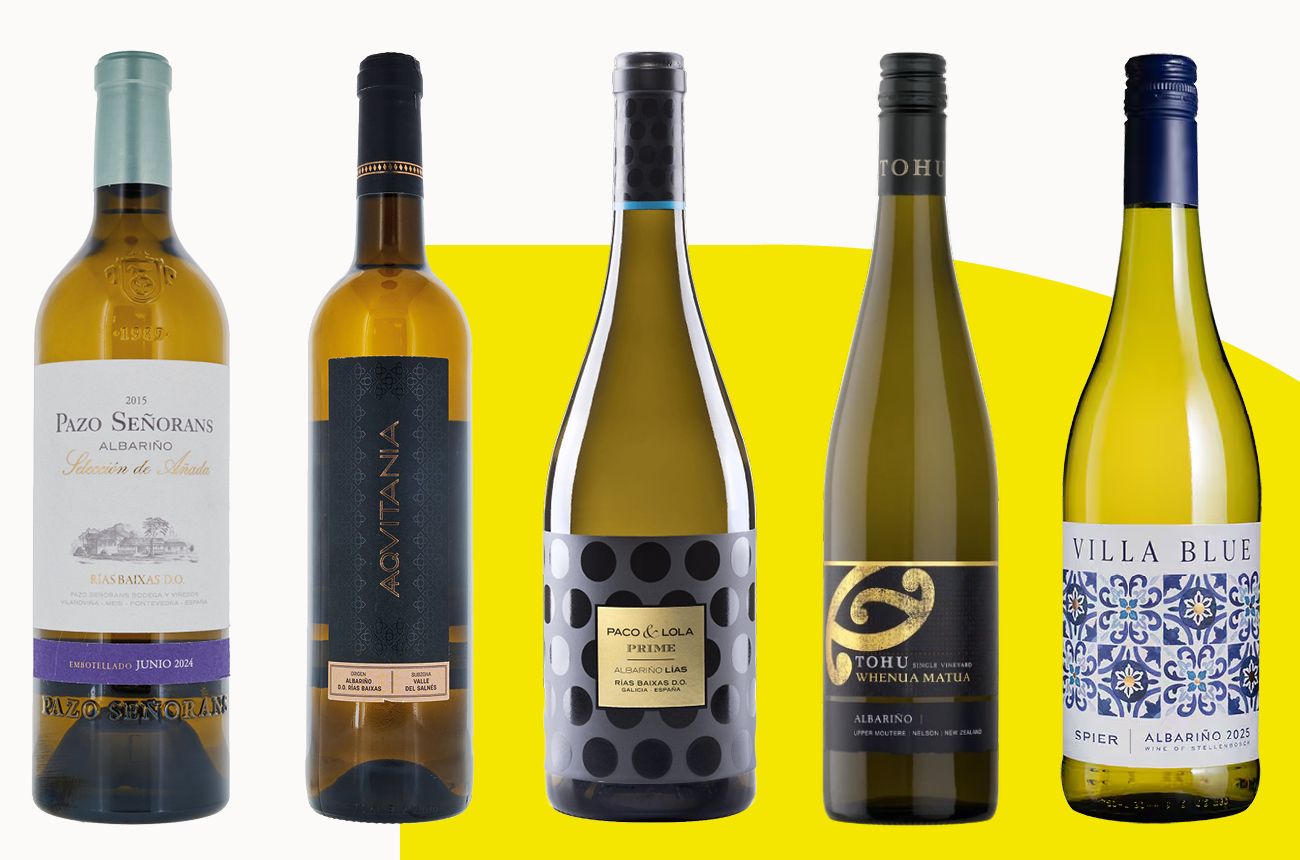
Pazo de Señorans, Selección De Añada Albariño, Rías Baixas 2015
Best in Show, 97 points
This is the fifth appearance of a Rias Baixas Albariño in our Best in Show selection, and triumphantly endorses local traditions for long lees ageing followed by bottle age: the wine is now in its eleventh year since the fine 2015 harvest. Our previous winners had been aged for 9, 5, 2 and just 1 year; indeed the popularity of this ‘heroic viticulture’ category means that there is now intense commercial pressure to hurry the wines to market, so classical long-aged alternatives can be hard to find. Pour it into the glass, though, and you’ll be amazed: the colour is still pale gold, while the aromas are fresh though complex: expect notes of nectarine, apricot, honeysuckle and citrus zest. The only clue to the wine’s age is its mushroomy aromatic back-tones. On the palate, age has brought softness and amplitude but the cut-stone acidity has kept its buoyant freshness; the delicacy and charm remain uncompromised while the stony finesse almost seems to emerge more memorably with time. A masterclass in regional tradition. Alcohol 13%
Bodegas Aquitania, Aquitania Albariño, Rías Baixas 2025
Platinum, 97 points
A highly distinctive style, capturing both the white peach and pear fleshiness and incisive limey precision that defines the grape. Warming nutty tones are joined by a lip-smacking saltiness that glides towards the long finale. Alc 13%
Paco & Lola, Prime Albariño, Rías Baixas 2021
Gold, 96 points
Dazzling white peach, nectarine, orange and honeysuckle perfume underscored by a vivid saline sensation. Textured and refreshing with citrus acidity and a long. Alc 13%
Rectoral Do Umia, Alectum Albariño, Rías Baixas 2025
Gold, 96 points
Arresting aromas of fresh herbs, crushed shells, lime and tangerine energise the pithy consistency and rounded, pear-imbued structure and fuse with the long, saline finish. Alc 12.5%
Terra De Asorei, Selección Privada Albariño, Rías Baixas 2022
Gold, 96 points
Punchy and peachy, with hints of white tea cutting through the palate. Moreish and sapid with lots of chewy texture and expressive acidity carrying the fruit. Alc 13%
Eidosela, Albariño, Rías Baixas 2025
Gold, 95 points
Inviting sea salt and grapefruit pith on the nose, with white peach, plum and citrus peel filling the palate. Salivating and mineral with mouth-watering length. Alc 13%
Granbazán, Etiqueta Verde Albariño, Rías Baixas 2025
Gold, 95 points
Distinctive notes of honeyed fruit, candied lemon peel and steely minerals set the tone, emboldened by the weighty structure and pithy acidity. Fluid and rapturous. Alc 13%
Pazos de Lusco, Albariño, Rías Baixas 2025
Gold, 95 points
Resplendent aromas of orange blossom, honeysuckle and white peach with a haunting mineral drive. Refreshing and saline with a stunning lemon acidity rippling at the end. Alc 13%
Torre Penelas, Blanco Granito, Rías Baixas 2023
Gold, 95 points
High-tone floral aromatics of honeysuckle and peach blossom build the foundations with bounteous peach melba juiciness and tantalising lime zest acidity layered on top. Divine. Alc 12.5%
Celdina, Albariño, Rías Baixas 2025
Silver, 93 points
Delicate and focused nose, with varietal notes of citrus fruit, white peach and blossom. Nicely textured, crystalline palate. Alc 12.5%
Mar De Frades, Finca Monteveiga Albariño, Rías Baixas 2021
Silver, 91 points
Some aromas of grapefruit, rhubarb and green apple with saline nuances. Energetic and refreshing, powerful palate with a mineral finish. Alc 12.65%
New Zealand
Tohu, Whenua Matua Albariño, Upper Moutere, Nelson 2025
Gold, 95 points
A frisson of kaffir lime, orange oil and honeyed herbals patrols the nose, while saline mineral characters frame the palate. Gorgeous grapefruit sherbet charges the length. Alc 13.5%
Waimea, Albariño, Waimea Plains, Nelson 2025
Silver, 92 points
Peachy aromatics, a touch of creamy citrus. Characteristic varietal palate with mineral base notes, breezy acidity. Real energy. Alc 13.5%
South Africa
Spier Wine Farm, Villa Blue Albariño, Stellenbosch 2025
Top Value Gold, 95 points
Ripe red apple and mango with flecks of citrus zest. Broad, creamy and concentrated, offset by vibrant acidity and a lingering saline finish. Alc 13.5%
United States
Casal Ventozela, Azul Marinho, Vinho Verde 2024
Value Gold, 95 points
A wonderful varietal showcase of ripe pear, peach, apricot and mandarin aroma with a riveting herbaceous complexity and supple citrus acidity. Long, elegant and rewarding. Alc 12.5%
Search all DWWA 2026 results
Region on the rise: Texas wines shine at DWWA 2026
Chenin heyday: How one grape became South Africa’s star at DWWA 2026