Krug is a Champagne house keen to remind us that it does things differently.
There is no ‘entry-level non-vintage’ here; instead there’s the Grande Cuvée, numbered in editions following the composition of the harvests used.
Then there are the single vintages, and the two Clos of Ambonnay and Le Mesnil, in Pinot Noir and Chardonnay respectively, whose prices and rarity ascend beyond the reaches of all but the luckiest Champagne lovers.
Should these rarer, more expensive wines be considered finer than the Grande Cuvée?
Absolutely not.
Equal footing
There are no hierarchies,’ says cellar master Julie Cavil. ‘At Krug every wine receives the same red carpet treatment. It is only the blending which decides’.
Despite the price difference, collectors and Krug fans tend to agree. While Krug vintages are rare treasures, side-by-side tastings tend to reveal little sense of down-grade to the more accessible Grande Cuvée.
The vintage is not ‘the best wine,’ says Cavil. ‘It is a wine that tells the singularity of the year’.
Grande Cuvée 174th Édition
Whether Grande Cuvée editions themselves always follow the strengths and weaknesses of the youngest years in their blend is open to debate.
Yet a comparison of the new 174th Édition, built around the generous, immaculate 2018 vintage, and the 173rd Édition centred on the challenging 2017, does make the case – even with the help of the house’s enviable reserve wine library.
Indeed, the reserve wine library takes precedence, even over the vintage bottling.
When the still base wines of the year, having spent a short ‘birth’ in old oak barrels before moving into individually tailored stainless steel, are lined up and assessed, first choice is given to blending components for Grande Cuvée, ‘and then to the library of reserve wines,’ says Cavil.
Only then, if interesting wines of the year remain, will a single vintage be released.
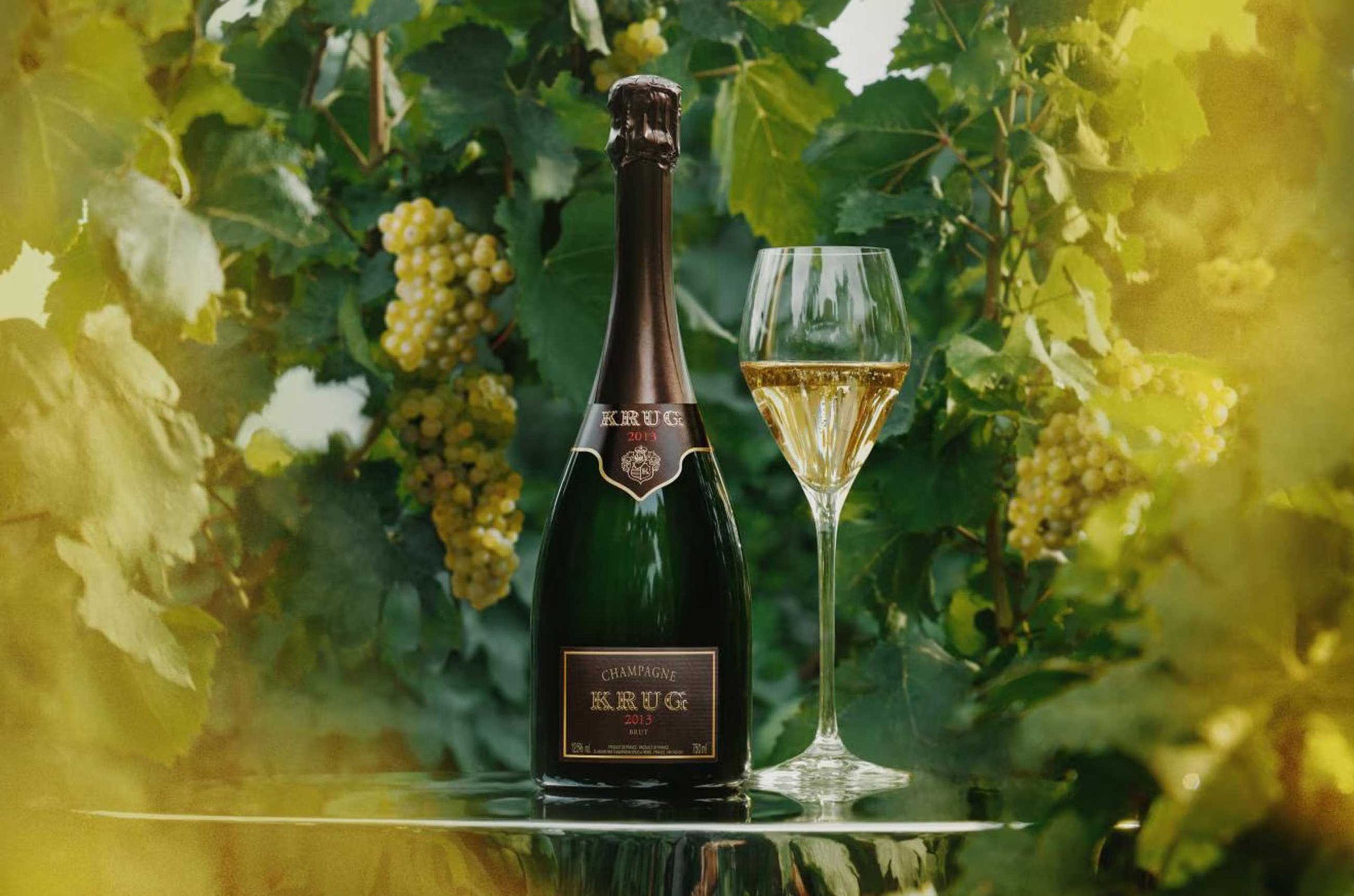
The 2013 vintage
Could it be said that the vintage bottling sometimes remained in the shadow of Grande Cuvée?
If so, then 2013 steps out boldly.
The 2011, 2008 and 2006 vintage releases told the story of the year, but the completeness, balance and age-worthiness of the blend in late-ripening 2013 has yielded the greatest Krug vintage of recent times.
With Chardonnay singing, Krug’s designation of the wine as ‘exalted citrus’ fits like a glove.
Clos d’Ambonnay 2008
The fortune doesn’t end there for followers of Krug’s rarer cuvées, though.
The blanc de noirs Clos d’Ambonnay cuvée from one of Champagne’s greatest vintages spent 17 years ageing in the cellar.
‘It was an incredible year, with lots of intensity,’ says Cavil. ‘But we had to be patient’.
The sheer force of the year in this charmed 0.68ha walled vineyard of Pinot Noir has yielded a wine of dramatic density, freshness and potency.
All wines may be treated as equals at Krug, but when it comes to vintages such as 2013 and 2008, some may be more equal than others.
New Krug releases not to miss
This is the most exciting moment in years to buy Champagne – here are 12 new releases to prove it
Our expert tastes Lanson Noble back to 1979 and finds out why these Champagnes age so well