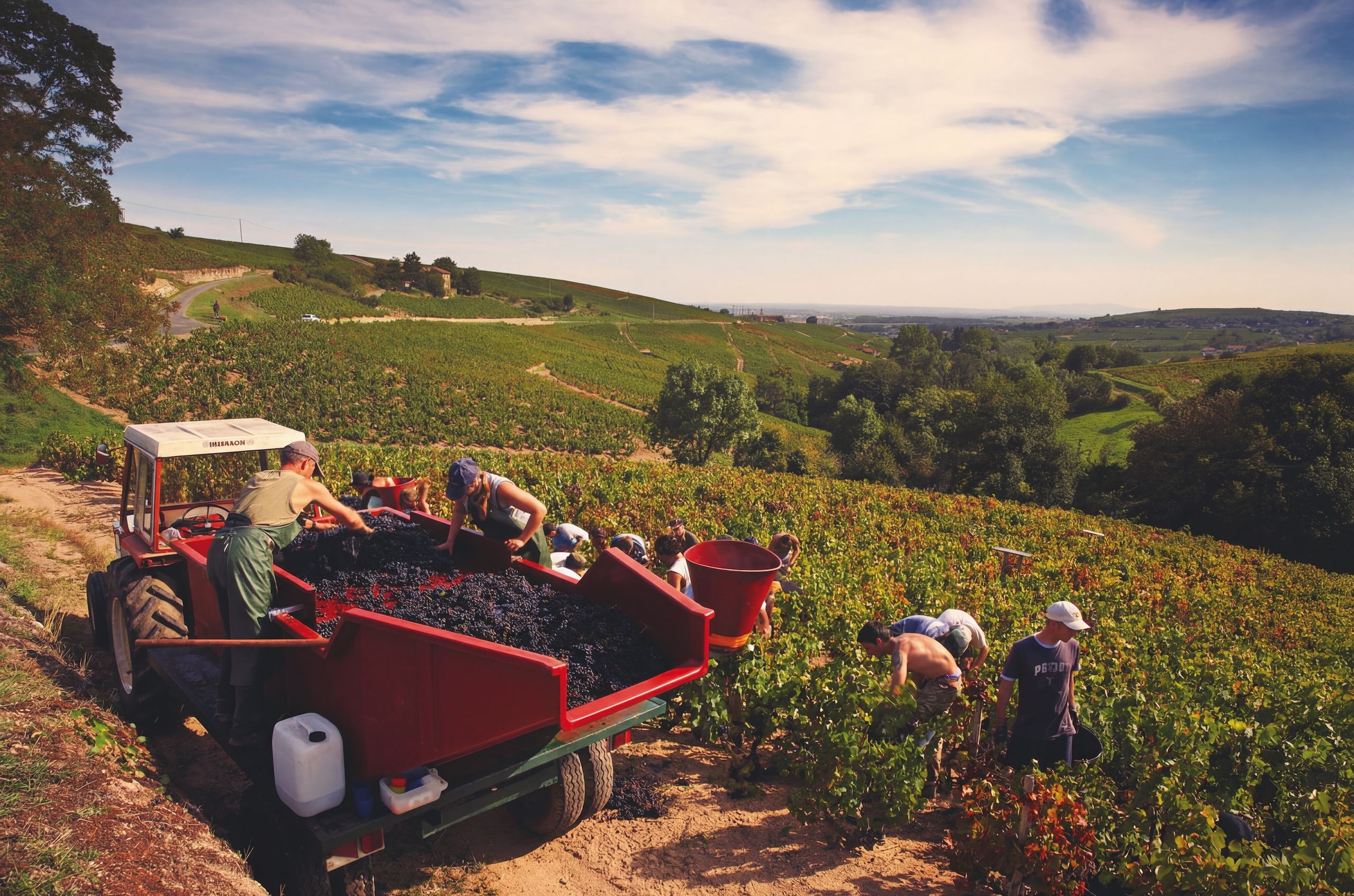
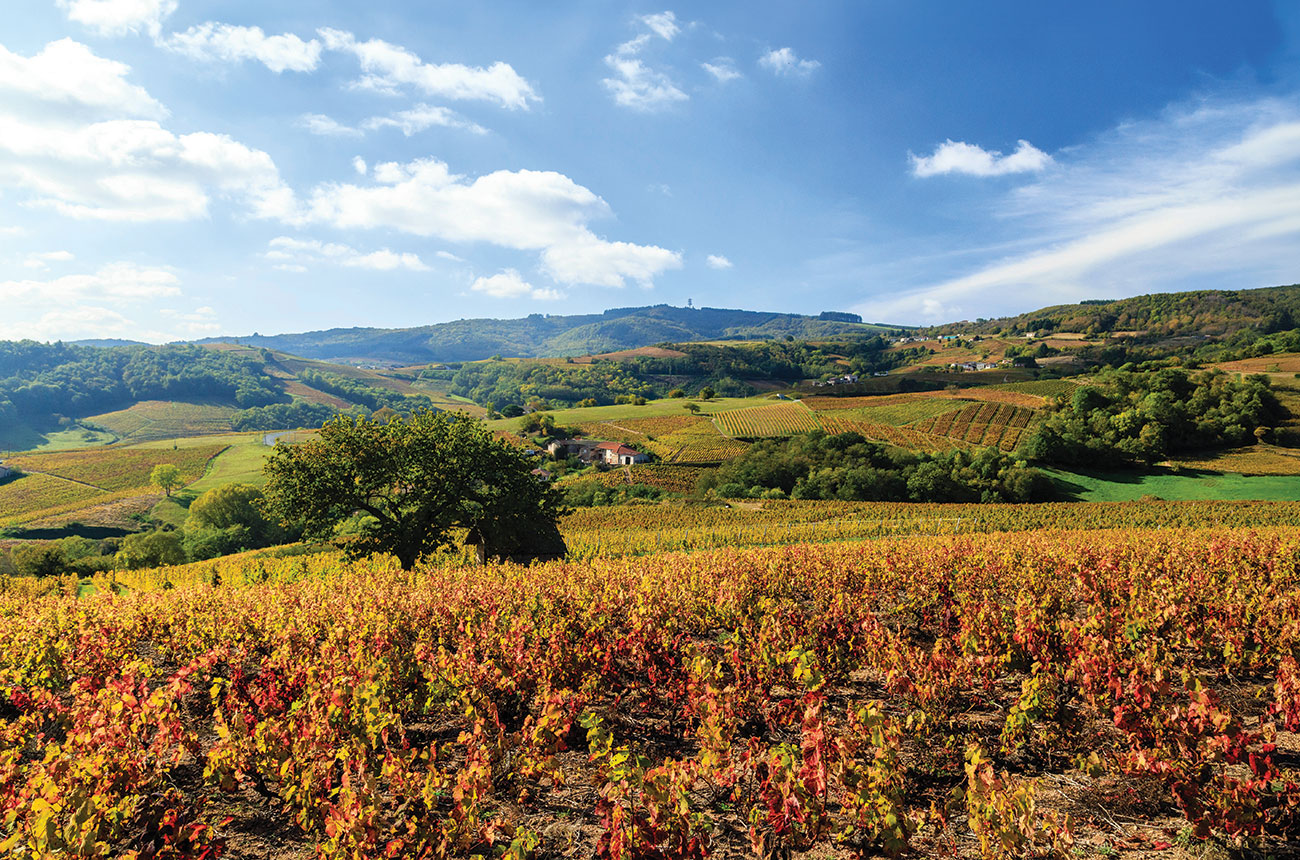
High up on the Col de Durbize, near the top of the Chiroubles appellation in Beaujolais, the view is breathtaking.
Due south, across a rippling wave of vineyard-covered hills, the mounded form of the Côte de Brouilly towers over the landscape. Beyond it, a flat plain spills away towards the Saône river.
On a cloudless day you can often catch a glimpse of Mont Blanc in the far distance, its snow-capped shoulders marking the highest point of the Alps.
The sloping vineyards to the north of the col are punctuated by copses of trees and sunshine-yellow gorse bushes.
Even though you’re less than 3km from the village, it’s peaceful up here, the silence interrupted only by the loud song of blackbirds and the occasional quiet hum of a peloton of cyclists whooshing by.
It’s not just the view that takes your breath away. Even on a sunny spring day, you can feel the wind that blows over the col.
Its name, Durbize, is a portmanteau of bize, the moniker used in the Alps for a cold, dry mountain wind, and dur (meaning ‘hard’), a reference to just how biting that wind can feel when it really gets going.
The bize is often keenly felt by the producers working the steep vineyards that spread out over the slopes beneath and behind the col.
It’s worth bearing in mind that although the Col de Durbize, perched at 500m above sea level, is one of the highest points in the region, some of the Chiroubles vineyards are situated even higher.
Work your heart out
Furthermore, not only is Chiroubles the highest of the 10 crus of Beaujolais – its highest-quality sub-regions – it also features the region’s most vertiginous slopes.
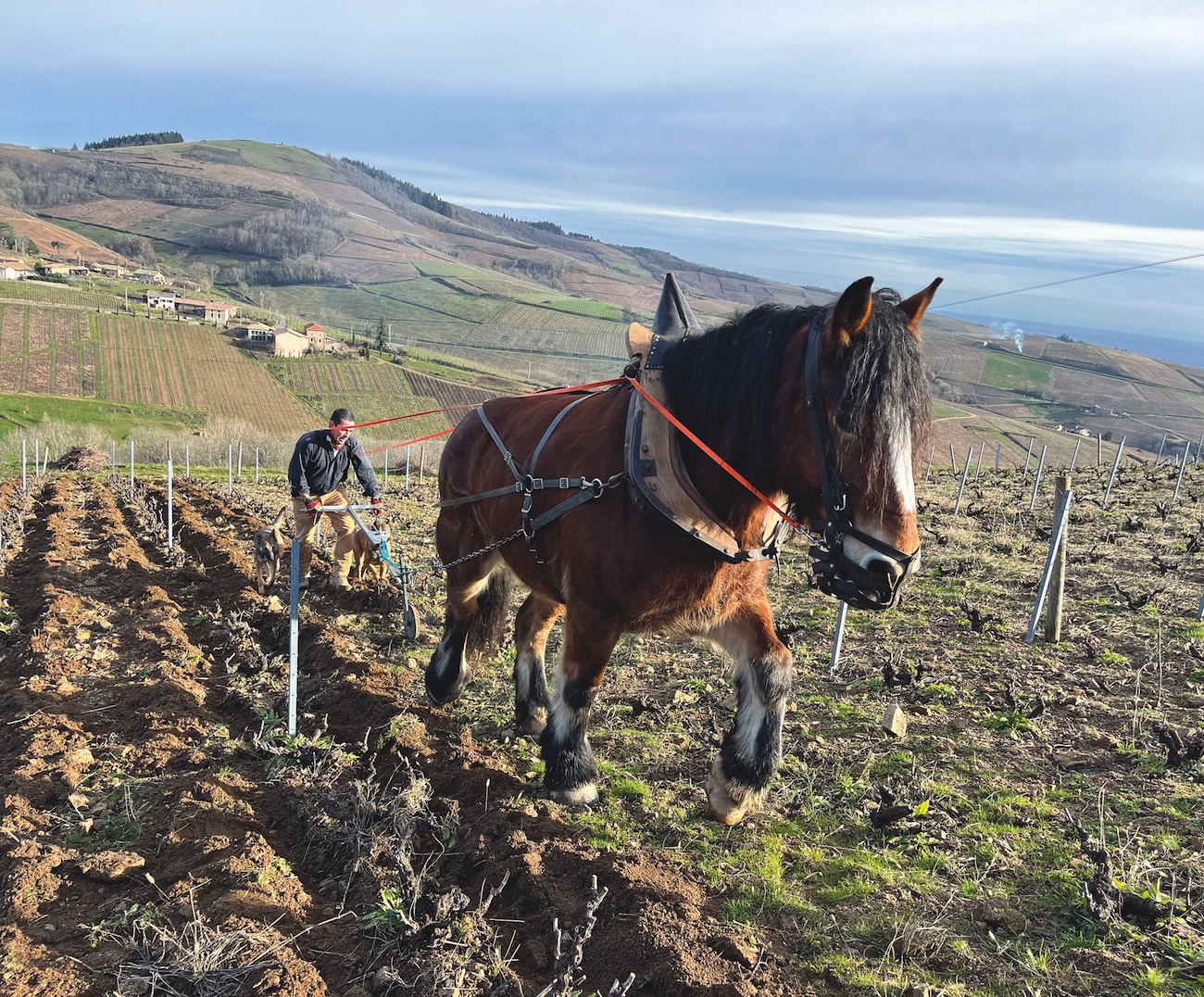
Toiling up and down the sharp inclines in this hilly cru is not for the faint of heart or the weak of limb.
The growers’ task is made even harder by the nature of the vines they’re tending. The vineyards of Beaujolais’ crus are largely populated by ancient bush vines, almost entirely Gamay, many of them so low to the ground that they look like bonsai versions of the more vigorous plants seen elsewhere.
Bending and kneeling to prune these vines, and to harvest the low-hanging bunches, takes a physical toll on Chiroubles’ growers over time.
‘I love being up there in my vineyards. I love the landscape, and the feeling that I’m surrounded by nature, and I love the views,’ says Domaine de la Grosse Pierre’s Pauline Passot.
Then she sighs. ‘It’s incredibly hard work and I have to work my heart out. The vineyards are so steep they just can’t be mechanised – everything has to be done by hand.’
But although those steep slopes, buffeting winds and old vines may be a tribulation for grape-growers, they are a distinct advantage in the context of climate change.
While the Chiroubles cru may have struggled to ripen its grapes in past years, when chaptalisation (adding sugar to the fermenting must to increase potential alcohol) was the norm in the region, the freshness derived from elevation and wind is now a positive blessing in a changing climate, when those tending vines grown in riper sites sometimes struggle to keep alcohol levels under control.
Rocky descent
The final piece in the puzzle of the distinctive terroir of Chiroubles is geology. It’s the only one of the 10 crus to be composed exclusively of the pink granite soils for which the region is renowned.
Even Fleurie, the cru most strongly associated with pink granite in most people’s minds, has a fan of alluvial soils situated in the southeast of the appellation.
In some parts of the Chiroubles appellation, geology and topography combine to create incredibly shallow soils in which the bedrock lies exposed, while elsewhere these rocks have decomposed to create relatively deep, free-draining granitic sands.
It’s this combination of elevation, cooling influences and granite soils that gives the wines of Chiroubles a unique tension and energy, while vine age (many of these plants are well over 80 years old) lends concentration and focus.
Chiroubles is typically fine-boned and perfumed: the Beaujolais equivalent, perhaps, of Volnay or Chambolle-Musigny.
Unfortunately for the region’s growers, however, Chiroubles doesn’t command anywhere near the price of the wines of the Côte d’Or, despite their stylistic similarities.
As a result, it’s perhaps unsurprising that over the course of the two years I spent researching my book The Wines of Beaujolais (£35 Académie du Vin Library, September 2025), Chiroubles lost nearly 15% of its vineyard area – and a recent trip to the region suggests that a further 5%-10% of vineyards have been abandoned in the past 12 months.
All this in a cru that is already the second smallest of the 10 in terms of area.
Commercial realities
‘Lost’ is a euphemism in this particular context. What typically happens is that, when a grower retires, he struggles to find anyone to take over his vineyards. These are then left to lie fallow, the grasses growing wild between the tightly spaced vines.
For many growers, farming a hectare or two of Chiroubles is, it would appear, far more trouble than it’s worth.
As Passot points out: ‘Very few people want to take on these difficult vineyards, especially when it’s hard to make a return on the investment in the time and money it takes to farm them.’
She’s not wrong. A quick back-of-an-envelope calculation suggests that the steepest hillside vineyards in Beaujolais cost two or three times more to farm than those that lie on flatter land – possibly even more if you farm organically, as many of the best producers do.
The story of Jules Métras’ La Montagne, one of the finest wines made in Chiroubles, is a perfect illustration of the potential loss to the wine world.
The 2024 vintage of this wine – and of its stablemate, the Vieilles Vignes Chiroubles – is the last Métras will ever bottle.
When I visited him last year, he told me he was giving up his long-term lease on the vineyards with great regret, but with a pragmatic eye on both the commercial realities of the situation and his own physical limitations.
Métras’ father Yvon, one of the pioneers of the natural wine movement in Beaujolais, has recently retired from the viticultural fray, handing over the management of his Fleurie vineyards to his son.
Métras, having decided that he wanted to keep his production on a small enough scale to enable him to operate as a one-man band, was faced with a decision about whether to keep his father’s vineyards or the ones he’d been farming under his own label.
Ultimately, much as he felt an affinity for his plots in Chiroubles, Métras’ calculation was driven by the pragmatics.
‘It’s just far easier to sell Fleurie than it is to sell Chiroubles,’ he shrugged, adding that another factor that influenced him was having watched some of his relatives farm Chiroubles’ sloping vineyards until they reached their 60s.
‘All those years of climbing up and down those hills, tending those low-lying vines, simply wore them out,’ he told me.
And there’s a further issue that makes Chiroubles a challenge for any producer. The hailstorms that sweep through the region with increasing frequency seem to strike the cru with both monotonous regularity and devastating consequences.
Most of the growers in Chiroubles tell me that they count on losing a significant proportion of their crop at least one year in three.
Sometimes, when the hailstorms roll through, they’ll escape with relatively minor damage, but in the worst-case scenarios, 70% or 80% of a vineyard’s potential harvest can be lost in the space of half an hour or so.
For the love of it
And yet this troublesome, capricious cru has a way of working its way into the hearts and souls of those who take the trouble to get to know it.
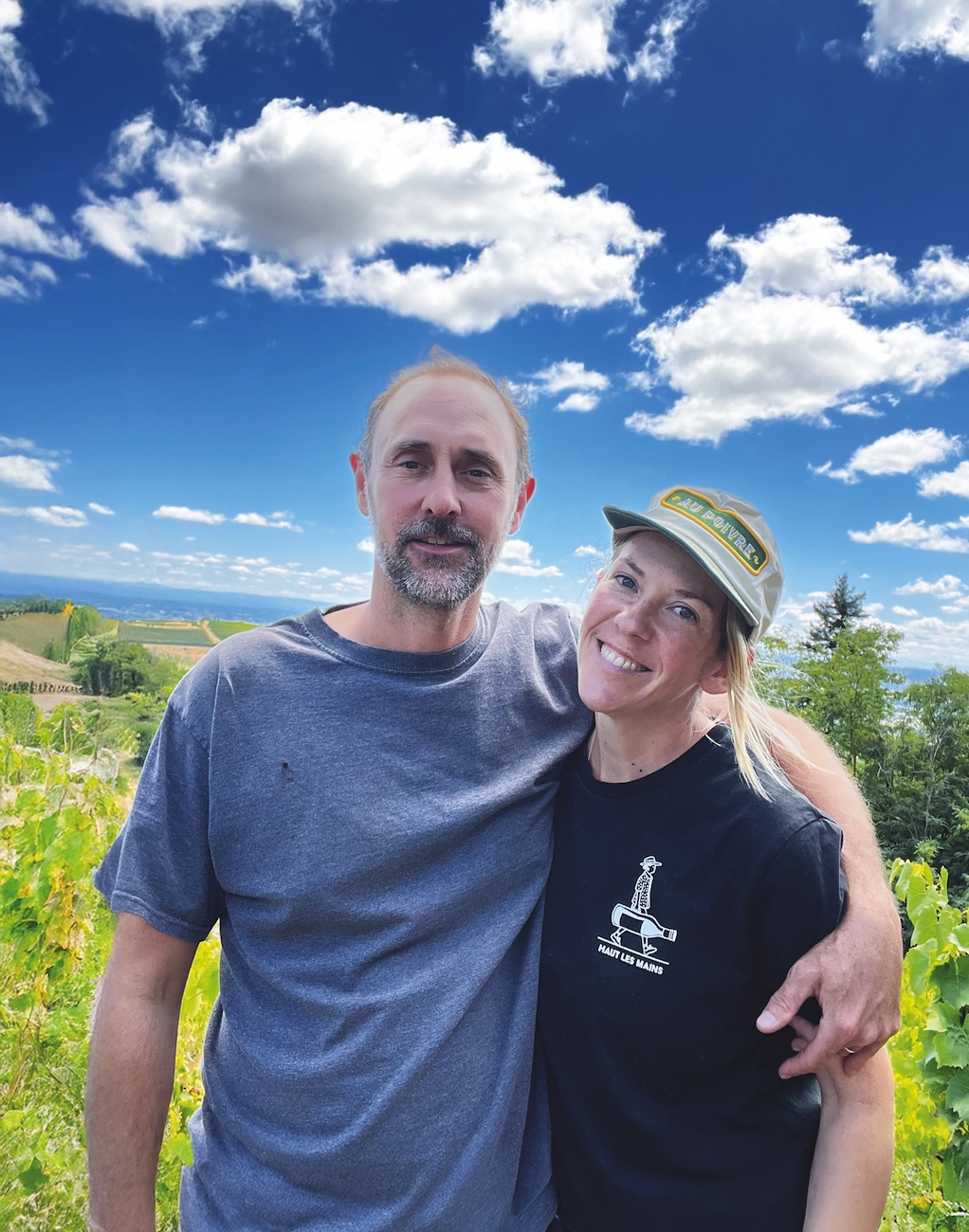
‘The people who farm these vineyards are doing it for love,’ says Michele Smith of Domaine Chapel, who farms 3ha of vineyards spread across three of Chiroubles’ lieux-dits (‘named locations’).
‘They’re doing it because they believe in the cru. I think that eventually this will resonate with people. Chiroubles deserves the same amount of respect as the more prestigious appellations – maybe even more because of the challenges that it brings. These wines just have the most amazing energy and vibrancy.’
But if the wines of Chiroubles are so good, why are they so difficult to sell?
One of the cru’s greatest problems is that, unlike the larger, more famous crus of Morgon and Fleurie, Chiroubles doesn’t have a big winemaking name – either in its past or in its present – to drive its image.
Most of the grapes grown in the cru have been absorbed into big (and often rather bland) négociant blends, humdrum wines that aren’t likely to attract discerning palates or turn collectors’ heads.
Nevertheless, the wines recommended below are evidence that great winemakers – if not famous ones – are prepared to carry a torch for Chiroubles.
Another issue that may play its part in Chiroubles’ travails is that the distinctive identity of each of the 10 Beaujolais crus isn’t yet widely recognised.
One importer told me, off the record, that the typical response from retailers and restaurants (ones that happily list a couple of dozen wines from Burgundy or a generous handful of Piedmontese Nebbiolos) is: ‘Thanks, but we already have a Beaujolais’.
Given that, for an outlet that believes that listing Beaujolais is a box-ticking exercise, the first cab off the rank is usually either a Morgon or a Fleurie (or possibly a Moulin-à-Vent if they’re feeling really adventurous), poor little Chiroubles rarely gets a look in.
The exhortation to ‘use it or lose it’ is a familiar one to any gym-goer over the age of 40, but it’s less frequently heard in the context of wine.
Nevertheless, the clock is ticking for Chiroubles. It’s time we all realised that the hills of Beaujolais conceal a hidden treasure.
If we don’t, there’s a risk that this particular pot of elegant, perfumed vinous gold will disappear from our lives forever.
Gamay at the extreme: Natasha’s pick of 10 Chiroubles to try
Secret Beaujolais: Our expert guide to must-visit wineries and restaurants
Marvellous Morgon: A guide to this star Beaujolais cru