


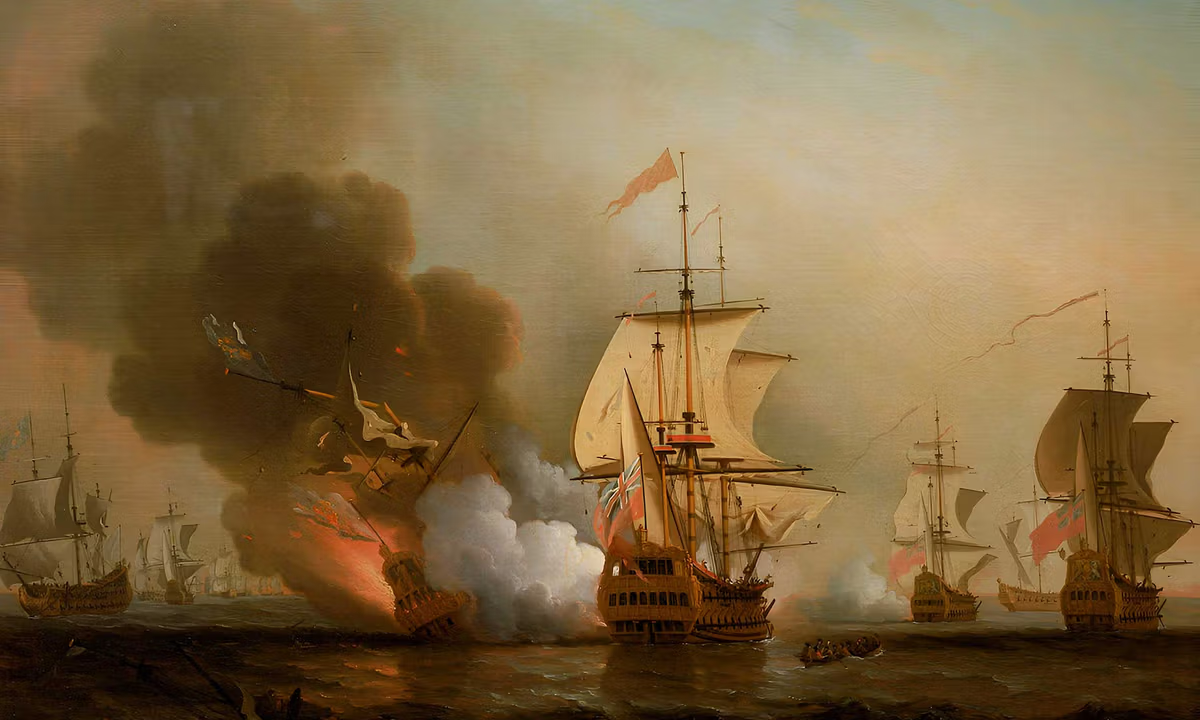
The treasure-laden Spanish galleon the San José, which sank off the coast of Colombia in 1708 after a battle with the British Royal Navy, is considered the ultimate find in the world of marine salvage and underwater archaeology—two opposing yet overlapping fields.
Since its official discovery was announced by the Colombian government in 2015, the San José became known to the wider world and has bobbed in and out of the news; its recovery complicated by technological limitations, philosophical debates and ownership disputes leading to lawsuits. Who has the right to the gold and other precious artefacts littering the floor of the Caribbean Sea? It is complicated.
In Neptune’s Fortune, the writer Julian Sancton deftly unpacks the saga of the San José around the equally compelling story of the Cuban American
archaeologist Roger Dooley, who was instrumental in finding what has been referred to as the holy grail of sunken treasure. His accidental breakthrough occurred during a research visit to the Archivo General de Indias in Seville, Spain, in 1984 while researching a different shipwreck.
Depending on who is talking, the contents of the San José are valued to be as low as $4bn and as high as $20bn. For the archaeologists, the historical value is worth more than the gold. For Colombians, the ship is in their waters and belongs to them. For Spain, not only is the ship a military vessel protected under law, but it is also a graveyard where 600 people lost their lives and should not be commercialised. For Peru, the gold was plundered from their land. For various Indigenous groups in South America, the gold was extracted by their exploited ancestors, and it belongs to them.
Enmeshed with Cuba
Dooley’s decades-long obsession with shipwrecks began in pre-revolution Cuba, where he was taken as a child to live with his maternal family and where he learned how to dive. He also became enchanted by the rebel soldiers and their leader Fidel Castro. Despite his American origins, he became enmeshed in the regime. During that period, he was known as Roger Montañés Caballero (his stepfather’s surname and his mother’s surname respectively).
Dooley studied archaeology in Havana and, combined with his scuba-diving expertise, began working at Carisub—the government agency focused on excavating the more than 200 historic Spanish shipwrecks surrounding the island and extracting treasure to shore up its funds.
“Of the many galleons believed to have sunk in the Caribbean, only three had ever been found and identified, all of them ransacked by treasure hunters before they could be properly studied,” Sancton writes.
Carisub’s primary mission troubled Dooley—while he admired treasure hunters for their daring adventures, he had become more devoted to archaeology. Sancton writes how the maverick adventurers of Dooley’s generation “had ceded the way to a more presentable class of salvors fluent in the language of archaeological ethos and cultural preservation”. No longer were these treasure hunters being hailed as “roguish heroes, dreamers, risk-takers”, but rather “grave robbers plundering cultural heritage for profit”.
The Colombian government has been in a long legal fight with a group of American investors that claim to have identified the location of the shipwreck in 1981—the company, called Glocca Mora, changed its name to Sea Search Armada.
In the small world of underwater archaeology, Dooley crossed paths with that crew and then assisted the Colombian government in connecting with the prestigious Woods Hole Oceanographic Institution. It was Dooley who also tried to enlist the support of the previous Colombian president in funding the search for the galleon in an area that Dooley had identified.
As a character, Dooley is so vividly drawn that it is hard not to find him charming. Sancton describes a scene in a Cuban bar in Key West as Dooley is dancing to són music while loudly lecturing about Spanish shipbuilding techniques, explaining how the clave, the rhythm at the foundation of so much Cuban music, originated in the old shipyards of Havana. As Sancton recalls: “It is named, he told me, after the hardwood pegs used to fasten planks together, which slaves turned into a particularly resonant percussion instrument.” In banging the pegs together, they were recreating beats born in Africa.
In the end, after all of Dooley’s work to raise funds to comb through the area he had correctly pinpointed—leading at last to the images that have been shown to the public of the bronze cannons on the seabed along with hundreds of Chinese porcelain cups and gold coins—he was not credited. Nor was he invited to the ceremonial announcement with Colombian officials, watching it on the news instead.
The story does not end there—perhaps it will never end. The $10bn legal dispute between Colombia and Sea Search Armada has reached the Hague’s Permanent Court of Arbitration and is ongoing. Spain maintains that the San José is national property and various other entities involved in searches on behalf of the Colombian government have filed lawsuits over non-payment for expedition expenses.
Sancton writes about how the legal and political quagmire following the discovery of the San José seemed to prove what the late, legendary shipwreck hunter Robert Marx declared: “treasure is trouble, and the more treasure, the more trouble”.
- Julian Sancton, Neptune’s Fortune: The Billion Dollar Shipwreck and the Ghosts of the Spanish Empire, Crown, 384pp, $33 (hb), published 27 January
- Ruth Lopez is an arts writer based in Chicago
