


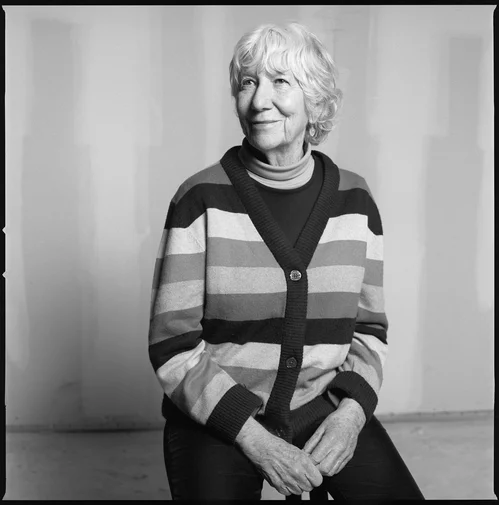
Mary Heilmann, whose insouciant, wobbly-edged abstractions upended the precision of Minimalism and Modernist geometry, died Friday at a hospital in Riverhead, New York. Her studio confirmed the cause was complications from a recent fall.
Born Mary Ann Heilmann in San Francisco on January 3, 1940, she grew up between the city and Los Angeles in an Irish Catholic family. Her father, a civil engineer, died when she was 13; her mother, a nurse, once warned that a life as an artist would mean she’d “starve in a garret.” “In my mind, I thought, ’Yes!’” Heilmann recalled in an interview with Bomb magazine in 1999. “That’s exactly what I wanted.” She studied English literature at UC Santa Barbara, where she met the ceramicist Ron Nagle and took her first pottery classes, later pursuing ceramics and sculpture at San Francisco State University and at Berkeley under Peter Voulkos. After earning her master’s degree, she moved to New York in 1968, falling in with a downtown circle at the renowned Max’s Kansas City nightclub that included Robert Smithson, Carl Andre, Dan Graham, and Richard Serra, a friend from high school.
Heilmann’s sculptural ambitions stalled when she was excluded from the Whitney Museum of American Art’s landmark 1969 show “Anti-Illusion: Procedures/Materials,” of whose 22 artists only two were women (Dia Art Foundation would showcase Heilmann’s sculptures in the context of better-known male peers with an influential 2017 exhibition). She turned to painting instead, calling it, in her 1999 memoir The All Night Movie, “a rebellious move” into “the much-maligned practice.”
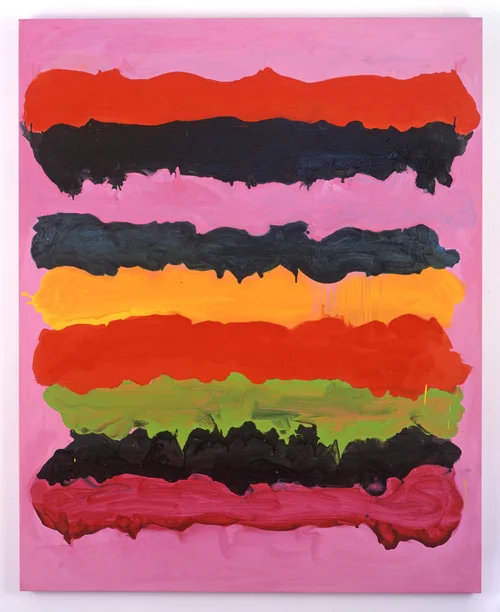
Her early paintings, including Little 9 x 9 (1973), made by wiping away pigment with her fingers, reworked the rectilinear grids of artists like Piet Mondrian and Sol LeWitt with off-kilter lines and dripping, high-key color. In 1978, after the deaths of the art dealer Norman E. Fisher and the artist Gordon Matta-Clark, she painted The End, a yellow rectangle marred by splashes of blood-red, calling it “a requiem” for those she had loved and lost. The following year, she painted Save the Last Dance for Me, an image of shrinking pink rectangles on black, a work she would consider the breakthrough that established her mature style. By the early 1980s, she felt shut out of the downtown scene: “My clothes were out of style. I’d lost my timing.” The spare paintings that followed, including Rosebud (1983) and Sea Wall (1986), are now considered among her finest.
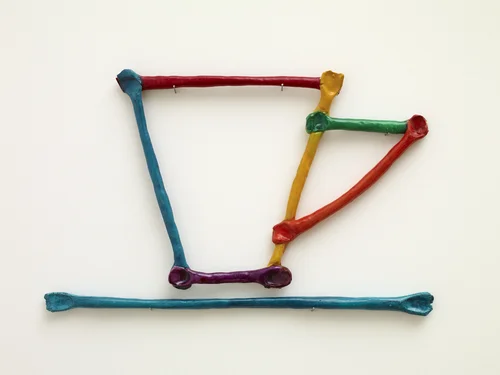
Gallerist Pat Hearn gave Heilmann the first of seven solo shows at her New York gallery beginning in 1986; Swiss powerhouse Hauser & Wirth began representing Heilmann in the late 1990s. Describing her process in 1987, she said, “When I make a painting, I’m like a kid stacking blocks; I push the shapes around in my mind, I count.” She also became known for boxy plywood chairs with webbed polypropylene seats, begun in 2002. Dozens of her chairs were installed on the Whitney Museum of American Art’s outdoor terrace in 2015 to help inaugurate its Meatpacking District building, and reappeared inside a decade later in “Long Line,“ a show named for a 2020 painting enlarged across the gallery’s walls.
Heilmann only received widespread recognition late in her career. Her first American museum retrospective, “Mary Heilmann: To Be Someone,” opened in 2007, when she was 67, at the Orange County Museum of Art in Newport Beach, California. The exhibition then travelled to the Contemporary Arts Museum Houston, the Wexner Center for the Arts in Columbus, Ohio, and New York’s New Museum. Later shows included the San Francisco Art Institute, Kunstmuseum Bonn, and London’s Whitechapel Gallery. “I have always worked from a sort of underdog position and got a lot of energy from that,” she told Whitehot Magazine in 2007. “So being ’top dog,’ now, is a little bit unsettling—I don’t exactly have the moves for that… but I’m gettin’ ’em!”
“The big boys just totally marginalized Mary because she was turning the whole construction of hard-edged geometry inside out,” the artist Marilyn Minter told the New York Times in 2008. Writing in Bomb magazine in 1999, Ross Bleckner said her paintings “contain a joy so contagious one smiles upon seeing them.” Heilmann herself was matter-of-fact about the sentiment running through her work: “I like to get at deep sentiments through sentimentality,” she said.
She never married and had no children; she is survived by two nieces and a nephew. Asked how she developed ideas for her paintings, she offered a characteristically unadorned answer: “I mostly just think. A lot of it is daydreaming. A lot of it is sitting.”
