


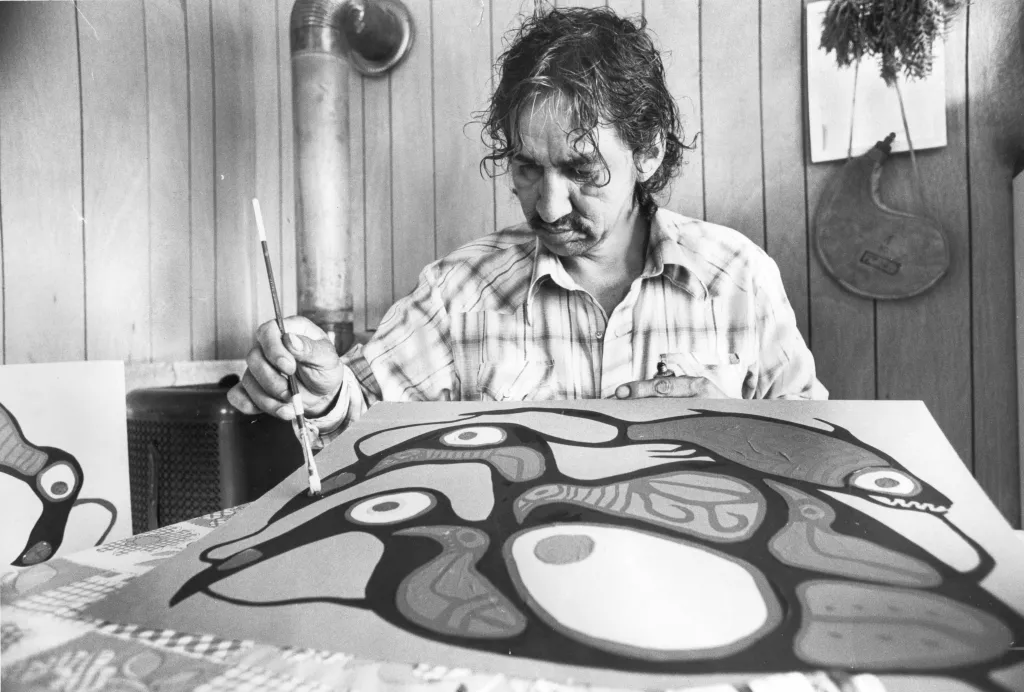
New information has been released by a little-known Canadian federal agency about its staffers’ years-long effort to contribute to a police investigation into fraudsters selling faked paintings supposedly by Indigenous Canadian artist Norval Morrisseau.
CityNews Toronto reports that the largest art fraud case in the history of Canada took at least 1,000 fakes off the market, though there may be thousands more still in private hands. The case made headlines internationally, but the contribution by the Canadian Conservation Institute, an obscure part of the Heritage Department, was previously unreported. The Institute assists some 2,700 museums, libraries, and archival organizations, and, in this case, assisted the Ontario Provincial Police, exposing fakes and ultimately testifying for the prosecution in the trial of one of the fraudsters.
Morrisseau, the unofficial founder of what became known as the Woodland School, died at 75 in 2007. His auction record was set in 2022 when the painting Animal Unity (1978) fetched $312,000 Canadian (about $227,000 at current exchange rates), more than tripling its high estimate, at Canadian auctioneer Cowley Abbott. In his late years, he realized that Toronto art gallery Maslak McLeod and others in Ontario and Alberta were selling fraudulent works under his name. He also disavowed the Morrisseau Family Foundation, formed by his children to authenticate his paintings, but later found to have approved bogus works.
The investigation that brought down the fraud rings began when Kevin Hearn, keyboardist for Canadian rock band Barenaked Ladies, bought a supposed Morrisseau from Maslak McLeod in 2005 and lent it to the Art Gallery of Ontario in 2010. Curator Gerald McMaster suspected that it was not genuine, and Hearn’s lawyer, Jonathan Sommer, soon found that the gallery had given a fictitious provenance for the work. The piece was also signed on the back, which was not the artist’s practice. Hearn sued and won a $60,000 judgment but has been unable to collect; the gallery owner died while the case was in court.
A 2019 documentary, There Are No Fakes, drew the attention of authorities by exposing the fraud ring and revealing that Morrisseau’s own family members enlisted child labor to create the paintings. In the National Post, critic Chris Knight called the story as set out in the film “as riveting as it is complicated.”
The Ontario Provincial Police investigated for more than two years. As part of the investigation, the Canadian Conservation Institute agreed to inspect four potential fakes, which arrived on its doorstep in 2021. Mylène Choquette, senior scientific documentation technologist at the Institute, viewed one of the paintings with a camera that reveals infrared spectra and, to her shock, found the letters R and LB under areas of red and light blue, revealing that the painting was created on canvases marked out by the makers in a fraudster’s equivalent of a paint-by-numbers scheme.
“I needed to just step away from the setup and just come back to see if I see it again,” Choquette told CityNews of the moment she spotted the codes. “Indeed, it was still there.”
The conservators found not only the R and LB, but also an area marked “medium green.” Conservators also detected polyvinyl acetate and styrene in a speck of paint, while Morrisseau’s confirmed works were made only with acrylic paint. When the police received the conservators’ findings, reports CityNews, they turned over another 26 contested works, which Choquette and her colleagues studied from 2021 to 2023.
Police would charge eight people in three suspected fraud rings with 40 charges, including forgery and defrauding the public of more than $5,000. They called David Voss the architect of the scheme and accused Gary Lamont of recruiting Indigenous artists, including Morrisseau’s nephew Benji and other family members. They alleged that the bad actors had created at least 1,000 fakes. Four suspects pleaded guilty, including mastermind David Voss, and Benji admitted guilt and had his case administered through a First Nations restorative justice program, while charges against two were dropped, CityNews notes.
Representatives of the Institute even testified for the prosecution at the trial of Jeff Cowan, who was found guilty of fraud and dealing in forged documents.
The Institute kept its work tightly under wraps until this month, when, convinced that learning the story would benefit all Canadians, it invited members of the press to visit its facility.
“Norval Morrisseau is one of the most important artists in Canada and his work is culturally significant to every single one of us,” senior conservation scientist Jennifer Poulin told CityNews. “And when an artist like that is picked out and abused and treated this way, it affects the entire country. And it’s really important that we’re able to try to stop this in any way that we can.”
A 2024 study by insurance company Chubb found that collectors named fraud and provenance concerns as their chief worry.
