


Nicknamed the “Little Louvre,” a hidden gem of European masterpieces in France’s Basque Country was given a new lease on life last fall.
Founded in 1891, the Musée Bonnat-Helleu in Bayonne is home to some 7,000 artworks spanning antiquity to the early 20th century, and it reopened after 14 years of renovations that doubled its exhibition space. About 10 months before the opening, the museum also got a new leader in Barthélémy Etchegoyen Glama, a 33-year-old native of the Basque Country.
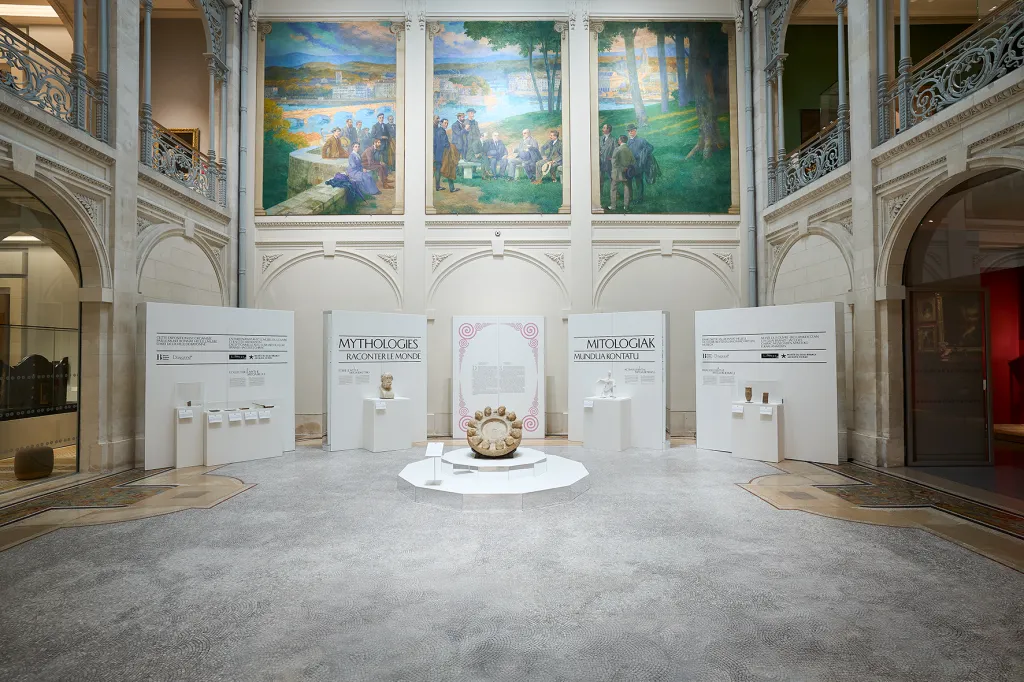
Last month, the Musée Bonnat-Helleu also presented its first temporary exhibition since its reopening, complemented by rare loans from the Louvre, its partner, and the Quai Branly museum in Paris. On view through November 9, “Mythologies: To Tell the Story of the World,” Etchegoyen Glama said, serves as “a kind of manifesto for the museum we want,” mythology being chosen for its broad scope and relevance to both locals and visitors from farther afield, with varying knowledge of art history.
Visitors are invited to travel across time and place to notice how societies around the world tended to weave similar, parallel myths. When seen together—a delightful if densely packed kaleidoscope of ancient and contemporary objects, masterpieces alongside little-known works, and even pieces by local designers and folk artists—the works on view reveal “recurring themes and figures that speak to our shared humanity,” he said.
At the exhibition’s entrance is a lamina, a part-goose, part-woman mask of Basque tradition, made by contemporary Owantshoozi studio designers. Sitting opposite it is one of the most famous busts of Homer, on loan from the Louvre. Further along is Raphael’s iconic Renaissance painting, Saint George and the Dragon (1503–05), hanging beside Syrian icon paintings of the same subject, made by Ne’meh al’Musawwir in 1666. Nearby, another beastly creature looms large: a “man-bear” known as the “Hartza”; this iteration was made in 2025 by Thomas Loyatho, for use in local carnivals as a symbol of the returning spring.
Put another way, “Mythologies” has a blockbuster-like title, attracting people who might expect a cursory exhibition on Greco-Roman and Egyptian mythology, but find an unexpected web of tales sharing common threads that, despite being spun across disparate histories and continents, continue to this day.
View of the exhibition “Mythologies: To Tell the Story of the World,” at the Musée Bonnat-Helleu in Bayonne.
Photo Alexandra Vaquero/courtesy Musée Bonnat-Helleu
This mixing of old and new from different geographical areas to think about how ideas don’t necessarily originate in just one place and to create open-ended forms of narrative has become de rigueur in the art world today. But Etchegoyen Glama said this thinking is facing growing, conservative backlash to varying degrees across Western countries, riding a wave that extends into critiques of inclusive, decolonial approaches to exhibition-making that raise social and political questions. (He would not provide examples of such criticism of his museum or its current exhibition out of professional courtesy to his museum colleagues and respect for their viewpoints.)
Globally, the most extreme example of this is, of course, the Trump administration’s repeated attacks on the Smithsonian Institution, which the president had said in a 2025 executive order had “come under the influence of a divisive, race-centered ideology.” But early forms of this trend have been simmering in Europe, too, albeit in less immediately obvious and public ways.
By way of example, Italy’s right-wing government has attempted to reshape cultural institutions with new leadership, following Prime Minister Giorgia Meloni’s complaints that the sector has been dominated by the political left. Others have also pointed to the controversial cancellation of what would have been the first major exhibition about French Caribbean artists planned for the Centre Pompidou-Metz, originally set to open in October; the museum has attributed the cancelation to financial reasons and the fault of shifting, unrealistic demands from the project’s lead curator, Claire Tancons. (The nixed exhibition will open instead at Harvard University’s Alain Locke Gallery next month.)
ARTnews spoke to four French museum insiders, who would only speak on background for fear of professional reprisals. They went so far as to point to the recent leadership change at the Louvre. Former president Laurence des Cars, whose curatorial approach has been described in the French press as “promoting social issues through art,” resigned from her post in February following last year’s theft of $102 million in jewels from the museum. Her replacement, Christophe Leribault, critics say, is a somewhat safer pick who will likely shift the museum away from the robust contemporary art program under Des Cars, and toward a more French and Western-centric vision. They cite his career being spent primarily at Paris-region museums as evidence, and Leribault told Le Monde in May he plans to reduce the Louvre’s contemporary art program.

Astrological Altar of Gabies: The Gods of Olympus and the Zodiac, Imperial Rome (Gabies), 2nd century CE.
Courtesy the Musée Bonnat-Helleu
The Bayonne museum’s “Mythologies” exhibit has enjoyed early critical acclaim in France, but its broad sweep across mediums and time runs counter to a more classical, academic method of preserving and exhibiting art for the main purpose of advancing the discipline of art history. Nevertheless, the Musée Bonnat-Helleu’s example, Etchegoyen Glama, who formerly worked as an advisor to Des Cars, said, “is a vision of the museum that is worth fighting for, because here, the public is at the center.”
In fact, he notices a growing divide between two different modes of operating that are forming in the museum world over these questions. “What’s going on in the museum field is a reflection of what is going on in society at large,” he said. “It’s true that there’s a form of reaction that is visible in all Western societies, in the US as well as in France.”
About a decade ago, things were different in France, when institutions were “embracing new ideas, new visions about a new role for the museum, and a sort of acknowledgement of the museum’s social responsibility” that championed the museum as a “social place open to a plurality of voices, whose responsibility was not just to preserve and exhibit artworks, but also to be a kind of forum,” Etchegoyen Glama said. While some in France and abroad “are still very much defending this idea, we see—and it’s only the beginning—some others going back to a previous period.”
“There’s a form of regression” across museums, agreed art historian Anne Lafont, who serves as a member of the Louvre’s scientific council and is the author of the 2019 book Art and Race: The African, (Wholly) Against the Enlightenment Eye, which examines visual representations of Black figures during the Enlightenment. While Lafont is confident that the relatively new inclusion of more women artists will continue in museums, “that is not necessarily the case for questions about the history of colonialism, imperial, and racial history within art history studies,” she said.
She pointed to French President Emmanuel Macron’s influential 2017 speech in favor of returning African heritage to the continent and to “Modèle Noir,” a 2019 exhibition at the Musée d’Orsay, then led by des Cars, that was the first to seriously explore sensitive questions around French imperialism, slavery, race, and how these issues are reflected in art objects through history. Conceived and co-curated by Denise Murrell, now curator at large at the Metropolitan Museum of Art in New York, it was a watershed for France.
“We had the feeling that a window was opening in France,” she said. “Perhaps it will be difficult to open it wider, or even to leave it open at all,” Lafont said.
Against this backdrop, the International Council of Museums (ICOM), one of the world’s largest global organizations for museum professionals, adopted a new code of ethics this past June that elaborates “how museums serve society” by “embracing different perspectives on heritage” and operating “as spaces for open dialogue, upholding human rights, practicing social justice and promoting peace.”
The French art press largely took issue with that guideline: In an editorial in Le Journal des Arts, Jean-Christophe Castelain wrote that ICOM “is not content to update professional regulations applicable to museums; it politicizes them. Social justice, the battle against discrimination, reparational practices, participation of communities, sustainability … the museum is called upon to respond to the contemporary world’s divisions.”
Anne Dressen, a curator at the Musée d’Art Moderne de Paris, has been researching these questions by surveying hundreds of museum labels and wall texts across Europe and the US. While her views differ on some points, she is on the same page as Lafont when it comes to documenting what appears to be sustained and continued inclusion of more women artists in exhibitions over the last decade.
However, instead of a conservative regression, Dressen has noticed institutions striving to adopt more innovative practices on a number of levels. “I see museums asking questions of themselves, and trying to rethink their existing terminologies, in an effort to open up to larger audiences.” One example is museums’ wall labels now mentioning tainted or dubious provenance. “If you just look back 10 to 15 years, there’s just no comparison,” she said.
Dressen does, however, notice that museum workers are faced with pressure to avoid controversy. A 2024 report by the Network of European Museum Organizations (NEMO) found that European museums face political influence around budget allocations and the resulting challenge of self-censorship in compliance with governing powers, which has had a chilling effect as more right-leaning politicians have been voted in.
View of the “Gallery of the Bodies,” at the Musée Bonnat-Helleu.
Photo Alexandra Vaquero/Courtesy Musée Bonnat-Helleu
The Musée Bonnat-Helleu’s new permanent collection hang echoes the curatorial methods of the “Mythologies” exhibition, where broad themes connect a variety of national schools. Etchegoyen Glama sees this as a means of reaching out to a “less exclusive” public unaccustomed to museums. The “Gallery of the Bodies,” which opens the hang, features artistic representations of bodies throughout time and geographies, from ancient Egypt to Greco-Roman antiquity to 17th-century Italy to 19th-century France, as well as works by Léon Bonnat, the museum’s eponymous benefactor.
Organized by themes like “The Moving Body,” “The Body after Death,” or “The Ideal Body,” the intention here is to show different perspectives across eras. Etchegoyen Glama pointed to Bonnat whose art was influenced by centuries of art history. “If you understand the relationship between an artist who was also a collector, … inspired by art that was much older than what he practiced himself, [then] you understand that the whole history of art is about connection through time and space,” he said. By placing all these works together, rather than separate galleries—divided by nation, school, and period—visitors, he said, can “enter the collection and the history of art first through their feelings and senses.”
View of the “Gallery of the Bodies” permanent collection display, at the Musée Bonnat-Helleu.
Photo Mathieu Prat/Courtesy Musée Bonnat-Helleu
