


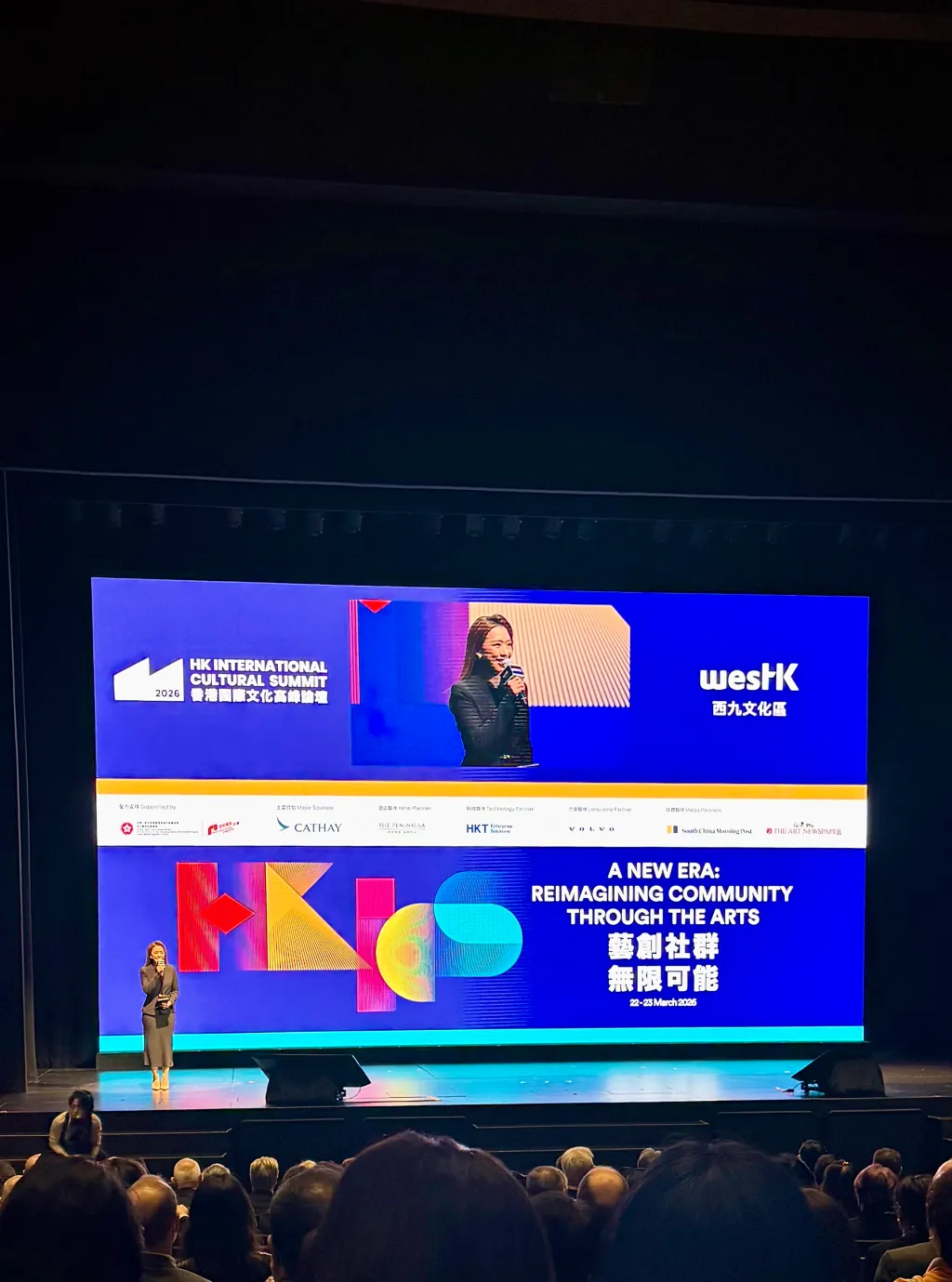
“We are witnessing growing geopolitical complexity around the world. In times like these, culture matters more than ever. Culture transcends borders,” said Hong Kong’s Secretary for Culture, Sports and Tourism, Rosanna Law, at the opening ceremony of this year’s Hong Kong International Cultural Summit on Monday.
The remark offered one of the summit’s few, curated nods to the destabilizing effects of the spiraling U.S.–Israel–Iran war on global transport and energy flows. But the implication landed cleanly: the world is reorganizing—and with it, the distribution of cultural influence. Panels and policy discussions painted a picture of a city weighing its next steps. Over decades, Hong Kong has established its role as a gateway between China and the West; now, it’s engineering a self-sufficient arts and cultural engine that serves first its residents and then its near and dear in the region.
The 2026 summit, titled A New Era: Reimagining Community Through the Arts, unfolded across the M+ museum and the Hong Kong Museum of Art. In his remarks, WKCDA Board chairman Bernard Chan said the event arrives “at a moment when the city is firmly reestablishing itself as an international cultural center,” while “ingraining” arts and culture into daily Hong Kong life. To those ends, Chaw announced that a slate of memoranda had been signed this week between Hong Kong, Mainland China, and European and regional institutions, covering professional training, performance, education, and collection sharing—from the Misk Art Institute in Saudi Arabia to the Czech Academy of Visual Arts and London’s Sadler’s Wells Theatre.
He stressed that local investment was paying off—nearly half of all museum visitors are residents—and hinted that greater change is just around the corner: the West Kowloon Performing Arts Center is set to open next year, followed by the West Kowloon Academy, a planned incubator for arts professionals. “Later this month, we will finalize the details of our collaboration with Art Basel for the next five years,” he added, highlighting the sustained ambition required to bring the partnership to fruition.
Ferried from harbor to harbor, the glowing city ribbon of Hong Kong unfurls ahead; it teems with thousands of visitors for its stalwart art month, milling from museum to museum—the unenlightened might assume the city’s work is done. But as Adrian Ellis, chair of the Global Cultural Districts Network, reminded one panel, only the savviest institutions survive “what comes after success.”
Ellis was one of 30 speakers from 14 countries who offered guidance, drawing on their own experience, to Hong Kong’s cultural leaders on the ongoing challenges of funding and engagement—perennial concerns for any arts and cultural venue, now compounded by 21st-century shifts in patronage. Elaine Bedell, chief executive of London’s Southbank Centre, which marks its 75th anniversary, said on the same panel as Ellis that she and her team are “increasingly” having to “justify” the funding they receive from the UK government. “In the past… it was given that public money would come, and it is no longer a given,” she said.
They spoke on the panel, Multi-Disciplinary Arts Districts in the 21st Century—Challenges and Opportunities. As the name suggests, cultural districts have emerged as one solution to the modern challenge of maintaining public interest in the arts. Hong Kong’s West Kowloon now joins these ranks.
Bedell and Ellis were joined by Mariët Westermann, director and CEO of the Solomon R. Guggenheim Museum and Foundation—a pioneer of the museum-brand model—and Douglas Gautier, CEO of the Royal Arts Complex in Saudi Arabia, a quintessentially Gulf project in terms of the scale and speed with which it is being conceived and built. Westermann, as steward of the Guggenheim’s multi-continental enterprise, spoke of the Bilbao Effect: the oft-pursued, never quite replicated success story of their first branch, Guggenheim Bilbao. Since opening in 1997, Guggenheim Bilbao has contributed hundreds of thousands of euros to the Basque region’s GDP.
“Cultural districts can be tremendous drivers of economic and social development, and thereby engines of human flourishing,” Westermann said. She added that locals make up 40% of the Guggenheim’s museum visitors, which informed her advice: stop chasing the “Bilbao Effect” and instead aspire to what she called “Bilbao 2.0”—a strategy prioritizing the development of a site-specific museum. “There are no cultural districts that flourish by hand alone. They cannot exist without distinctive institutions within them, and art museums are key to that for a reason,” she said.
Bedell, with her characteristic calm, stressed that Hong Kong—like any aspiring cultural district—shouldn’t be overly reliant on government funding. Costs creep up where you least expect them: maintaining roads, sewage, utilities, and public open spaces—technical matters most museum-studies programs probably skip over.
Ellis, who consults on these matters at the highest levels, essentially told the world’s most powerful cultural professionals to get more creative. If patrons have flipped the script—What does my patronage buy me?—he suggested finding unconventional revenue: adjacent parking lots, art hotels, consulting, franchising, in short. Though, this thought process doesn’t come naturally to the museum-minded, he acknowledged.
“It’s great that museums are generally quite conservative in their government structures,” he said. “But I do think that if I were looking ahead 20 years or so, I would be increasingly bold in my thinking about earned income, simply because of inevitable trends.”
