


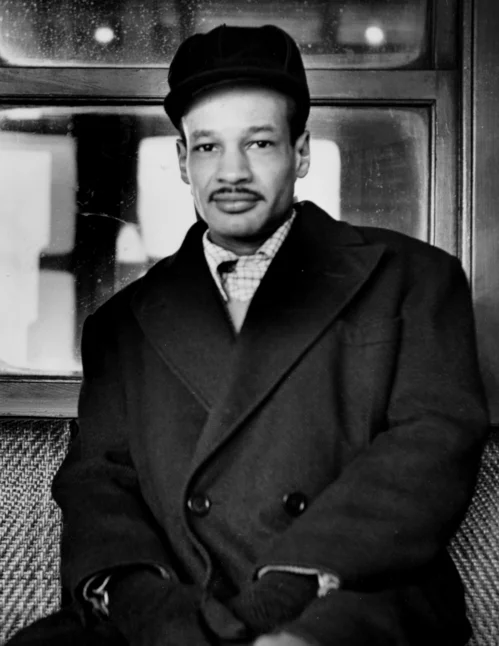
He was a member of the Spiral Group, the pioneering collective of African American artists in the 1960s, and an artistic peer to Romare Bearden and Emma Amos. Georgia O’Keeffe so admired his talents that she hired him as a personal conservator to her paintings.
But, today, artist Felrath Hines, who died in 1993, is largely unknown—even in the art world.
“Hines was strongly devoted to abstraction and pursued it with a very independent and persistent attitude,” said Andrew Schoelkopf, the owner and founder of New York’s Schoelkopf Gallery. Right now, the gallery is presenting an intimate showcase of Hines’s works, on view through August 21st.
The exhibition includes five key paintings by the artist from the 1950s and ’60s, decades when he produced evocative abstractions painted in bold but sensuous brushstrokes. The exhibition is part of the gallery’s ongoing effort to shine new light on Hines’s career, and builds on a 2022 solo presentation of his work at ADAA: The Art Show in New York.
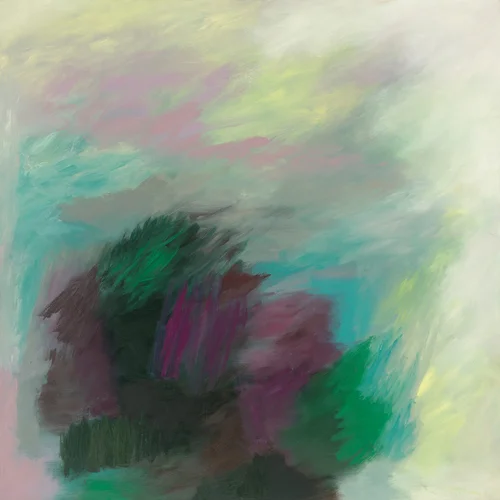
The jewel of this exhibition is The Bush from 1962, a gestural abstraction painted in foggy passages of greens, purples, and grays, like a landscape seen in the distance of a misty shore. The work is emblematic of Hines’s best paintings of the 1960s. “You can see how his brushwork is the work of an adept painter. It’s rich and layered, which creates a certain luminosity in the surface. I also find his sense of color to be tremendously skillful and alluring,” said Schoelkopf.
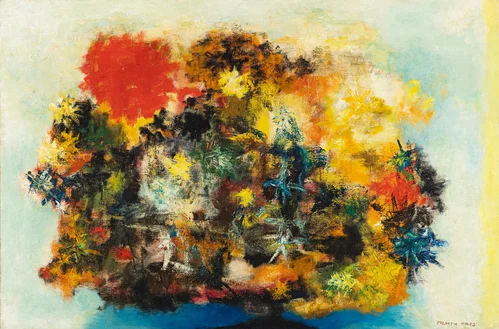
Bouquet, 1957
Felrath Hines
Schoelkopf Gallery
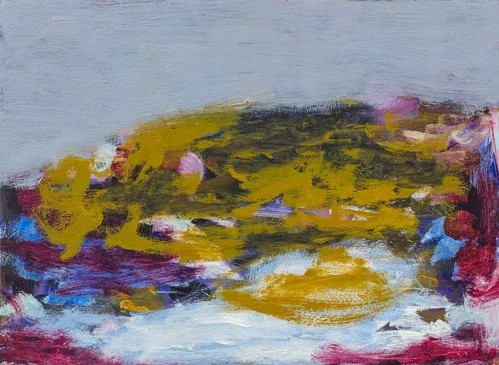
Landscape, 1953
Felrath Hines
Schoelkopf Gallery
The gallery first became interested in Hines’s works while researching the Spiral Group, a collective of African American artists who explored the role of art in relation to society and the Civil Rights Movement. “As a member of the Spiral Group, he was a prominent figure in the New York City art world and the Black creative scene of the time,” added Schoelkopf. Still, unlike other Black artists of the era, such as Bearden or Jacob Lawrence, Hines’s story has remained largely untold.
Born Samuel Felrath Hines Jr. in Indianapolis in 1913, the artist had his first forays into art as a teenager, after receiving a scholarship for classes at the John Herron School of Art Saturday School. Following high school, he worked as a firefighter, and as a railway waiter, earning money to support classes at the School of the Art Institute of Chicago. By 1946, he had moved to New York where he studied with the Russian-born American painter Nahum Tschacbasov, while also taking classes at New York University and Pratt.
By 1951, Hines had started working at a frame shop in the city. His skill as a painter and his knowledge of framing eventually led him into a career as a conservator at New York’s Fine Arts Conservation Laboratories.
His career as a conservator and his practice as an artist were side by side for most of his life. Over the years, he took major positions at the Museum of Modern Art, the Hirshhorn Museum and Sculpture Garden, and the Smithsonian’s National Portrait Gallery. Early in his conservator career, he helped conserve one of Claude Monet’s “Water Lilies” paintings for MoMA, an experience that informed his own luminous palette and layered approach to abstraction (the influence is evident in a work like The Bush). Later, Georgia O’Keeffe would bring on Hines to lead the conservation of her personal collection, as well as the care of her works in private and museum collections during the 1970s.
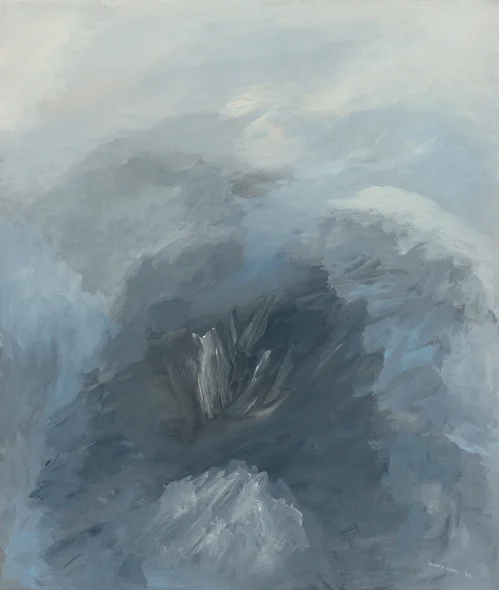
Sea Shell, 1962
Felrath Hines
Schoelkopf Gallery
Sea Shell, 1962
Felrath Hines
Schoelkopf Gallery
Hines’s painting style continued to evolve. His gestural abstractions, now on view at Schoelkopf Gallery, later gave way to geometric abstractions influenced by De Stijl and Piet Mondrian. While Hines was an active participant in the Spiral Group, he always maintained a very individualized artistic vision.
“Despite his predilection for looking at art in exhibits and galleries, he never painted with other artists,” wrote historian Rachel Berenson Perry in her defining monograph of the artist, The Life and Art of Felrath Hines: From Dark to Light.
The artist wasn’t one to seek the limelight, either. “He was a regular social presence in the New York art world, especially in Black creative circles, but he didn’t like to draw attention to himself,” said Schoelkopf.
Throughout his career, Hines also resisted being classified primarily as a Black artist and believed his work, and abstraction, were universal languages in their expression and reach. As such, he turned down invitations to exhibit in shows focused on the work of Black artists alone, including the major exhibition “Contemporary Black Artists in America” at the Whitney Museum of American Art in 1971. These decisions may have contributed to his relative obscurity.
His career as a conservator, at times, detracted from his art practice, too. “He was very dedicated to his work, but he went through long periods of time where his ‘day job’ as a conservator prevented him from spending any time working on his personal creative practice,” said Schoelkopf. A 1979 article described Hines as having “two careers: executing his own art and repairing the art of others.”
In 1984, he retired as the chief conservator of the Hirshhorn Museum and Sculpture Garden, and devoted the last years of his life entirely to painting, creating some of the most significant works of geometric abstraction in his career. He continued to believe in the power of art, despite never reaching widespread fame. In 1983, he said in an interview, “In my view, an artist’s work is to rearrange everyday phenomena so as to enlarge our perception of who we are and what goes on about us.”
Today, Hines’s reputation is steadily growing (Schoelkopf Gallery has placed his works with institutions including the Cincinnati Art Museum). Schoelkopf says that with Hines one can’t help but notice “how razor-thin the margin is between the type of success Georgia O’Keeffe had” and that of “an artist as well educated, well trained, intelligent, and important as Felrath Hines.” The art world, he thinks, may soon be catching up.
