

Close Menu
  • News
  • Stocks
  • Bonds
  • Commodities
  • Collectables
    • Art
    • Classic Cars
    • Whiskey
    • Wine
  • Trading
  • Alternative Investment
  • Markets
  • More
    • Economy
    • Money
    • Business
    • Personal Finance
    • Investing
    • Financial Planning
    • ETFs
    • Equities
    • Funds

Subscribe to Updates

Get the latest markets and assets news and updates directly to your inbox.

Trending Now

Falling Finances Follows Trump’s Takeover of the Kennedy Center: Report

August 26, 2026

Bolivia’s most visited museum kicks off five-year restoration project – The Art Newspaper

August 26, 2026

Gold Base: The Sudbury Basin in Canada

August 26, 2026
Facebook X (Twitter) Instagram
The Asset ObserverThe Asset Observer
Newsletter
LIVE MARKET DATA
  • News
  • Stocks
  • Bonds
  • Commodities
  • Collectables
    • Art
    • Classic Cars
    • Whiskey
    • Wine
  • Trading
  • Alternative Investment
  • Markets
  • More
    • Economy
    • Money
    • Business
    • Personal Finance
    • Investing
    • Financial Planning
    • ETFs
    • Equities
    • Funds
The Asset ObserverThe Asset Observer
Home»Art Market
Art Market

Bolivia’s most visited museum kicks off five-year restoration project – The Art Newspaper

News RoomBy News RoomAugust 26, 2026
Share
Facebook Twitter LinkedIn Pinterest Email

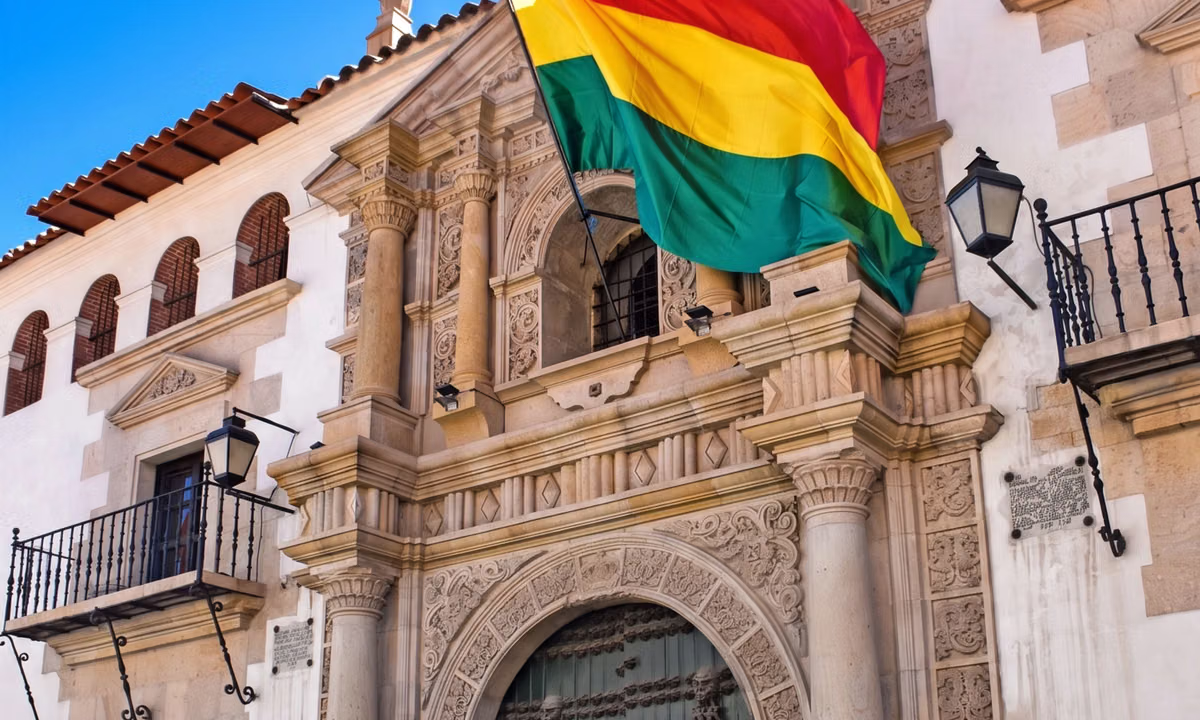
The Casa Nacional de Moneda (National Mint) in Potosí, Bolivia, will begin a major restoration project next month. The Baroque-style building is today Bolivia’s most visited museum, renowned for its wooden coin-rolling machinery and numismatic and colonial religious art collections. Built between 1759 and 1773 following a design by the architect Salvador de Villa, it functioned as a mint both under Spanish colonial rule and after Bolivian independence.

“This building is a jewel of 18th-century industrial architecture,” Daniel Oropeza, the director of the Casa Nacional de Moneda, tells The Art Newspaper. “The mint is practically a fortress, built of stone, wood, iron and tiles. It’s the cultural heart of Bolivia.”

Restoration will begin with the building’s leaking roofs and continue with its stonework. “Around 60% of the roofs are in critical condition due to a lack of maintenance over the past ten years,” Oropeza says. The building’s first restoration began in 1940 and continued until 1973.

Located in the centre of the city, the mint takes up two whole blocks. The Cultural Foundation of the Central Bank of Bolivia manages its 15,000-sq.-m of built space; most of the complex’s walls are more than a metre thick. The current building replaced the first mint, founded by Viceroy of Peru Francisco de Toledo in 1572.

The Casa Nacional de Moneda, a complex spanning two city blocks, has roofs are in dire need of repair Courtesy the Casa Nacional de Moneda

Potosí was once one of the richest cities in the world and, with 160,000 inhabitants in 1625, also one of the most populous. Located at 4,000m above sea level in the foothills of Cerro Rico—an Andean mountain that housed the largest silver mines during the colonial era—Potosí became the financial engine of the Spanish Empire.

The mines of Cerro Rico were discovered in 1545 and supplied the world with silver of exceptional purity. The Spanish silver dollar (real de a ocho) travelled as far as China and India, fuelling trade and becoming the world’s first reserve currency, a status it maintained until the 19th century. Such was the city’s fame that Potosí was mentioned in Miguel de Cervantes’s novel Don Quixote. Its silver was shipped from the port of Arica, today part of Chile, to the port of El Callao in Lima. From there it travelled to Panama en route to Seville, Spain.

Indigenous people were the first to work in the Cerro Rico mines. Eventually, enslaved Africans were brought to Potosí. Many worked in the smelting furnaces that operated 24 hours a day, seven days a week in shifts that could last up to 20 hours, effectively living in the mint itself.

“The Casa Nacional de Moneda showcases various stages of history in Bolivia, such as slavery and the relationship with the Indigenous world,” says Andrés Zaratti, a former Bolivian vice minister of cultures and folklore. In 1987, Unesco declared the Imperial City of Potosí—as it was known in the 16th century—a World Heritage Site.

The restoration of the roofs of the mint will cost around $513,000, financed by the Inter-American Development Bank. The work is expected to last 150 days, during which time the museum will remain open to visitors. The goal is to restore 3,178 sq. m of roofing. The Central Bank of Bolivia will finance the remainder of the building’s restoration. The entire restoration process is expected to last five years.

Share. Facebook Twitter Pinterest LinkedIn Tumblr Email

Keep Reading

Falling Finances Follows Trump’s Takeover of the Kennedy Center: Report

Historic Sulfur Emissions Likely Damaged Murujuga Rock Art, New Study Finds

How One Painting Set This Seoul Art Collector on a Lifelong Journey

A GoFundMe Campaign Has Been Launched to Preserve Marijke De Roover’s Work

A brush with… Richard Tuttle—podcast – The Art Newspaper

New York‘s High Line announces fall 2026 commissions by Alvaro Barrington, Marianna Simnett, and more.

National Museum of Ireland Employee Charged with Possession of Military-Grade Explosive, Artist Gao Zhen Receives Three-Year Prison Sentence, The Venice Film Festival Defends Inclusion of Russian-born Filmmaker, and More: Morning Links for August 26, 2026

Gwangju Biennale permits Taiwan Pavilion name after row – The Art Newspaper

A £20 M. Mondrian Painting is the Highlight of Christie’s Frieze Week Evening Sale in October

Recent Posts
  • Falling Finances Follows Trump’s Takeover of the Kennedy Center: Report
  • Bolivia’s most visited museum kicks off five-year restoration project – The Art Newspaper
  • Gold Base: The Sudbury Basin in Canada
  • Historic Sulfur Emissions Likely Damaged Murujuga Rock Art, New Study Finds
  • Homeland Announces Non-Brokered Private Placement

Subscribe to Newsletter

Get the latest markets and assets news and updates directly to your inbox.

Editors Picks

Bolivia’s most visited museum kicks off five-year restoration project – The Art Newspaper

August 26, 2026

Gold Base: The Sudbury Basin in Canada

August 26, 2026

Historic Sulfur Emissions Likely Damaged Murujuga Rock Art, New Study Finds

August 26, 2026

Homeland Announces Non-Brokered Private Placement

August 26, 2026

How One Painting Set This Seoul Art Collector on a Lifelong Journey

August 26, 2026
Facebook X (Twitter) Instagram
© 2026 The Asset Observer. All Rights Reserved.
  • Privacy Policy
  • Terms
  • Press Release
  • Advertise
  • Contact

Type above and press Enter to search. Press Esc to cancel.