


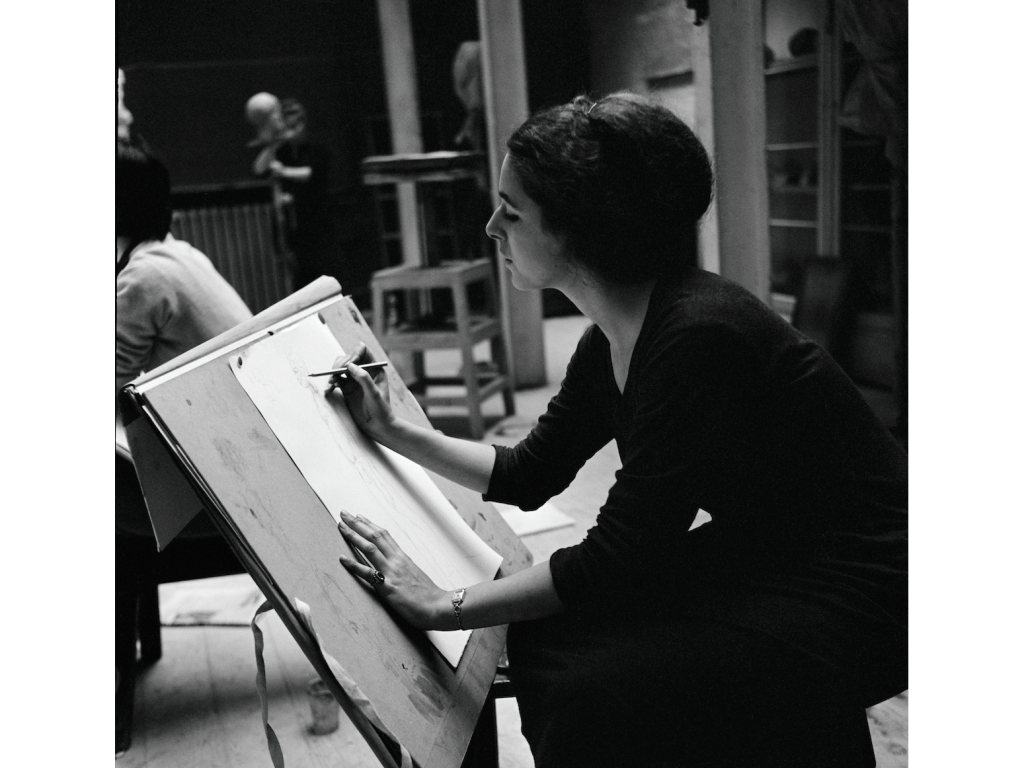
British artist, printmaker, and educator Tess Jaray, known for her hard-edge abstractions, died on May 24 at age 88. The news was first reported by the Guardian in May.
Jaray was born in 1937 in Vienna into a Jewish family with artistic connections: her father was an engineer and inventor, and her mother had studied fashion; her father’s aunt was collector and gallerist Lea Bondi Jaray, and his godfather was the noted Austrian art historian Ernst Gombrich, author of The Story of Art.
After Nazi Germany annexed Austria in 1938, Jaray fled with her parents to Britain, where they settled in rural Worcestershire. Her uncle Richard Jaray, a furniture designer and architect, was sent to the Łódź ghetto, where he and his mother were murdered. Other relatives were deported to the concentration camps Theresienstadt and Auschwitz.
Jaray studied at St Martin’s School of Art from 1954 to 1957, then enrolled at the Slade School of Fine Art, graduating in 1960. A traveling scholarship to visit Italy the same year sparked a lifelong interest in architecture, which would influence both her paintings and her public art projects.
By 1962, Jaray was making hard-edge abstract paintings that conjured architectural structures or details; delineated with masking tape and executed without visible brush strokes, they were carefully plotted out through multiple preliminary drawings, and in later years, on a computer. Taking flatness even further, Jaray’s works from the 2000s—such as her “Thorn” series (2014)—featured supports of metal painted with acrylic, into which she cut designs with a laser.
In the 1980s, Jaray began to accept public commissions, including a floor at Victoria Station in London (1985), a brick precinct for Wakefield Cathedral (1989–1992), and the stone floor of St. Mary’s Church in Nottingham (2014). On the strength of these and other projects, she was made an honorary fellow of the Royal Institute of British Architects in 1995.
Between 1968 and 1999, Jaray ran the postgraduate course at Slade, where her pupils included Turner Prize–winning British artist Martin Creed, among many others. In 2010 she was elected a Royal Academician; In 2017 she was awarded an honorary professorship by Norwich University of the Arts.
Jaray’s work is in the collections of the Fogg Art Museum, Harvard University, Cambridge, Massachusetts; the British Museum, Tate, and the Victoria and Albert Museum, all in London; the Centre Pompidou, Paris; the Belvedere Museum and mumok, both in Vienna; and the Western Australia Art Gallery, Perth, among other institutions.
Jaray married painter Marc Vaux in 1960; they divorced in 1982. She is survived by their daughters, Anna and Georgia, and by four grandchildren.
