


In a powerful show of faith in the UK’s art market, the British billionaire Joe Lewis will sell a tranche of his substantial art collection in a standalone sale at Sotheby’s in London this June. Estimated to make between £150m and £200m, it is the most valuable single-owner collection ever to be sold in the UK, an accolade currently held by the Pauline Karpidas collection which totalled £101m (with fees) at Sotheby’s last September.
The sale follows the £35.8m (with fees) sale of four works from the Lewis collection at Sotheby’s in March. That selection focused solely on School of London artists—Francis Bacon, Lucian Freud and Leon Kossoff—which, according to Sotheby’s Europe chairman Oliver Barker, is “inseparable from the core DNA of Joe’s collection.”
The Lewises clearly used that sale as a market test, and the June sale represents “a much broader aperture”, Barker says, “a global checklist of the Titans of the last 150 years: Freud, Modigliani, Klimt, Schiele, Caillebotte, Soutine, Picasso, Bacon”. It is, Barker says, “unequivocally the best thing that we’ve ever offered in London, both in terms of estimate, but equally in terms of creativity and impact as well.”
Gustav Klimt’s Bildnis Gertrud Loew (Gertha Felsőványi)
Courtesy Sotheby’s
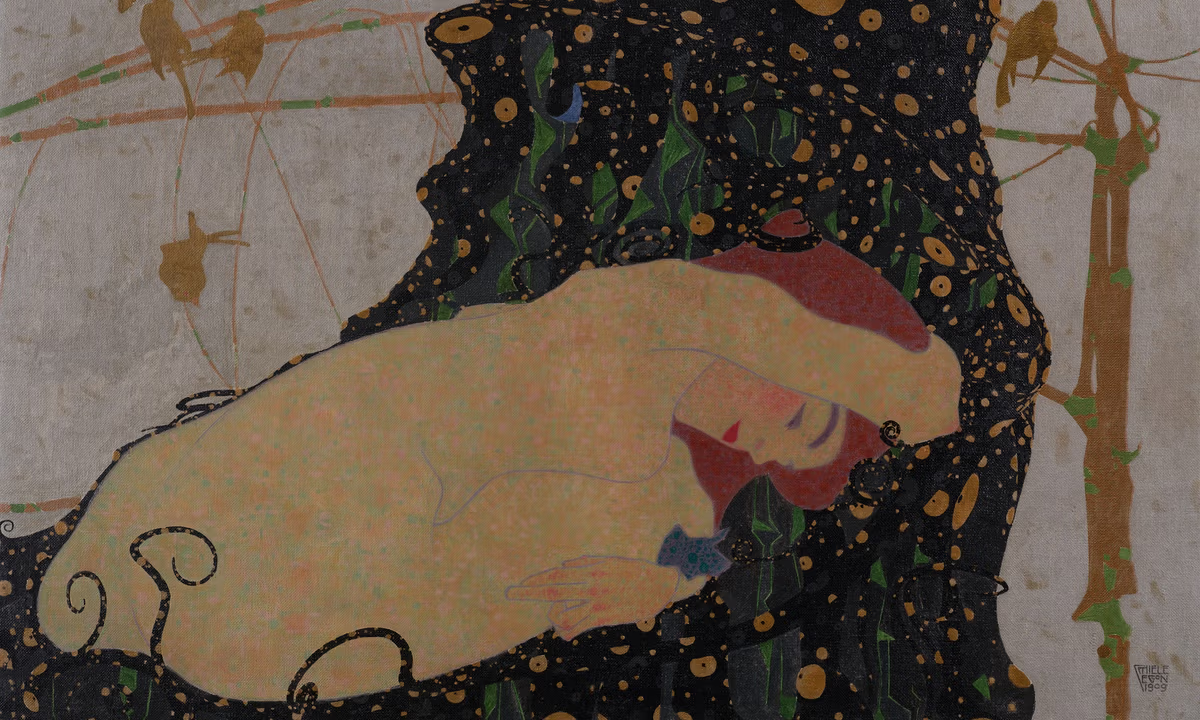
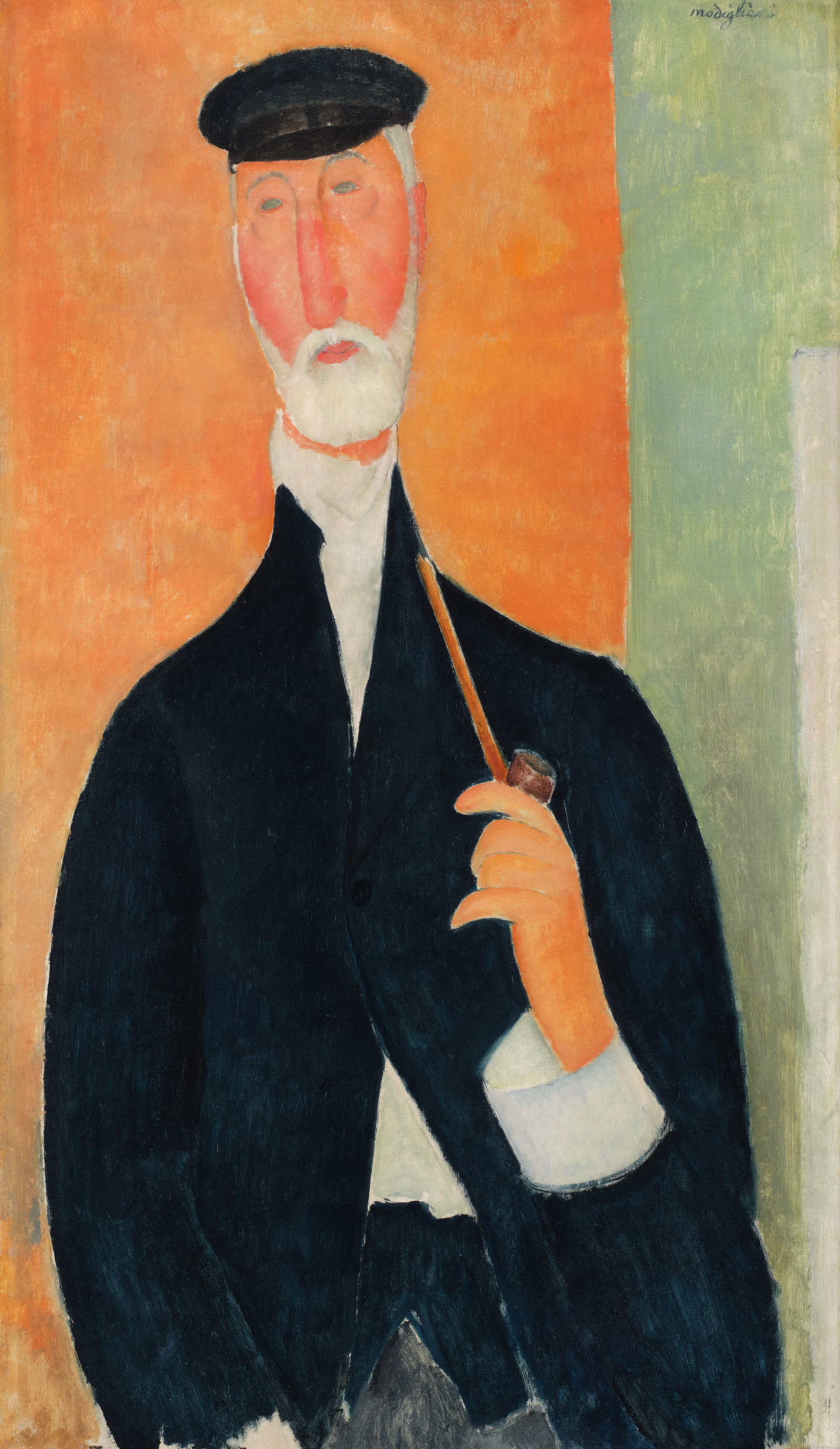
The highlights revealed today include Gustav Klimt’s 1902 society portrait Bildnis Gertrud Loew (est £20–£30m), Amedeo Modigliani’s Homme à la pipe (Le notaire de Nice,est. £12-18m), Francis Bacon’s Two Studies for Self-Portrait (1977, est. £8m-£12m), a 1936 drawing of Dora Maar by Pablo Picasso (est. £600,000-£800,000), Chaïm Soutine’s Portrait de garçon en bleu (around 1928, est. £1.8m-£2.5m) and Lucian Freud’s Woman in a Grey Sweater (1987-88, est. £3m-£4m). Danaë by Egon Schiele, painted in 1909 when he was just 19, is offered for the first time since it was withdrawn from a Sotheby’s New York sale in May 2017. It was offered then for $30m to $40m and returns now with a considerably lower estimate of £12m to £18m (around $16.1m to $24.2m).
A selection will be on view for the first time at Sotheby’s New York this Saturday, 2 May, and more will be announced before the London sale in later June (exact date to be confirmed).
Lewis and his daughter Vivienne have accumulated the collection over many decades, but mostly between the early 1990s and around 2015. A family spokesperson says the March results were an affirmation of “the enduring power of figurative painting.” They add that the Lewises have “reshaped and refocused the collection” over many years, so “while this public sale represents a significant staging post, our journey as collectors is far from over—we remain committed to the avant-garde painters of today, much of whose work is informed by the artists showcased here”.
Gustave Caillebotte’s Portrait de Paul Hugot
Courtesy Sotheby’s
Barker describes Lewis as “an incredibly savvy and sophisticated collector” and thinks his name is “aspirational” for younger collectors. He stresses: “This is by no means the closing of the chapter, the Lewis collection is still very actively buying, mostly through Joe’s daughter, Vivienne, who is incredibly engaged in the global art market. [The sale] says a lot about a generational shift of interest and taste in the family as well.”
The decision to sell the collection in London is no accident. For the past decade since Brexit, the London auction market has been perceived—sometimes justifiably, sometimes not—to be in decline, lagging behind New York and the ascendant stars of Paris and Hong Kong. The end of season summer auctions in London have had a particularly tough time: in 2024 Christie’s chose to eschew June Modern and contemporary auctions in the city altogether. But, as Barker points out, it is still the second biggest art market globally, behind New York, and Lewis’s decision to sell in London is a calculated vote of confidence. “I love the fact that we’re going to be handling these in London, the city of Joe’s birth. It also vindicates the strategy of sticking to a major summer sales season in London.”
Barker sees Lewis’s move as “an injection of trust” in London, perhaps an act of rebellion. “Joe has always been a rule breaker. He’s always been somebody who likes to question the proven mechanism of things.” With several enormous collections coming up for sale in New York next month—S.I. Newhouse’s $450m collection among them—there was also the risk that Lewis’s collection would, perhaps implausibly when seen in a UK context, become just another £100m-plus collection.
Barker is well aware of that fact, particularly in a “congested” art market calendar, and says the decision to sell in London was strategic: “[Lewis] is incredibly savvy, and he looked very closely at the Karpidas sale last year and the results in March”. He continues: “For too long, the narrative has been that London is down and out. I think [the Lewis collection] is the firm proof that, actually, it is superlative. Absolutely, we could have sold this in New York, but I don’t think it would have the traction we can give it in London.”
Amedeo Modigliani’s Homme à la pipe (Le notaire de Nice)
Courtesy Sotheby’s
Lewis, 89, a long-time Bahamas resident currently estimated to be worth around $7bn by Forbes, made his fortune in currency trading during the 1980s and 90s, and now presides over the investment firm Tavistock Group which owns over 200 companies. In 2025 he was pardoned by US President Donald Trump after pleading guilty to insider trading in 2024, which resulted in a $5m fine. In the 1990s, Lewis became the largest single shareholder at Christie’s, before reportedly selling his stake to Francois Pinault in 1998 for £200m, roughly doubling his initial investment. In 2016, the Guardian reported that the Panama Papers revealed that Lewis had quietly bought the fabled collection of Victor and Sally Ganz privately before its public auction at Christie’s, under the Ganz name, in 1997. Lewis had agreed that any profits above the $168m he paid would be split with the auction house—effectively, an early version of a guarantee. The collection made $206m, a record for a single owner sale at the time.
“His collecting journey has definitely put him in a position of proximity to the market, which very, very few people achieve,” Barker says. “It is no accident, I suppose, that people who own the auction houses are often great collectors, whether it’s Francois Pinault or Alfred Taubman. Joe was buying art before his involvement with the auction house, but at the same time, he was always highly instinctive, and knew many of the artists as well.” He adds, “like a lot of great collectors, he was never afraid to pay, in some cases, extraordinary sums to secure the greatest works.”
One work for which Lewis paid a large sum is Klimt’s Bildnis Gertrud Loew (Gertha Felsőványi) which he bought at Sotheby’s in 2015, for £24.8m (with fees). This June, the restituted work has a conservative estimate of £20m to £30m, despite the high profile sale of Klimt’s portrait of Elisabeth Lederer (1914-16) at Sotheby’s New York in November for $236.4m.
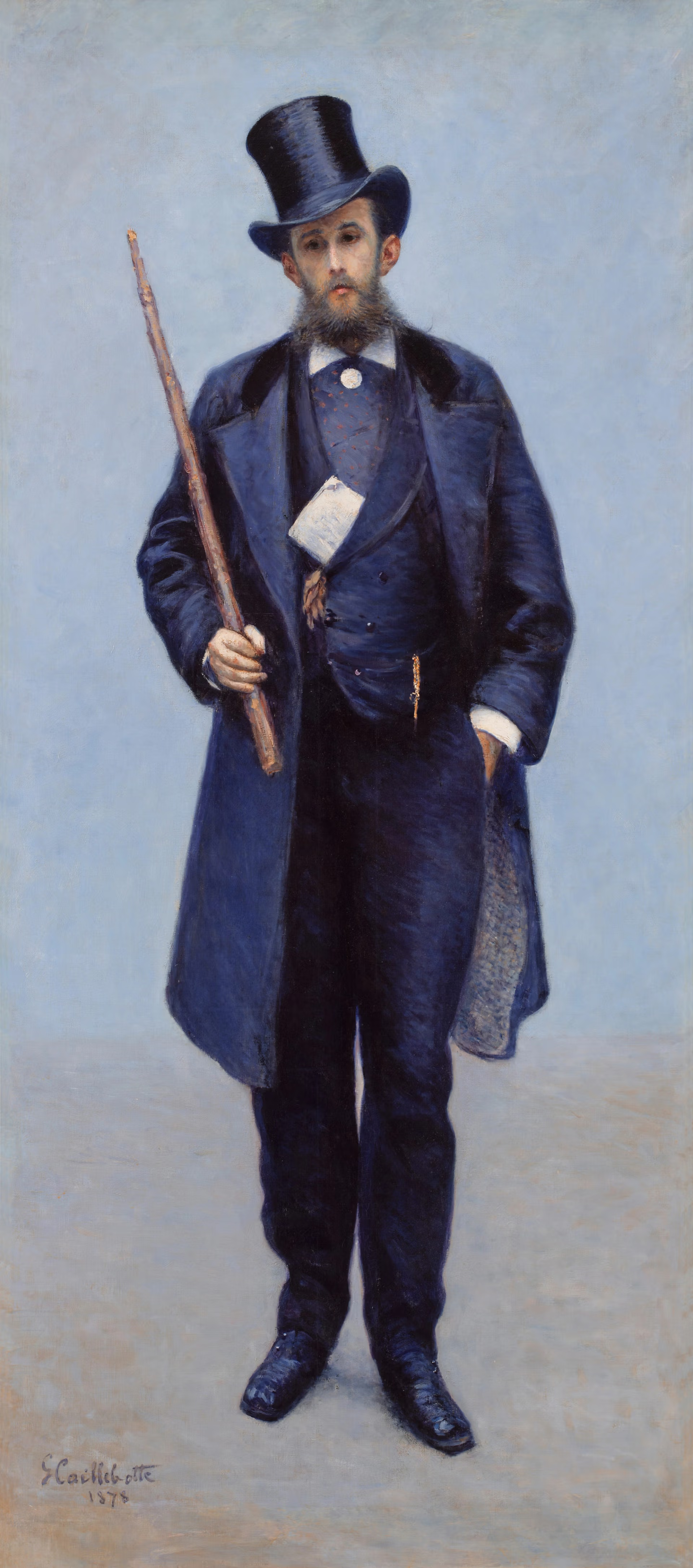
“Joe is a collector who loves to situate his art at the time of creation, he loves the stories around them” Barker says, pointing to the Modigliani, Homme à la pipe (Le notaire de Nice), painted in 1918 at the end of Modigliani’s life when he had been sent to recuperate in Nice, and started painting the locals. Meanwhile, Caillebotte’s Portrait de Paul Hugot—exhibited in the 2024 Musée d’Orsay retrospective—depicts the artist’s close friend, neighbour and patron. “I read into the Caillebotte a little bit of Joe himself—the proud businessman, parading on his on his way to work,” Barker says.
As in March, the Lewises have chosen not to take a guarantee for the collection, preferring to let the market decide against measured estimates.
