


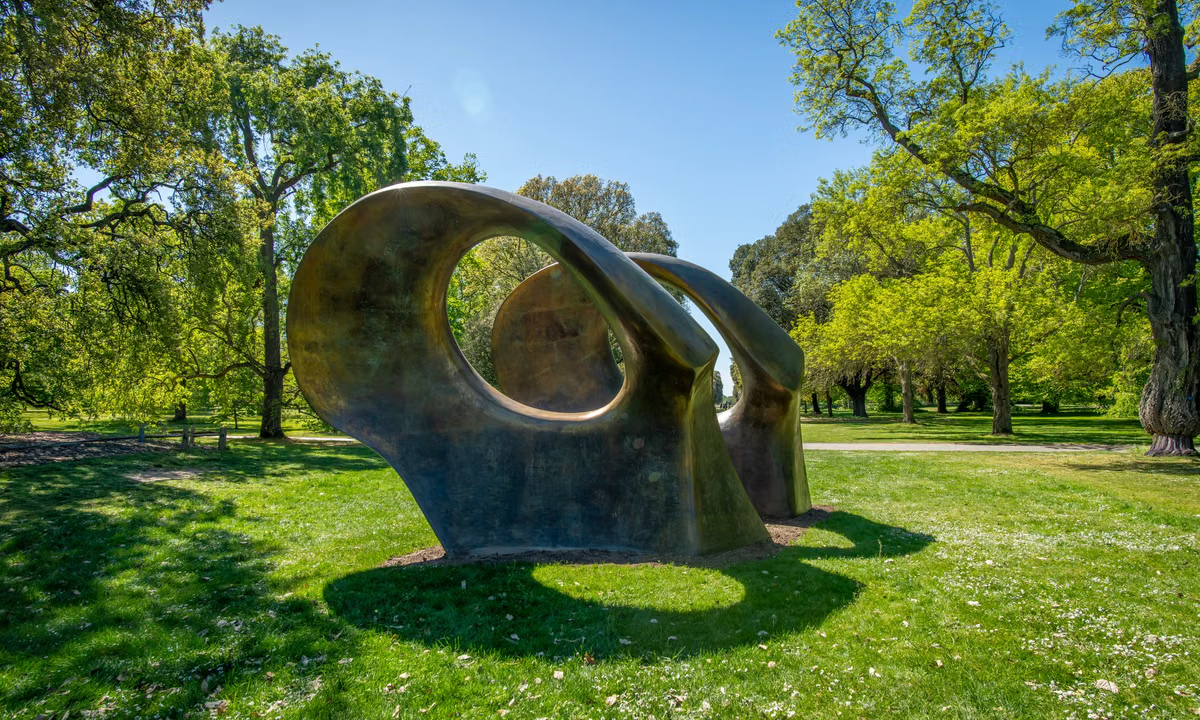
Henry Moore’s sculptures shown at Kew Gardens this year feel in their most natural setting: an English garden under English light. Henry Moore: Monumental Nature (until 31 January 2027) is one of the best arranged exhibitions of Moore you are likely to see, and the most profoundly engaging, in large part due to the natural setting of Kew, where all of nature, it seems, is gathered. Walking around the gardens is like wandering the stage of a grand drama, an epic conversation, in which the protagonists are great bronze forms and the surrounding trees and shrubs, and palm house flora.
Conversations between sculpture and nature seem endless. The dark enclosed form of Totem Head (1968) stands against the giant enclosed crown of the evergreen Atlas cedar behind, as if it has emerged from the tree. The almost-touching interior spikes of Oval with Points (1968-70) echo the open, spindly, billowing branches of the verrucosa ash against which it is set. One of the most remarkable trees at Kew (for me, at least) is the great deodar that sprawls in a strange, ungainly fashion, branches historically lopped, presumably to keep the entire structure balanced, the whole kept in place by a wire support. For the rest of this year, it is engaged in an intricate and profound conversation with the trap-like curving forms of Moore’s Hill Arches (1973), patinated a light coppery green.
Henry Moore’s Large Totem Head (1968) Photo: Ines Stuart-Davidson
The hang of Moore’s sculptures and drawings in the Shirley Sherwood Gallery gives the background to this drama. Moore’s Transformation Drawings from the 1930s turn stone and bone into living things, art as a form of reanimation. A sprawling elmwood Reclining Figure (1959-64), languishes at the centre of the gallery, alongside rare hardwood specimens from the collection at Kew, and drawings of trees at Perry Green and Forte dei Marmi. The tree drawings are the least satisfyingly Moore-like. Faced with this greatest of rivals, the sculptural quality of a tree, Moore was forced to abandon all stylistic transformation. The Reclining Figure is also hard to appreciate under gallery lighting, making you think that the real origin of Moore’s sculpture is not so much the forms of nature but the softening effect of natural light and atmosphere.
Never far away at Kew, however, is a note of unease. One of Moore’s grandest sculptures, Three Piece Sculpture: Vertebrae (1968-69), stands beside the ornamental lake in front of the great airship-like Palm House. The smooth, bronze forms, interlocking in a beguiling organic puzzle, are displayed on a low plinth, like tokens in a game played by giants. Unlike almost all other sculptures, it seems cut off from its surroundings. In sheer weight and brutality, Three Piece Sculpture: Vertebrae seems connected more with the commercial jet planes that cross overhead every 60 seconds on the flight path to Heathrow. It is a reminder that over two-thirds of Moore’s works are in North America, and it was US collectors and architects who provided the money with which such costly sculptures could be fabricated and transported.
American origins
Three Piece Sculpture: Vertebrae is one of these; the largest version cast was installed outside I.M. Pei’s monumental brutalist City Hall in Dallas, Texas, where it was renamed Dallas Piece. Just a few months earlier, Moore’s other late great work, Knife Edge Mirror Two Piece (1977), had been installed outside the National Gallery of Art in Washington, DC, also by Pei.
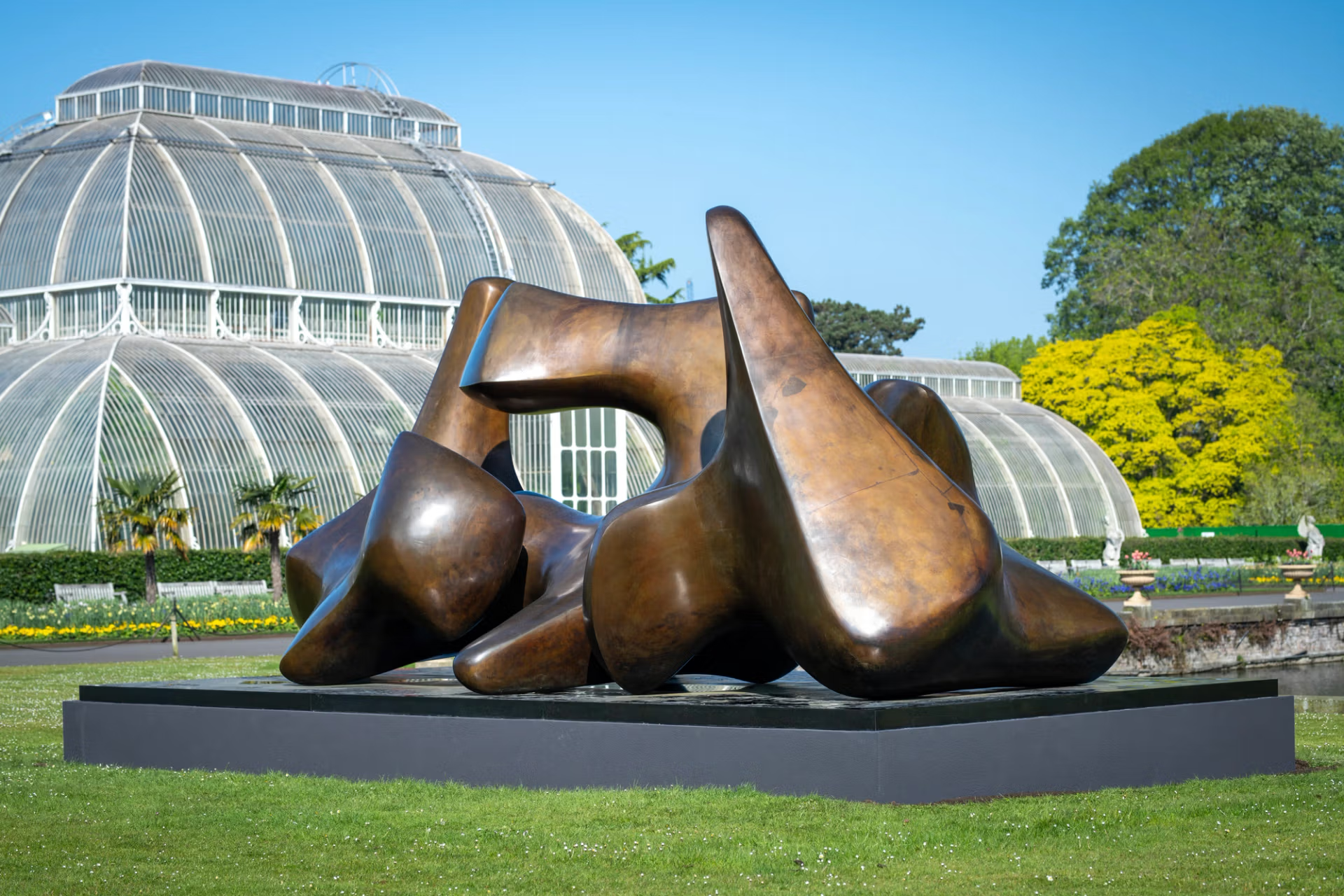
Henry Moore’s Three Piece Sculpture Vertebrae (1968-69) at Kew Photo: Ines Stuart-Davidson
These twinned sculptures are among the most important works of public sculpture anywhere. The Dallas Piece brilliantly energises the surrounding public space. Moore’s multi-directional forms feel like a battery storing civic energy, making clear the public designation of the plaza on which it stands.
And yet, as Mark Lamster recently reported in the Dallas Morning News, both Pei’s building and the sculpture on the plaza are currently under threat from the Trumpist-dominated city council, who want to raze the building and replace it with a casino and an arena. The fate of the sculpture in this case is yet unknown. Perhaps it would turn into what the writer Tom Wolfe called ‘curb flash’—Moore’s sculptures doing little else but enhancing real estate value.
The background reminder at Kew of Moore’s transatlantic career might make us rethink the idea of a simple, or direct, relationship between sculptures and the natural world. Being inspired by nature is not the same things as being ‘of’ nature. The great bronze brutalist forms, in all their mystery and the genius of their fabrication, seem more a reminder of the impossibility of returning to natural innocence. In Moore’s day it might have seemed, as he once put it, that “nature is inexhaustible”, but we now know that it is not.
• John-Paul Stonard is an author and art historian. His latest book, The Worst Exhibition in the World: Degenerate Art, 1937, was published on 5 May
• Henry Moore: Monumental Nature, Kew Gardens, London, until 31 January 2027
