


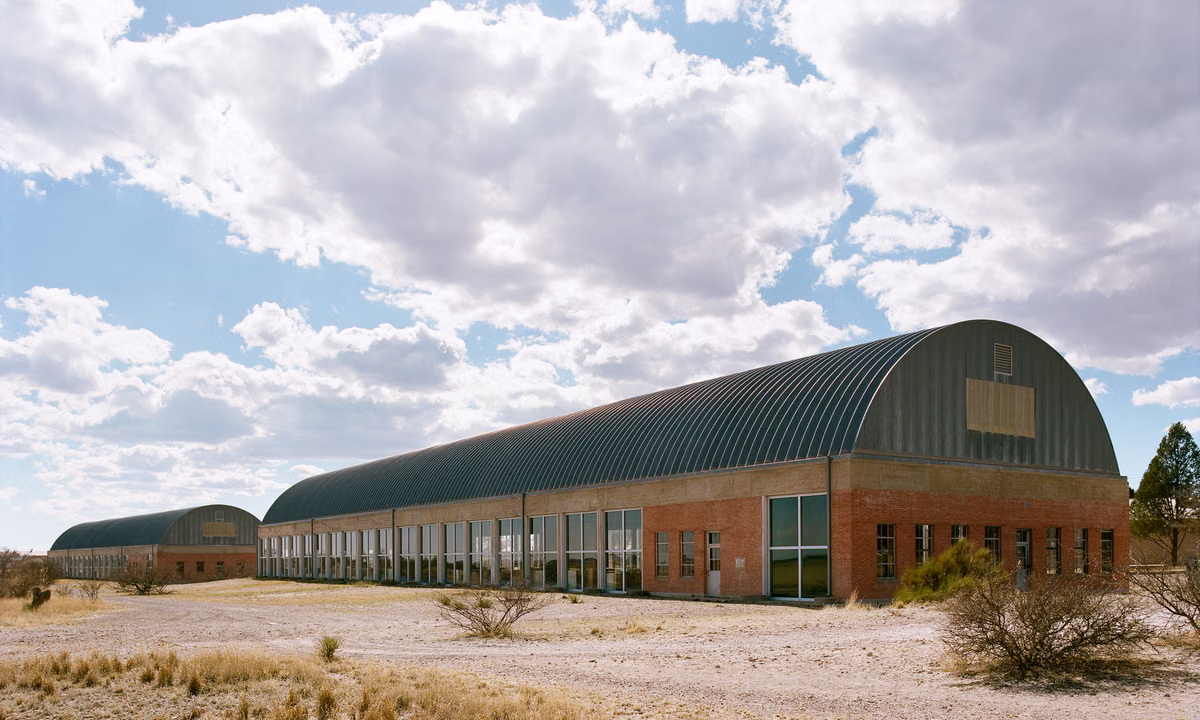
This autumn, restoration work will commence on the two former artillery sheds that house Donald Judd’s 100 untitled works in mill aluminium (1982-86) at the Chinati Foundation in Marfa, Texas. Having remained precisely where Judd sited them, each of the mill-aluminium boxes will be moved for the first time in more than 40 years, so that a team of conservators can address crucial infrastructure concerns in the buildings. The restoration project comes on the heels of the Artillery Sheds’ recognition last year on the National Register of Historic Places as part of the Donald Judd Historic District.
Judd acquired the sheds in the late 1970s, purchasing the majority of Fort D.A. Russell—a compound built in 1939 by the US Army Corps of Engineers—with the vision of creating a museum of permanent, site-specific installations.
“The art and architecture of the past that we know is that which remains,” Judd wrote in a 1987 statement about his concept for Chinati. “The best is that which remains where it was painted, placed or built.” With this long view of history, he believed that “somewhere a portion of contemporary art has to exist as an example of what the art and its context were meant to be”.
This precisely has been Chinati’s mission. Its sprawling campus of 340 acres on the northeastern edge of the Chihuahuan Desert boasts 34 buildings with permanent installations by artists including Dan Flavin, Roni Horn, Carl Andre and Robert Irwin. In addition, a large building in the centre of town is dedicated to John Chamberlain; it was the first of Chinati’s buildings to undergo restoration in 2022 and thus serves, in the words of executive director Caitlin Murray, as a “really good example of how to do this well”.
Donald Judd inspects the recently installed pre-fabricated metal panel roof on the South Artillery Shed, 1984 Courtesy the Chinati Foundation Archives
Beset by a changing climate, with increasingly intense rainstorms and rising temperatures, Chinati has assembled a team of experts to devise an altogether invisible strategy for mitigating wear to the Artillery Sheds and safeguarding them for years to come. The team includes Schaum Architects; Alfred Lippincott, who partnered with Judd on the original fabrication and placement of the works in the 1980s; and the Getty Conservation Institute; alongside engineers, climate specialists, conservators and landscape designers.
Despite Judd’s extensive writing on art, architecture and the stakes of museological display, “he didn’t provide a direct mandate about care”, Murray tells The Art Newspaper. “Our overall goal for the team is to preserve the experience of the work as Judd intended, and to make sure we’re creating opportunities for visitors to experience Judd’s work on their own terms with as little distraction as possible.”
Climate-control systems that other museums might readily install are thus out of the question for Chinati. Such interventions, though ideal for ensuring long-term preservation, would fundamentally contradict Judd’s intention for the spaces.
The multi-year project will instead include the installation of energy-efficient glass and passive air-circulation systems to reduce temperatures, the implementation of rainwater harvesting systems to facilitate drainage and sustain newly planted native grasses, the creation of improved pathways for greater accessibility, and repairs to the roofs, gutters and façades.
“It’s not just the building or the artworks,” Murray says, speaking of Judd’s ethos, “but the integration of the art, architecture and landscape. That goes for all the works in Chinati’s collection.”
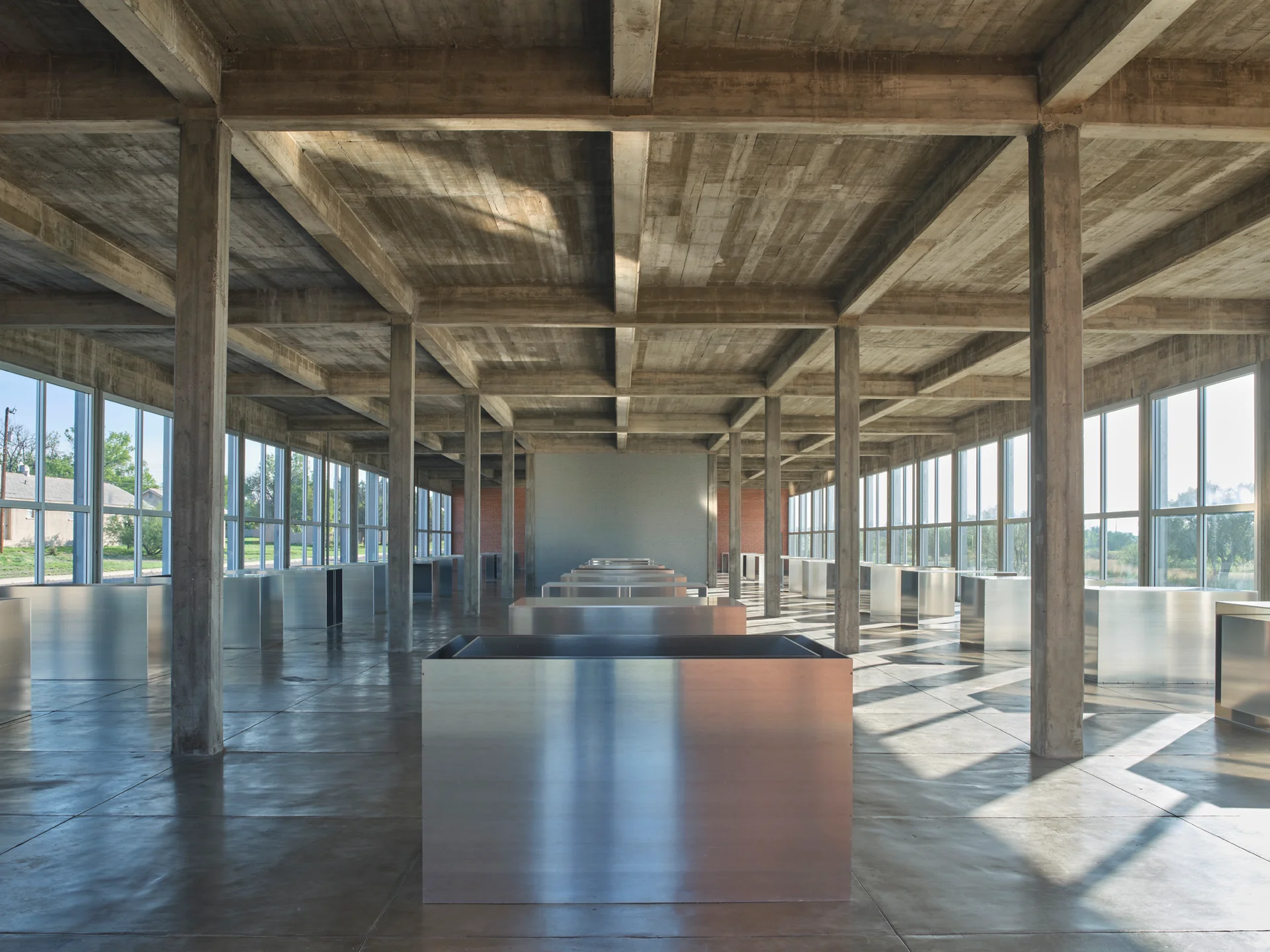
Donald Judd’s 100 untitled works in mill aluminium (1982–86) Photo: Alex Marks, courtesy the Chinati Foundation. Donald Judd art: © 2026 Judd Foundation / Artists Rights Society (ARS), New York
“One of the things that’s unique about this work,” Murray continues, “is that because we don’t have mechanical systems, there’s a quietness. We think about the incredible visual nature of these works but, as we experience these spaces, there’s something sensorially that’s bigger than the visual.”
To preserve this experience as much as possible, the restoration team devised a passive-air system. Schaum Architects explains in a report that this includes “using the existing opening and breaks caused by concrete expansion joints so that minimal filtered fresh air will circulate in the space”. The approach, which reflects a changing tide in conservation practice internationally, focuses on “moderating extremes rather than chasing a static, museum-standard environment”.
The restoration team has additionally adopted an approach comparable to Judd’s own working methods to refit the Artillery Sheds’ quartered windows—designed by the artist to supplant the buildings’ garage doors—with new single-pane glass treated to shed dust and reduce temperatures. To ensure that the new windows are indistinguishable from the originals, the team will do “full scale mock-ups of a few types of glass, and will live with them for a year to study and experience the glass directly and its relationship to the work”, Murray says. “Transparency from outside through to the concrete works is of paramount importance.”
The 39th annual Chinati Weekend (9-11 October) will be a final opportunity to visit the Artillery Sheds before work begins in November. “This is a once-in-a-generation preservation project,” Murray says. “This work is so fundamental to Chinati and the experience of Chinati. We want to take our time to do it carefully, to do it correctly.”
