


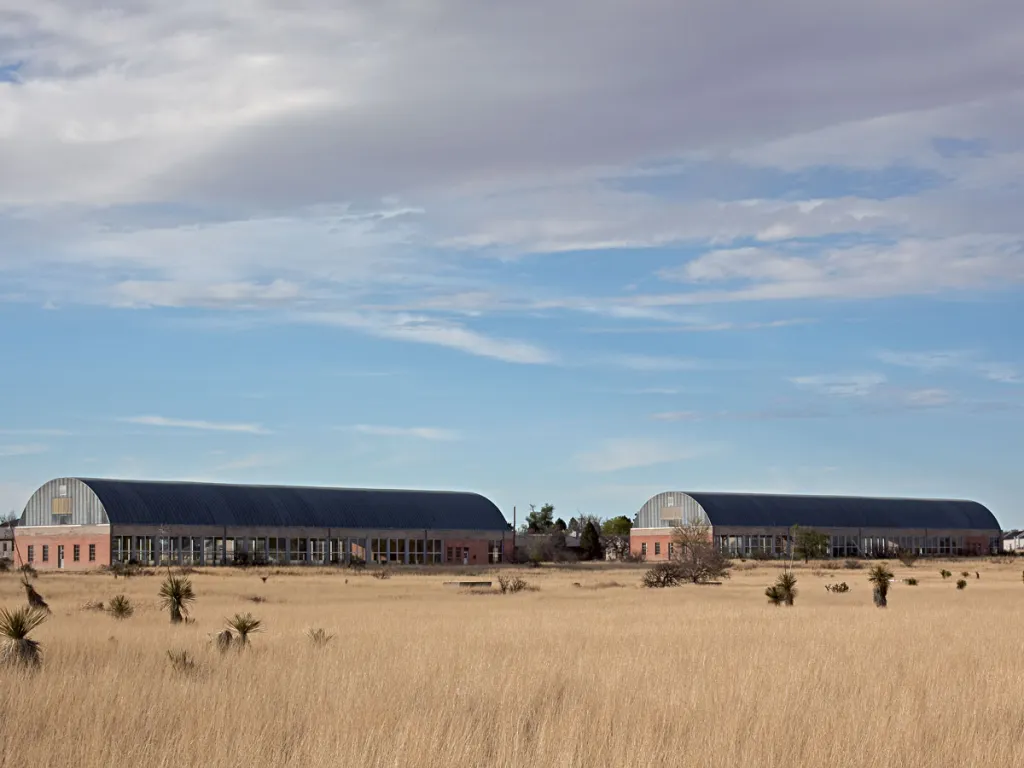
The Chinati Foundation in Marfa, Texas, has revealed its plans for a two-year restoration of the Artillery Sheds, which house Donald Judd’s iconic 100 untitled works in mill aluminum (1982–86). During this period, beginning in October, the 100-piece installation will be removed from view.
The restoration will address several issues affecting the Artillery Sheds, including repairing the roof and gutters, creating a passive cooling system, and replacing the glass windows that surround the two buildings’ long sides with energy-efficient ones, as well as take a more comprehensive approach to the grounds, with an ADA pathway connecting the buildings with the rest of the campus and a restoration of the landscape by planting native grasses and a system for water capture. The restoration will be done in phases: while one building is undergoing construction, the other will house all 100 aluminum works.
“The thinking around this restoration has been a number of years in the making,” Chinati’s executive director Caitlin Murray told ARTnews in an interview. “That’s partially because it’s such a large undertaking for Chinati, and we want to be extremely careful.”
The restoration of the Artillery Sheds will also require a significant investment on the part of Chinati. The foundation has so far raised $9.5 million of the $16 million it has deemed necessary for its “Art as Intended” capital campaign. The current funds allow Chinati to begin “shoveling ground later this year,” while the total amount will go toward increasing the foundation’s endowment, Murray said, adding “Doing a large-scale restoration project of this kind, with our increasingly historic buildings and grounds, [requires] that we always be thinking about the long-term sustainability of Chinati.”
Judd is known for his exacting vision, whether for the fabrication of his artworks or the plans for Chinati, which he had dreamed up before the passage of the Americans with Disabilities Act. Adding ADA pathways might then seem counterintuitive to Judd purists, but Murray said her team is executing it in such a way that honors the artist’s intentions.
“We want everyone who wants to come to Chinati to be able to see and experience as much of the work as possible. This felt like an important and necessary part of this project, to increase accessibility and provide more equitable access to the work,” Murray said. “We’ve tried to bring to this project is a certain amount of pragmatism—a balance between excellence and humility. We want to do things really well, while also in a particular scale that’s respectful to the work and to the place.”
Aerial view of the Chinati Foundation, Marfa, Texas.
Photo Florian Holzherr/Courtesy The Chinati Foundation
In addressing the site’s landscape, in the high Chihuahuan Desert, the biggest concern is the 12 inches of erosion, or when “the wind essentially peels off the top layer of sand and soil and carries it elsewhere,” that the site has faced in the past four decades, according to Stephen Martin, Chinati’s director of preservation and planning. “We have to rebuild all of that landscape—it’s important to not only us but the greater region,” he said, noting that the native grasses will go a long way to prevent new erosion. “West Texas is a windy place, and we want to do everything we can to restore the land.”
Our ongoing climate crisis is also something Chinati has taken into account for this project. “We have noticed increasing climatic activity: our dust storms are getting worse, our rains are getting worse,” Murray said. “Land restoration has been a fundamental part of our thinking about this project because we are thinking more broadly about an ecosystem. The Chihuahuan Desert is not just any desert—it has its own needs.”
Martin added, “Chinati is so significant in that it makes art, architecture, land, environment all equal and inextricably linked.”

Donald Judd, 100 untitled works in mill aluminum, 1982–86, at the Chinati Foundation, Marfa, Texas.
Photo: Alex Marks/Courtesy The Chinati Foundation Art: ©2026 Judd Foundation / Artists Rights Society (ARS), New York
Perhaps the biggest question Chinati has had to consider is whether or not the closure of 100 untitled works in mill aluminum for at least two years will deter any of the more than 20,000 annual visitors who make the trek to Far West Texas to see one of Judd’s most important works. Murray pointed out that Chinati has 12 other permanent installations other than the famed aluminum pieces that will still be on view.
The restoration also comes 40 years after the establishment of the Chinati Foundation and the completion of 100 untitled works in mill aluminum, which have not been moved since 1986. It also arrives just over a year after the National Register of Historic Places updates its listing of the Fort D.A. Russell Historic District, where Chinati is located, to include Judd’s artistic interventions, including his outdoor work 15 untitled works in concrete (1980–84).
“As with all the permanent installations at Chinati, the question of duration and the permanent nature of the installations [here] have so much to do with the fact that the works are fully formed by their context,” Murray said. “For Judd, the space around his work was as important as the work itself, so we’ve taken the time to understand what that means in terms of the experience of the work itself, what it is we’re preserving, both in terms of Judd’s vision for the work and visitors’ experience of the work.”
Built in 1939 on an active military site ahead of the US’s entry into World War II, the Artillery Sheds haven’t been without issue in their nearly 90-year history. With funding from the Dia Art Foundation, Judd purchased them in 1979 and began his own restoration on them, replacing the garage doors that enclosed the buildings’ two long sides with a series of continuous windows. In his 1989 essay, “Artillery Sheds,” Judd details his process to finalize the works, writing that the original “flat roofs leaked” and that patching them had proved “futile.” To help alleviate this problem and add insulation, he added the curved roofs made of corrugated metal, which doubled the buildings’ heights.
Donald Judd inspects the recently installed pre-fabricated metal panel roof on the South Artillery Shed, 1984.
Courtesy Chinati Foundation Archives
In the three decades since Judd’s death in 1994, the Chinati Foundation has taken a slow approach to realize the full plans for the institution the artist had envisioned: Dan Flavin’s untitled (Marfa project) opened in 2000, the John Wesley Gallery in 2004, Robert Irwin’s untitled (dawn to dusk) in 2016, and the John Chamberlain Building in downtown Marfa reopened in 2022 after a restoration.
Chinati completed a master plan in 2017, which Murray said has driven “our thinking institutionally” for the past decade and has guided them in making sure they were “asking the right questions” as they proceeded with each step. “It helped us to understand what the most urgent needs are, particularly for our buildings and building preservation. We wanted to be careful and considered in that [approach] and make sure we were bringing the right team together.”
She continued, “Why we’re undertaking this right now is because there’s an urgent threat to the pieces due to the incursion of water, dust, other environmental considerations, but we also took the time to consider all the elements carefully and to build the project team to make sure that we could really do this work really well.”
Donald Judd, Artillery Sheds with 100 untitled works in mill aluminum, 1982–86, at the Chinati Foundation, Marfa, Texas.
Photo: Alex Marks/Courtesy The Chinati Foundation Art: ©2026 Judd Foundation / Artists Rights Society (ARS), New York
Since joining Chinati as director in 2023, after 15 years at the Judd Foundation, Murray has taken special care in getting that team together, which includes nearly a dozen external partners. Working with the foundation’s head of conservation Bogna Skwara are conservation consultants from the Getty Conservation Institute, as well as Alfred Lippincott, the co-owner of Lippincott’s, the original fabricator of 100 untitled works in mill aluminum. Higgins Quasebarth & Partners will consult on the overall historic preservation, while Schaum Architects will oversee the architectural design and TyLin the structural integrity of the Artillery Sheds. Additionally, Jim Martinez, co-author of Marfa Garden: A Field Guide to Plants of the Chihuahuan Desert, will serve as a landscape consultant.
“We are very attentive to bringing on institutional knowledge as well as engineering and scientific expertise,” Skwara said, noting that a full conservation of 100 untitled works in mill aluminum isn’t required, though “treatment opportunities” for specific pieces will be part of the overall evaluation conducted by her team. “Of course, any artwork will change over 40 years. This closure will give us a real opportunity to spend focused time with the works.”
