


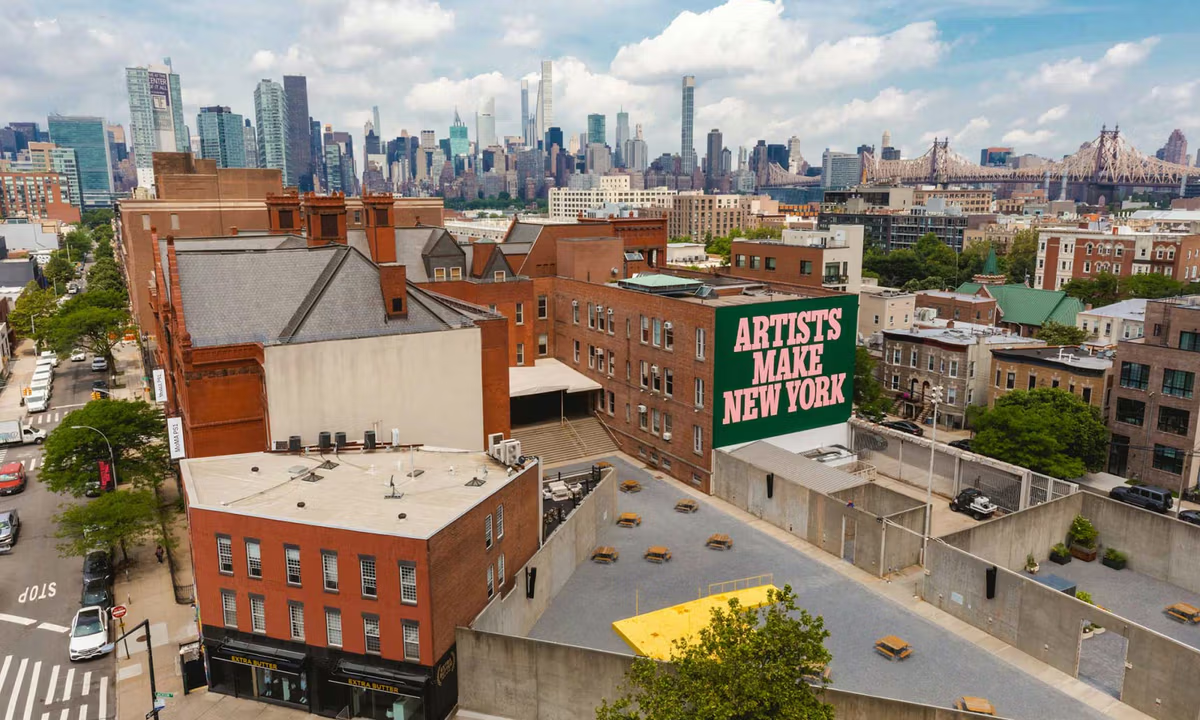
The New York-based artist Josh Kline published an essay in February that went unexpectedly viral. If you are an artist, not just in the Big Apple, chances are you read his words and felt more seen than ever before.
Dramatically titled “New York Real Estate and the Ruin of American Art” and appearing in the art journal October, Kline’s essay posits that the US art world is in serious trouble. And the primary cause is the cost of real estate in its heartland, New York (and Los Angeles). This is what is driving up artists’ living and education costs, forcing artists out of their studios, shuttering artist-run exhibition spaces, scaring museums into risk-averse programming and making galleries only show what is guaranteed to sell—which is to say, paintings. Artists have long felt this art-world centre is where they must be if they are to make it, but actually living and working in New York and showing your work there is fast becoming impossible.
That the art world is in crisis is a commonplace assessment. As the sociologist András Szántó puts it in his 2025 book The Future of the Art World: 38 Dialogues: “Reinvention is not optional.” Kline, of course, directly addresses the artist’s side of this confounding equation. But as Szántó shows, insiders of every stripe are trying to figure out what to do. One common denominator looms large: the imperative to decentre the way we think about and invest in this industry.
I live in London. But reading Kline’s essay made me feel seen too. I am an art-school graduate who never made enough money to afford a studio. Then, because I always needed to work full time, I did not make enough art to retain my gallery representation. Most days feel like a battle not just to keep my practice alive but increasingly, because my work-work is also tied to the art world, to earn enough to keep afloat. Meanwhile my husband, Hiraki Sawa, is a full-time artist with an international career and top-tier galleries on two continents. But his world was upended when developers evicted everyone in what was one of the last affordable studio complexes in the city. He now mostly works from home. We no longer have a living room.
In an interview published in Artnews after his October essay went viral, Kline mentions an artist who shows with a mega-gallery but works at his dining-room table. That spatial restriction, not to mention the financial strain it inevitably comes with, directly impacts the kind of work an artist makes.
This all leads to Kline laying down a gauntlet: “New York no longer deserves the ambitions and ideas of the country’s young artists.” If family ties and responsibilities have not yet knitted you in place, dare to go elsewhere. Find wherever rent is cheap enough to give you the time and space you need to experiment on whatever scale your ideas suggest.
Spirit of the artists
Another call to bravery, addressed not at artists but museum directors, comes from the Vanguard Award for Innovative Arts Leaders, newly launched by Remuseum—an independent think tank created by the Crystal Bridges Museum of American Art in Bentonville, Arkansas. In partnership with the Doris Duke Foundation, the programme aims to counter the institutional risk aversion that Kline rightly highlights by boosting decision-makers’ confidence.
Remuseum’s founding director, Stephen Reily, was formerly director of the Speed Art Museum in Louisville, Kentucky. One thing that struck him then was how hard it was to find, within an institutional setting, “the spirit of the artists” whose work it presents. “And by the spirit of artists, I mean creative, generative, never getting stuck in one way of doing things, always being open-minded,” he tells The Art Newspaper.
This autumn, a cohort of ten arts leaders will be selected from an open call to the programme. The leaders will be invited to a year-long residency with input from management, business and entrepreneurship experts. They will also receive $100,000 with which to implement, in their home institutions, whatever they come up with after the residency. This could be improving access, maintaining their buildings, caring for collections or making their museums—and the art in them—more important to more people. As Reily puts it: “We need new ideas more than ever.”
Of course, this is the opposite of encouraging Kline’s mass uprooting. Remuseum is based in a small city in the middle of the US, and the Vanguard candidates will be selected from institutions across the country. The programme is all about properly investing in everywhere that is not New York or Los Angeles, which chimes with what I heard from museum directors all over the country when reporting on the current state of US museums in January. Faced with persistent low attendance and funding cuts, they all said that prioritising the local is vital.
To my mind, both Kline’s and Reily’s proposed fixes for this broken art world highlight a crucial point: that ours is both shaped by and integral to the wider world. Kline, in his conclusion, notes that decamping from New York “would also reorient artists away from global power and towards their own societies”. While that makes it sound like an extra benefit, it strikes me that the most radical thing we can all do is make this the priority. Because whether you choose a city, a town or a village, what you are choosing is its people.
Research has shown that, contrary to what politicians and urban developers have often said, artists do not single-handedly or intentionally cause gentrification and displacement of poorer communities. Artists are usually displaced too. It also shows, however, that they can be central in resisting gentrification. Kline is right in pointing out the lack of community in places like Manhattan’s Meatpacking District and Tribeca. But even I know that New York is much bigger, more layered and much poorer than the glitz of those areas alone might suggest.
Socioeconomic inequality in our biggest cities is only growing. There are plenty of communities in all of them that cannot escape their gravity yet are only ever more crushed by it. Every eviction of an artist studio by a rapacious landlord echoes similar losses of youth clubs, community centres, markets, small businesses, not to mention homes. Reinvention is built into the artist’s DNA. A car mechanic, for example, has much less wiggle room. Surely that is one reason to stay and fight for a better city?
Movement can become extractive
Equally, there are solid outward-looking reasons for moving elsewhere. The fuller and more expensive our cities, the emptier the places between them—emptied of all the kinds of capital that communities need to thrive. That said, when wholesale free movement to wherever is most financially attractive does not adequately consider whoever is already there, it can quickly become extractive. Kline cites Lisbon and Marseille as examples of cheaper places that artists in Europe are flocking to after leaving the increasingly unaffordable Berlin. But so are digital nomads at large. Anthropologists show that existing communities in those cities, who often cannot choose to leave, are being squeezed by the influx. It is—wait for it—pushing rents up.
Ours is the bit of the world of work that has found serious systems for ascribing value to (among other things) walking, running, digging, sitting, melting snowballs, a crack in the floor, a leap into the void and telepathy. People already operating outside of Western economic strongholds—or in resistance mode within them—demonstrate that the wherewithal to radically respond is still possible. What is most riveting about Kline’s essay is how, in its conclusion, it almost reads like an avant-garde manifesto. Imagine if it really did galvanise a radical movement: if our choice to either forego top-heavy metropolises and invest elsewhere, or to remain in place as a unique resisting force, were fundamentally not about space but about what we can do for our neighbours.
