


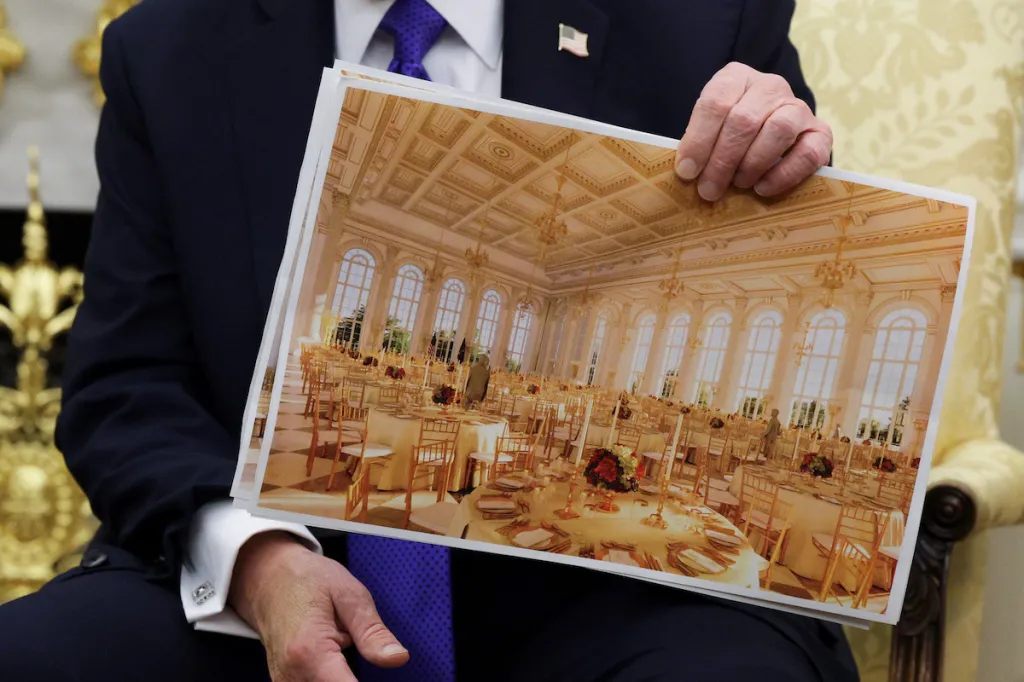
The construction of President Donald Trump’s luxury ballroom will proceed as planned and replace the East Wing of the White House, a divided Supreme Court ruled on Monday, the New York Times reported.
The National Trust for Historic Preservation, a nonprofit chartered by Congress to guard public buildings, challenged the construction of the project. It argued that longtime member Alison K. Hoagland, a District of Columbia resident and architectural historian, was personally and professionally harmed by the destruction of the White House’s East Wing, which was important to her work.
The court ruled in a 5-to-4 vote that the trust did not have the legal grounds to bring its lawsuit because the persons in question were not directly harmed by the project. The majority argued that the order did not address the legality of the project, but rather the question of who could sue to block construction.
“This is not the final decision on the merits of our case and does not resolve our fundamental argument—that each president is a temporary steward of the People’s House and does not have the unilateral authority to demolish and redesign it without the approval of Congress,” Brent Leggs, president of the trust, said in a statement.
Chief Justice John G. Roberts Jr. and the court’s three liberal Justices argued that the construction was “likely unlawful” in their dissents.
In his dissent, the Chief Justice wrote, the White House is “an iconic American building whose symbolism and history are wrapped up in its architecture.” He added, “All the more reason to ensure that those responsible follow the rules in deciding what to tear down and what to build up at the People’s House.”
This Supreme Court ruling reversed previous lower court orders that had slowed construction up to this point, while an earlier ruling issued by the Supreme Court within the last two weeks declined to stop the construction as it considered the case. To stop the project now would likely require a new lawsuit from an individual or group with standing like Congress, which is currently controlled by Republicans in the House and Senate.
“We are living in the Golden Age of America, and this Building will be one of the Greatest ever constructed in Washington, D.C.,” Trump wrote in a Truth Social post following the decision. “When completed in the Summer of 2028, the magnificent Ballroom and Military Complex will be something that the entire Country is very proud of.”
The incoming 90,000-square-foot ballroom and military complex will almost double the size of the main building and its East and West wings. It is expected to accommodate 650 people, which more than triples the current 200-person capacity. The renovations also include upgrades to the presidential bunker below.
Trump added that the project, which has grown since its initial conception, is “under budget and ahead of schedule. The Ballroom is totally funded by Great Patriots and Corporations and, therefore, is a Gift — At no cost to the American Taxpayer.”
It is estimated to cost $400 million and, despite Trump’s claims, the administration transferred about $350 million in taxpayer money from the Secret Service for “security enhancements” to the ballroom and bunker earlier this year in June.
Stopping the construction of the project, the Trump administration argued in the ruling, was a national security concern. The project is now 65 percent complete, with a team of 250 people working 20 hours a day, seven days a week, per government court filings.
The New York Times previously reported that the Secret Service plans to spend $220 million to protect the ballroom, including the installation of bulletproof glass, drone detection technology, and other threat filters and detectors. The taxpayer-funded upgrades reportedly also include a $180 million visitor screening facility for added protection.
