






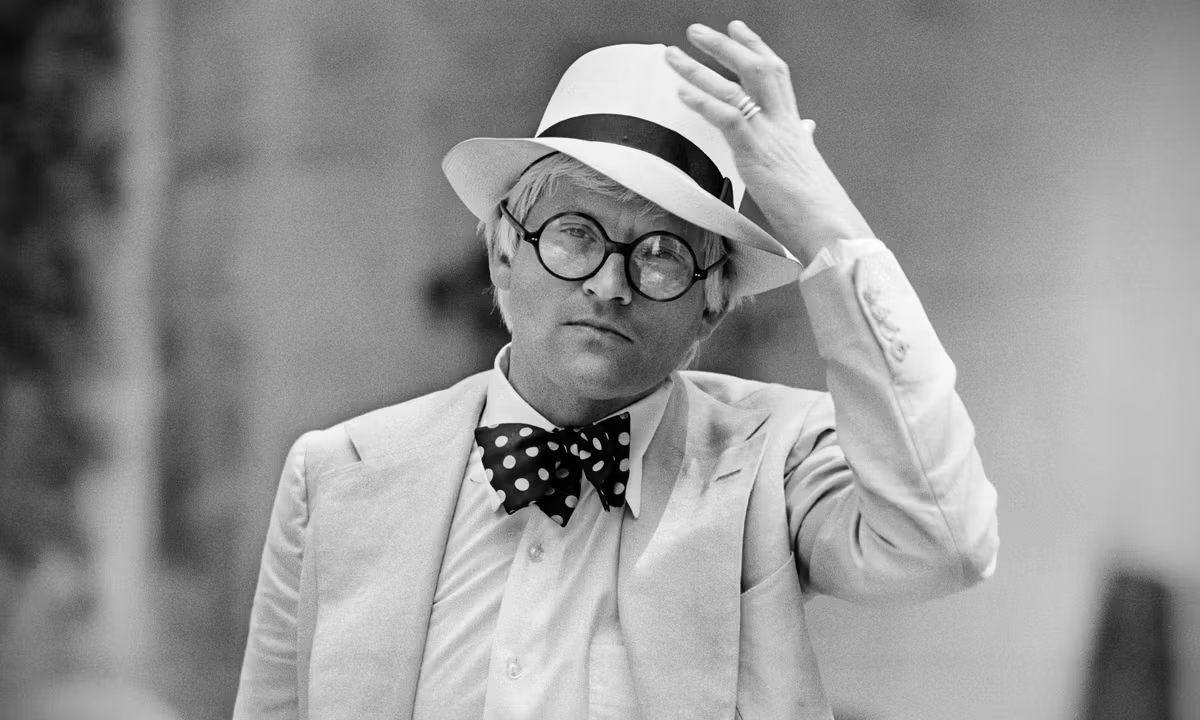
When David Hockney died at home on Thursday at the age of 88, he was probably the most famous artist in the world. His extraordinary success was founded not only on his brio and versatility as an artist, hauling everything from 15th-century Delft optics to the Apple iPad Pro into the service of picture-making, but also his cheerful chutzpah that has inspired many people who otherwise find modern art remote and inaccessible.
That Hockney was such a celebrated figure is even more remarkable when we consider his childhood growing up at 61 Steadman Terrace in Bradford, the West Yorkshire market town best known as a manufacturing centre for the wool trade. Born in 1937 to Laura and Kenneth Hockney—a clerk who earned a meagre wage in a dry-salters and then as an upholsterer of prams, but who was also an ardent internationalist, opera enthusiast, and conscientious objector—the man who Lucian Freud called “The Yorkshire Master”’ was not destined to be an artist. “When I went to art school”, Hockney later remembered, a neighbour said, ‘Some of the people in the art school just don’t work at all. Lazy buggers.’ And I said, ‘Oh I am going to work, don’t worry.’ And I did.”
After four years working hard on domestic and street scenes at the Bradford School of Art, kicking back at the “kitchen sink” realism of the moment, and carting his painter’s materials in one of his father’s reconditioned prams, Hockney heard the distant hum of London. Offered a place at both the Slade School of Art and the Royal College of Art (RCA), he chose the RCA on account of its more avant-garde attitude, over the painterly rigour of the Slade. This decision was soon vindicated. After enrolling in September 1959, Hockney was shown as part of the fabled New Contemporaries exhibition in 1961; an event that signalled the arrival of British Pop Art—or what curators Donna De Salvo and Paul Schimmel dubbed “Hand-Painted Pop”. Soon he would befriend Freud, Francis Bacon, R. B. Kitaj, Paula Rego, and just about everyone else in the beating heart of a London art scene that was, for a brief moment, the centre of the world. Sixty-four years after New Contemporaries, the artist was the subject of David Hockney 25 at Fondation Louis Vuitton in Paris, his largest ever exhibition made up of over 400 works dating back to Hockney’s 1955 portrait of his father.
Hockney came out as gay while still at the RCA. The title of his first significant work, We Two Boys Together Clinging (1961), was lifted from a poem in Walt Whitman’s epic Leaves of Grass. It features daubed graffito as a figural element in a scene in which two young men embrace one another in Dubuffet-esque naivety. By using Whitman’s alphabet code to designate himself and his lovers (“4.8” means “D. H.”, the artist himself), and leaving some words (such as, we might guess, “queer” and “boy”) obscured, Hockney gestured to the fact that this was a representation of an illegal act, years before homosexuality was decriminalised in the Sexual Offences Act 1967.
In 1961, Hockney spent the summer in New York. He hung out with Andy Warhol and Dennis Hopper. It was the start of a lifelong love affair with America. The Rake’s Progress (1961), a suite of sixteen plates was a modern and autobiographical retelling of William Hogarth’s morality tale on a spendthrift son who wastes all his money on riotous living, sex, and gambling. (It is probable that this was less a homage to Hogarth, and more to his modernist heroes, Igor Stravinsky, W. H. Auden, and Chester Kalman, who collaborated on a 1951 English-language libretto on the original 1735 prints.) Hockney would continue working with prints, and develop set designs in the intermedial modernist tradition, for the rest of his career.
But it was not in New York that this rake from Yorkshire got the best kicks; that came on the West Coast on his first visit to San Bernadino in January 1964. “When I went to Los Angeles”, Hockney reflected: “it was really three times better than I thought it would be.” Los Angeles offered membership in a flamboyant gay scene (centred on the Red Raven on Melrose Avenue), the picturesque leisure of the Mediterranean, and the rewards of the famous Californian fascination with the authentic, sophisticated Englishman. This was a role Hockney cultivated perfectly: the insider’s outsider. He was invited to glamorous parties in Beverly Hills, and swam in celebrity swimming pools that glistened all year round. Swimming pools were the subject of several paintings by Hockney between 1964 and 1971, as he tried to find a solution to the artist’s age-old problem of capturing the movement of water.
Made using acrylic Liquitex on a white cotton duck canvas, with no underdrawing, A Bigger Splash (1967) became the artist’s best-known work. It features a plush pastel pink and glass house flanked by palm trees and a vacant director’s chair, with an impossibly still cobalt blue pool disturbed by the aftermath of a hot young thing jumping in. The splash was a moment; it took Hockney two weeks to paint it using small brushes. In its focus not on the diver but the splash he makes, and as a cautionary tale for what might happen when life gets too damn good, A Bigger Splash was Hockney’s The Fall of Icarus.
If California allowed Hockney to develop the effects of coalescing hard geometry and gestural brushstrokes, then it would also encourage him towards greater realism as the 1970s progressed. (He continually ignored the voguish directions of an art market, and around about now that was moving from abstraction to conceptualism.) Hockney may have been the best double portraitist Britain has ever produced, and his ability to capture the loving intimacy and silent disconnection between couples was profound: Mr and Mrs Clark and Percy (1970-71) is a perfect study of what it means to be (or to look) louche and bohemian, with cat; My Parents (1977) transformed Laura and Kenneth’s drab living room into a polychromatic paradise.
Hockney never stopped returning to Yorkshire, especially for Christmas: as a single son, he said he had no choice. But the summer of 2004 signalled the start of a prolonged return that would see him up sticks to the seaside town of Bridlington, and settle in his sister’s modest suburban house. It was during this decade that Hockney created works like Bigger Trees Near Warter Or/Ou Peinture Sur Le Motif Pour Le Nouvel Age Post-Photographique (2007), his largest painting, that used computer technology and 50 panels to depict a large sycamore at the very furtive start of spring. The changing of the seasons was a central focus for this period, as seen in the remarkable panorama of spatial depth, Woldgate Woods (2010), Hockney’s creative reinvention of himself as a video artist as he sought to capture a landscape but from multiple perspectives at the same time.
When he was in his early eighties, Hockney the restless artist was no less inspired by the atmospheres of where he lived, be that in London, California, or Bridlington, and he relocated to Normandy during the first wave of the Covid-19 pandemic. “If you ask me where I live, I’d always say it’s wherever I happen to be,” he reflected: “I’m an English Los Angelino, now resident in France… I’m going to show the French how to paint Normandy.” The subject of these new works— flowers, ponds, trees—may have had Monet calling out their conservatism, but how they were produced—on an iPad—seemed both odd for this painting purist and perfectly in tune with his belief that artists have always used whatever the new technology might be to help them make pictures. 116 of these new iPad drawings became The Arrival of Spring, an exhibition at the RA in summer 2021. It was not a critical success, nor deserved to be. But Hockney’s silly Normandy drawings did achieve something extraordinary: emblazoned on the screens by Piccadilly Circus, they captured one of the few genuinely national moments of hope in a weary, warning-fuelled period. Reflecting on the pictures, Hockney said: “We have lost touch with nature, rather foolishly as we are a part of it, not outside it. This [the pandemic] will in time be over and then what? What have we learned?… The only real things in life are food and love, in that order, just like [for] our little dog Ruby… and the source of art is love. I love life.”
David Hockney, born Bradford, Yorkshire, 9 July 1937; studied Bradford School of Art 1953-57, Royal College of Art, London, 1959-62; John Moores Painting Prize 1967; Royal Academician 1991; Companion of Honour 1997; Order of Merit 2012; companion of Jean-Pierre Gonçalves de Lima; died 11 June 2026.


