


I’ll say that I did not expect the exhibition “Modernity and Opulence: Wiener Werkstätte Women,” at the Jewish Museum in New York, to open with work by two men. Nor did I anticipate the wall label lauding one Nazi, listed among the founding members described as “progressive thinkers.” But I’d been eagerly awaiting my afternoon with the work of the little-known ladies of fin-de-siècle Vienna, so this puzzling prelude was hardly a deterrent.
Alongside the Arts & Crafts and Art Nouveau movements, the Wiener Werkstätte—a collective active in Vienna from 1903 to 1932—made wallpapers, cutlery, and more that brought natural motifs indoors at a time when industrialization was severing nature from modern life. At their best, these movements framed beauty as something that should be accessible to everyone, and the built environment as one total work of art. Aesthetic experiences were here not reserved for museums or the elite, but folded in along with daily drudgeries.
But if like me you find Art Nouveau, the best known of the three, to be sickly sweet—like the frilly frosting on a store-bought sheet cake—then its more reserved Germanic corollary, Jugendstil, of which the Wiener Werkstätte was part, might have just what you need. The Wiener Werkstätte produced the most consistently beautiful objects of the 20th century that I know of. I’ll never understand why it was Scandinavian Midcentury design that took over every Brooklyn-hipster apartment—sleek all-wood-everything with Monstera leaves—when the resplendent Viennese vision of interior design was right there for the taking. Maybe it is simply less imitable?
View of the 2026 exhibition “Modernity and Opulence: Women of the Wiener Werkstätte,” at the Jewish Museum, New York.
Photo Kris Graves Projects/Julian Calero
“Modernity and Opulence”—the exhibition title implying the group’s commendable balance between decadence and restraint—really gets going in a gallery of glassware just beyond the entrance. Entering it, I was immediately overcome by the urge to possess the entire contents of the china cabinet on view—a feeling I rarely experience at art museums, which tend to hold treasures I wouldn’t dare dream of owning. The cups on display, with sleek forms and graphic twinkles, immediately felt relatable yet also transcendent, the boundary between life and art blissfully obliterated.
I admit I sometimes wonder why there is no Jugendstil Ikea, few Wiener Werkstätte knockoffs—none can even be found in the museum’s gift shop. But maybe we’re better off. William Morris, the Arts & Crafts head honcho, had imagined a socialist utopia where his dazzling wallpapers meant that everyone could access nature and beauty, anywhere, any time. But instead, and owing partly to his commitment to craftsmanship over mass production for the way it enabled dignity in work, his designs have remained largely luxury goods. For Walter Benjamin, this irreconcilable dilemma is why Art Nouveau and its ilk fail; for Theodor Adorno, this failure is what makes it modern.
Surely, the flat-packed Temu version of Jugendstil would degrade the requisite natural and human resources and contradict its whole ethos. After all, as Wiener Werkstätte co-founders Josef Hoffmann and Koloman Moser write in a text reproduced in the catalog, “The boundless evil, caused by shoddy mass-produced goods, and by the uncritical imitation of earlier styles, is like a tidal wave sweeping across the world.” This paradox—a longing for beauty to be distributed equally, even though it cannot be diluted for ease of distribution, and might even require rarity—is why the period continues to fascinate me. Call me Team Adorno.
The Wiener Werkstätte’s undue obscurity may have something to do with not only those epistolary expressions of skepticism by the founding fathers of the Frankfurt School, but also Hoffmann’s latter-day Nazism, which in this show goes unmentioned. I can’t deny that the man worked miracles: Call him my problematic fave. I never knew a fork could make me feel so many things until I encountered his exacting tableware, considered in every way. His cutlery’s subtly unusual proportions manage to be elegant and playful at the same time, like that perfect joke that lands gracefully at a cocktail party, where everyone laughs and nobody chortles.

View of the 2026 exhibition “Modernity and Opulence: Women of the Wiener Werkstätte,” at the Jewish Museum, New York.
Photo Kris Graves Projects/Julian Calero
But still, Hoffmann is one of the only figures in the Jewish Museum show to have stayed in Vienna through World War II and survived—which is always a clue for this cohort. The curators tell this story subtly, listing birth and death years and locations for each artist; few died in Austria. After the Anschluss in 1938, Hoffmann was appointed to oversee the revival (and reinterpretation) of Vienna’s applied arts. His output during this period included but is not limited to designing a silver swastika teapot and spearheading the interior renovation of an S.S. Officers’ Club, making it into a luxury locale.
Nazi memorandums did flag Hoffmann as being judenfreundlich (friendly to Jews) and indeed, he worked closely with women and Jewish designers before the war. But I smell opportunism: He relied on Jewish patrons and then on the Nazi war machine.
But about the women: Some 200 were part of the Werkstätte, a quarter of them Jewish. Partly they wound up there because, until the 1920s, women were not allowed to enroll in Vienna’s various fine arts academies. But the Kunstgewerbeschule (School of Applied Arts) admitted them, figuring that the decorative arts were related enough to domestic duties. Austrian women won the right the vote only in 1918, about midway through the Werkstätte’s run.
Still, the story is, as ever, one step forward and two steps back. That glass gallery showcases collaborations between Hoffmann and one of the show’s two Jewish and female protagonists, Felice Rix, whose career Hoffmann helped launch. He designed glassware that she then patterned dazzlingly, his calculated glass shapes enabling her designs to float as if in thin air. A wall text informs that women were often relegated to such surface work at the Werkstätte—putting Austrian architect Adolf Loos’s 1913 equivocation of ornament with femininity (and more infamously, with crime) into perspective. Subsequent sections see her penchant for patterns grow more whimsical and graphic, particularly after she marries and relocates to Japan in 1926, adopting them for fabrics and for wallpapers.
Felice Rix-Ueno: Tarantella, 1929.
Photo ©MAK/Branislav Djordjevic
But before patterns, postcards were women’s earliest forays in: These cheaper wares subsidized the Werkstätte’s more luxurious products, which were spearheaded by men—a classic tale of devalued feminized labor enabling the works that get remembered as masterpieces. Maria Likarz’s postcard contributions near the entrance rhyme with Egon Schiele’s drawings (not on view): Garments are rendered as patterned planes or flat fields of color, and outlined figures fill the frame from edge to edge.
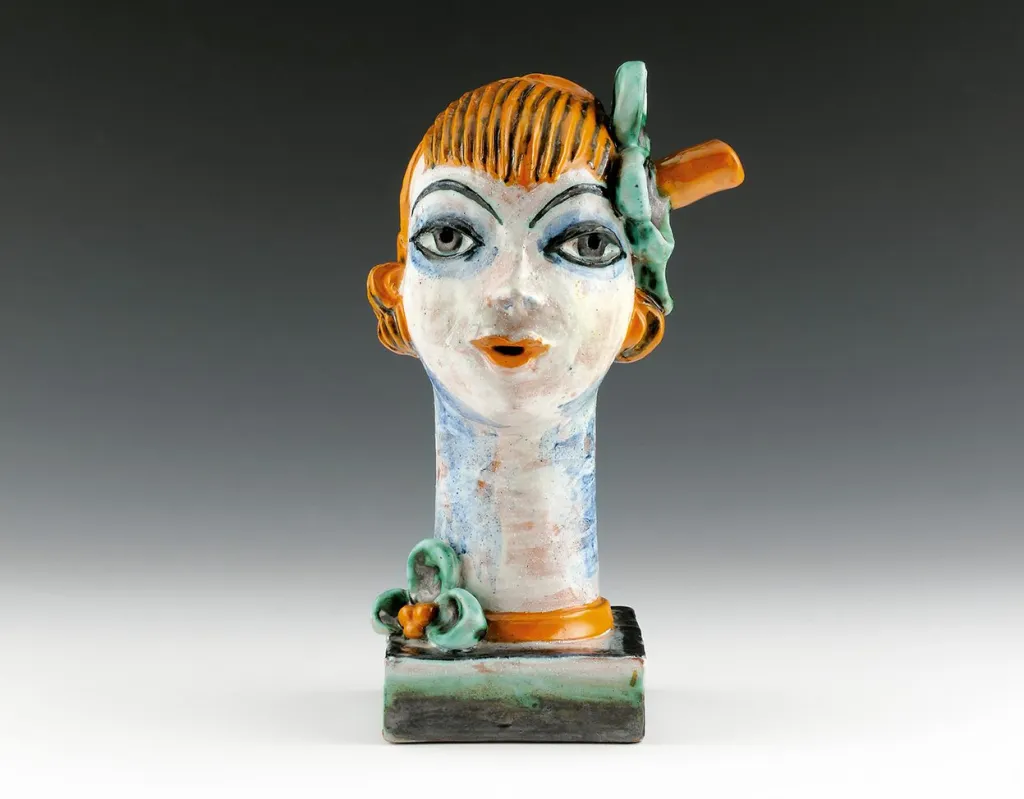
The wall labels at the Jewish Museum can only hold so much complexity, but that doesn’t stop the objects. One section, titled “A New Woman For a New Era,” claims that the group “mined such trivializing stereotypes as the childish female craftsperson to create a powerful vision of an emancipated woman,” though stops short of saying how. Next to this big claim is a tiny, crudely handmade sculpture by Kitty Rix (Felice’s sister) of a girl riding a cat as if it were a horse. It feels to me unironic: I see a grown-up fulfilling her girlish dreams unabashedly, in the cat and in the show’s smattering of charming clay couples. The silliest couple you ever did see is spotted balancing lamps on their heads like jesters, wearing harlequin-esque outfits in primary colors to boot.
Undeniably, Art Nouveau had a fascination with femininity that could oscillate between celebratory and troubling, taking its most objectifying form in women-nature-candelabra-type objets d’art, the kind figuring nymphy, doe-eyed women with impossibly long hair—to say nothing of their proportions. The works in this show by Viennese women are decidedly less sexualized, and often focused on fashion; they seem to revel in the playful joy that attends archetypal girlishness. A pastel floral blouse boasting a pattern by Felice Rix is screaming Easter; it’s almost camp. Its flowing form marked freedom from the confines of the corset, fashion by women, for women. Susi Singer’s figurative candlestick has style and sass that owes at least partly to its earthenware origins, favored at the Werkstätte for its affordability over porcelain, but much less capable of refined shapes. (Vally Wieselthier, the show’s second protagonist, also specialized in earthenware). A more direct rebuttal to French fashion and post-Rococo femininity fetishes appears in a suite of prints by Lotte Calm, Fritzi Löw, and Dagobert Peche meant to promote Viennese designs over the era’s haute couture. Linocut emerges as the perfect medium for capturing the era’s boxy dresses and bold, dazzling patterns.
Kitty Rix: Girl Riding a Cat, ca. 1920s.
Working at the Kunstgewerbeschule under educational reformer Franz Cžek, Wiener Werkstätte women also designed toys designed to tap into childlike spontaneity. Mind you this was Freud’s heyday, his milieu. Most memorable is a design for a toy carriage to be pulled by the family dog. This and everything the Werkstätte made is art you can use, ideals you can live. So is the stunningly segmented choker by Amalie Szeps, which alternates between metal beads and silk threads. It feels wrong to behold in a vitrine when it’s so clearly meant to be embodied. I’d be happy to volunteer.
At its height, in 1922, the Werkstätte opened a New York store. But the whole operation folded in 1932, as did so much else following the 1929 stock market crash. As to what happened to the artists, the museum tells this story subtly with those death dates and locations. Read them closely, and you’ll notice that they’re flung all over the world—New York, Kyoto, Los Angeles, Rome. Most chilling are those that say unknown, or declare unambiguously: Murdered in a death camp.
