


When Eric Ravilious was selected to represent English culture at the 1937 Paris International Exhibition, he designed a vast mural based on his earlier triptych, Tennis (1930), in which men and women in immaculate whites dart across a red-clay court bordered by a brilliant green lawn. Since modern tennis emerged in mid-19th-century England and spread abroad, artists have been drawn to its clean geometry, kinetic rhythms, and associations with leisure. Edward Hopper captured the game’s elegant choreography in his energetic watercolor Tennis Players (1916–20), while Andy Warhol transformed champion Chris Evert into a Pop icon in 38 silkscreen portraits.
Today, the sport is enjoying renewed prominence, both on and off the court. Participation in the United States has risen 54 percent since 2019, reaching a record of 27.3 million players in 2025, according to the United States Tennis Association. Tennis-core has inspired interiors, fashion lines, and films like Luca Guadagnino’s box-office hit Challengers. Museums too have followed suit. The Newport Art Museum recently traced the game’s visual history in “The Court: Art in Play,” while Pérez Art Museum Miami’s current “Get in the Game: Sports, Art, Culture” includes many racket-centric works. This past June, 32 artists competed on a painted court at the inaugural Casa Axis International Open in Valencia, Spain; the winner earned a residency and the chance to reimagine the court for next year’s event.
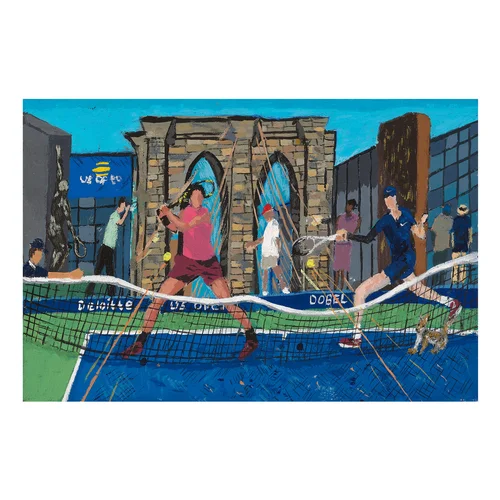
Alcaraz and Sinner Conquer New York, 2025
Shaun Ellison
ART FOR CHANGE
While tennis’s graphic simplicity and country-club history remain part of its appeal, contemporary painters including Jonas Wood, Sheena Rose, Honor Titus, Rachael Bos, and Shaun Ellison have embraced the sport’s recent reinvention. Using familiar forms such as the divided court, the net, the uniform, and the lone figure, artists are revealing how differently the game is played, watched, and pictured today.
Brooklyn-based painter Shaun Ellison knows the sport’s changing public image firsthand. A former Division I player who competed internationally as a junior, the South African artist once associated the game with “white privilege” and a rigid perfectionism he wanted to escape. Returning years later, he found a more diverse and expressive roster of stars—including Coco Gauff, Frances Tiafoe, Naomi Osaka, and Felix Auger-Aliassime—whose backgrounds and distinctive styles disrupted the conventionally elite mold and opened the once-insular environment up. “There’s definitely more freedom to be oneself,” he told Artsy in an interview.
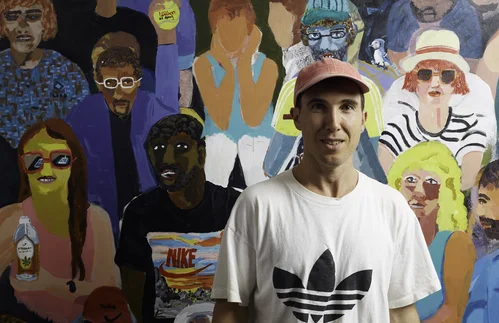
Ellison pictures that accessibility by treating the court as a theatrical stage shared by players and spectators. In his “Grand Slam” paintings, fans appear as individuals distinguished by their gestures and attire. More recent works collage matches amid sunflowers, swimming pools, airplanes, city skylines, and other evidence of life unfolding beyond the baseline. In the hand-embellished edition US Open, Federer vs. Nadal (2025), Ellison tempers the imagined match’s “life-or-death” intensity with a giraffe peering over the bleachers and a man in a fluorescent vest and hard hat carrying a traffic cone. “There’s tennis here,” he said, “but it’s not everything.”
While painting helped to repair Ellison’s relationship with tennis, painting its female champions helped to heal Sheena Rose’s relationship with her body. Diagnosed with lupus, a chronic autoimmune disease, the Barbados-based artist could no longer cycle or kickbox as she once had. Still, she could channel her energy into paintings of Black athletes in motion. “It started as a kind of wish fulfillment,” she told Artsy. “I hid their faces so I could imagine they were me or that they could be any Black woman who wanted to play.”
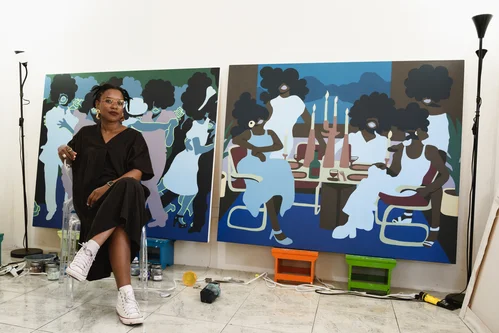
Rose spends hours studying images of her subjects’ matches, searching for telling positions and postures. Although oversized cumulus-shaped afros obscure their features, her players remain identifiable through their signature stances. “It’s like a fingerprint,” she said, citing Venus Williams’s raised foot and other players’ characteristic leaps.
Lately, Rose’s flat, Technicolor compositions have centered on moments of compassion rather than competition between opponents. Surreal interventions like a shower of shimmering asterisks or, in Good Omen (2024), a kaleidoscope of monarch butterflies commemorate the visibility and permission that a generation of Black all-stars have established for the younger athletes coming up behind them. “It’s as much about their energy and connection as it is the game,” she said.
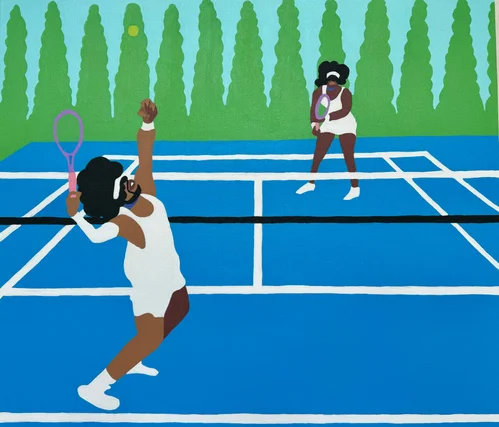
Aim Higher, 2024
Sheena Rose
Johansson Projects
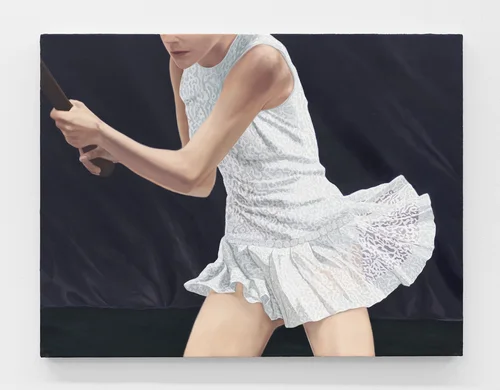
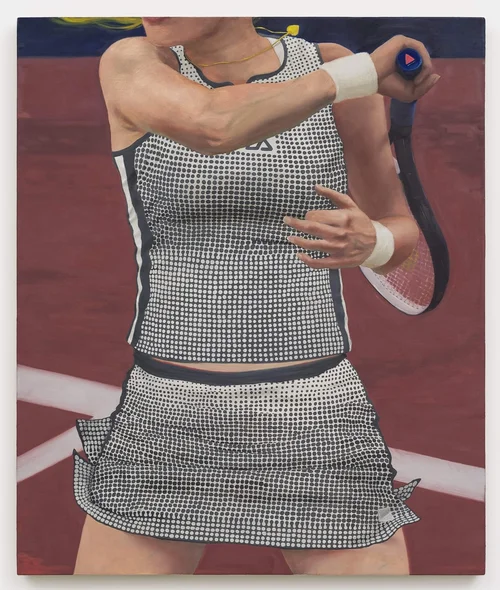
Chicago-based painter Rachael Bos is likewise an avid researcher, though her investigations often begin with a player’s kit. She traces each outfit to a specific match, then searches the footage for the right pose. Uniforms “serve a utilitarian purpose,” she said, while also representing so much: “an athlete, a nation, an era.” In J. Dokic (2022), Jelena Dokic’s polka-dot skirt set turns her torso into a dense field of pattern, while C. Evert (2023) renders Chris Evert’s silvery, semi-sheer dress in hyperreal detail, down to the spandex shorts visible just beneath the pleated skirt.
Many of her portraits exclude everything above the mouth and below the knees. For Bos, the tight-cropped framing evokes the public gaze that elevates athletes into symbols that transcend the individual. Social media has shifted that dynamic, she observed: Not only do fans have greater access to players, but athletes have a platform to speak for themselves. That visibility is helping tennis stars acquire the “rock-star” status long afforded athletes in other major American sports. Their kits, she adds, carry the game’s enduring traditions into its pop-culture present.
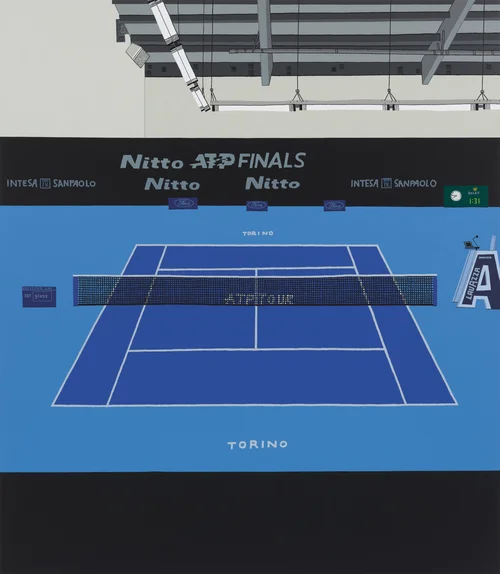
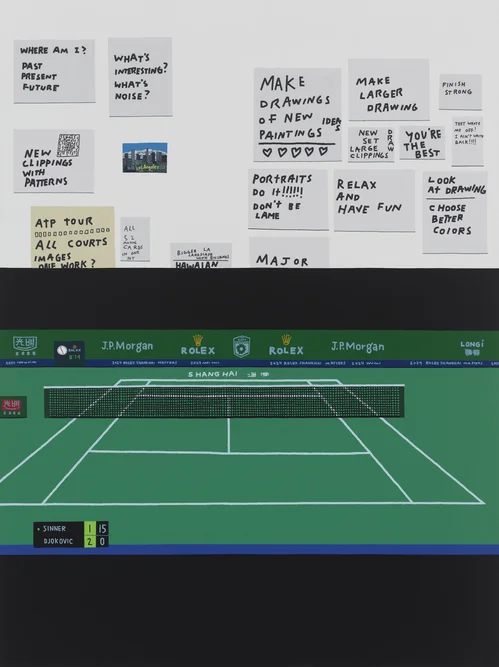
The bold patterns covering Bos’s outfits seem to expand across Jonas Wood’s paintings. The Los Angeles–based artist began painting tennis courts—or, more precisely, images of courts appearing on screens in his home and studio—in 2011. Their standardized layout allows for endless variations on the same form. “My paintings of tennis courts are about an interest in abstraction, and how the court becomes a geometric puzzle,” he has said.
For his recent eponymous exhibition at Gagosian Beverly Hills, Wood based each painting on a photograph or collage of a televised match, preserving the foreshortened view from behind the baseline. The court sits inside a horizontal television screen, itself sometimes nested within a vertical phone screen: a frame within a frame within a frame. Because the viewpoint remains fixed, differences in palette, surface texture, and signage identify each tournament: rust-red clay in French Open with Wood Grain (2025), brilliant purple set within charcoal gray in WTA Finals Riyadh (2025). The repetition makes the court something like scales for a pianist—a way, Wood has said, to “keep practicing something I like, and continue to get better at it.”
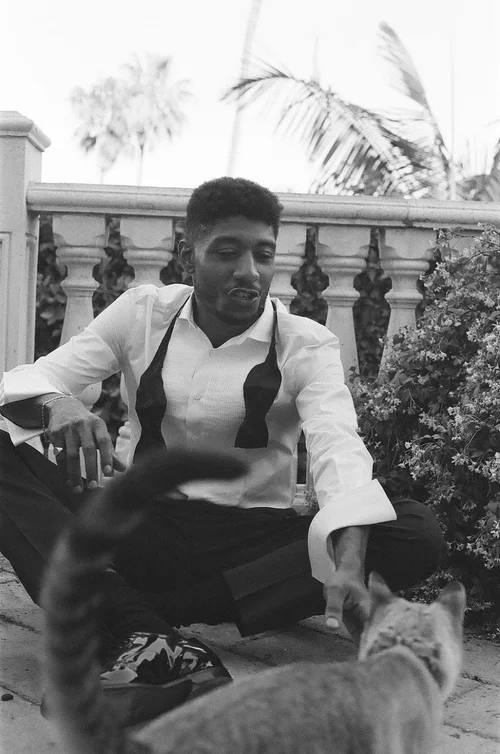
As both a player and a painter, Los Angeles–based artist Honor Titus knows the comparison firsthand. “They’re both intensely psychological,” he told Artsy, “while also being chiseling endeavors.” First shown at Timothy Taylor, his richly colored compositions feature debonair Black players lunging and serving across manicured courts. Rippling muscles and kinetic postures convey their athleticism, while narrowed eyes and slackened jaws register intense concentration.
In Down the Line (2020), a man in a polo, slacks, and adidas Originals Rod Laver sneakers reaches to return a ball over a scrollwork fence, his gaze fixed just beyond the painting’s right edge. By centering Black players within rarefied settings, Titus, like Rose, revises a visual tradition long shaped by racial and class exclusion.
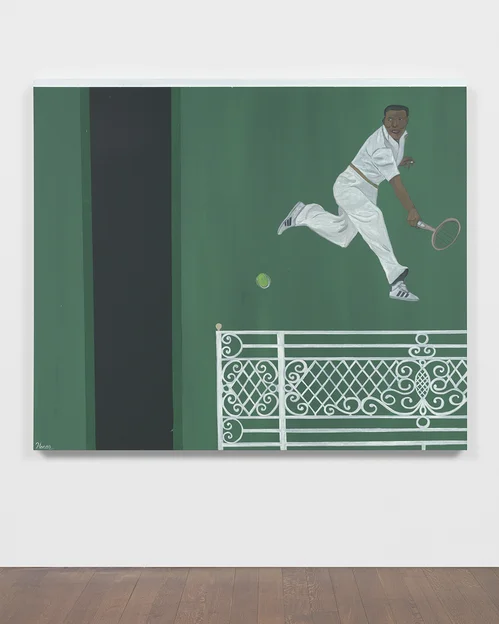
His court’s stark geometries dramatize these tensions. “Separation and confinement are already built into the architecture of the court,” Titus said. “The lines, the net, what’s in, what’s out, who belongs on which side.” The ornamental wrought-iron fences and white colonnades that cut across the compositions evoke private clubs and gated estates, wherein beautiful design doubles as a barrier. His compound perspectives further unsettle the divisions, collapsing foreground and background until the painted boundaries seem to shift beneath the players’ feet.
