


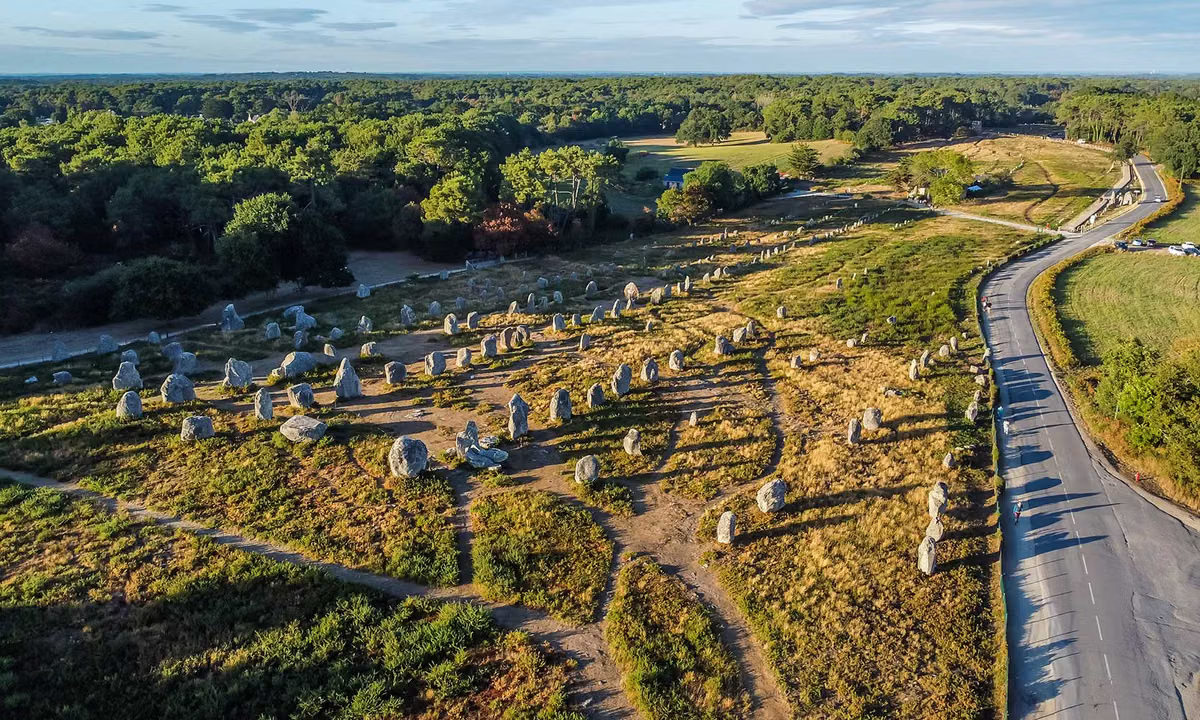
Over 6,000 years ago, farmers in Brittany, western France, erected around 3,000 stones in long rows, stretching for more than 4km across what is today the town of Carnac. These builders made sure to place shorter stones at the east side of the arrangement and taller ones to the west, some standing nearly 4m tall, and erected others in the shape of semicircular and rectangular enclosures. They also built hearths beside the stones’ irregular granite forms, perhaps for cooking or simply for light, and buried their dead beneath mounds of earth and megalithic tombs across the sacred landscape.
Across Europe, megalith builders left no guide to help us interpret their carved symbols and motifs
But what did Carnac’s mysterious standing stones mean to these early builders? Were they a way of monitoring the movements of the sun and moon? A colossal calendar? Or were they the petrified bodies of soldiers, as one 17th-century legend relates. For archaeologists trying to understand the site, any new piece of the puzzle could help provide an answer.
This mystery has long endured, partly because there has been little excavation at Carnac compared with most archaeological sites of this significance. Individuals conducted sporadic excavations before the 20th century; and even then, except for archaeological investigations from the 1920s to the early 1940s, the aim has mainly been a place to preserve and protect. Its global significance was cemented in 2025 when the Megaliths of Carnac and of the shores of Morbihan were inscribed on Unesco’s World Heritage list.
Now, writing in the journal Archaeological Prospection, Guillaume Bruniaux of the archaeological consultancy ArchéoSolution and his colleagues have provided a glimpse into just how much remains to be uncovered at Carnac. Using geophysical techniques to peer beneath the ground, the team surveyed an area of around 2.5 hectares and revealed the presence of buried standing stones (including short alignments beyond the previously investigated area), burial mounds and cooking stone pits. As well as showing the site to be larger than previously believed, these new discoveries will hopefully provide new insights into the megalith builders.
Monumental mysteries from Orkney to Malta
Similar longstanding mysteries surround megalithic monuments across Europe, from Orkney to Andalusia, and Stonehenge to Malta. Understanding why prehistoric Europeans decided to make such huge stone constructions has long been a goal of archaeologists, and investigations continue to reveal previously unknown sites and works of art.
In southern Spain, for example, a team has recently studied the megalithic necropolises of the Fardes River, according to research published in Archaeological Prospection. This vast region is filled with prehistoric sites, but many remain unrecorded, a problem exacerbated by a difficult terrain filled with valleys and ravines. This led Juan Antonio Cámara Serrano of the University of Granada and his colleagues to survey the area using LiDAR (light detection and ranging) and remotely piloted drones, which allows them to record the landscape from the sky. Using this technology, the team identified 40 anomalies, which they then visited on the ground. Their preliminary conclusions revealed that half of these anomalies were indeed archaeological sites, including burial mounds, stone structures and a fortified settlement.
The massive pieces of granite, the purpose of which remains unknown Photo: Mike Workman
Meanwhile, a team led by Ivona Dlábiková of the Technical University of Ostrava in the Czech Republic has published in the journal npj Heritage Science their research into engraved standing stones first discovered in 1988 in the town of Holíč, Slovakia, when an apartment building was under construction. Over 40 megaliths were unearthed, of which 21 were later re-erected close to a castle.
Almost all of the megaliths are weathered, so the team used 3D lasergrammetry and other methods on three of the stones to reveal and reconstruct their faded carvings. Two of them stood out: on one stone, a human figure holds a tool; another bears the shape of an animal. Both figures are accompanied by concentric circles. The researchers note that these motifs bear stylistic similarities to Neolithic art found in Italy, France and Scotland. And they conclude that the site may be an overlooked example of Neolithic monumental culture in central Europe—an area where few megalithic monuments have been identified.
Across Europe, the megalith builders left no writing to explain their constructions, no guide to help us interpret their carved symbols and motifs. Their intentions remain obscure. But like chipping away at a massive stone block, each monument discovered and art examined brings us a little closer to understanding their colossal achievements.
