


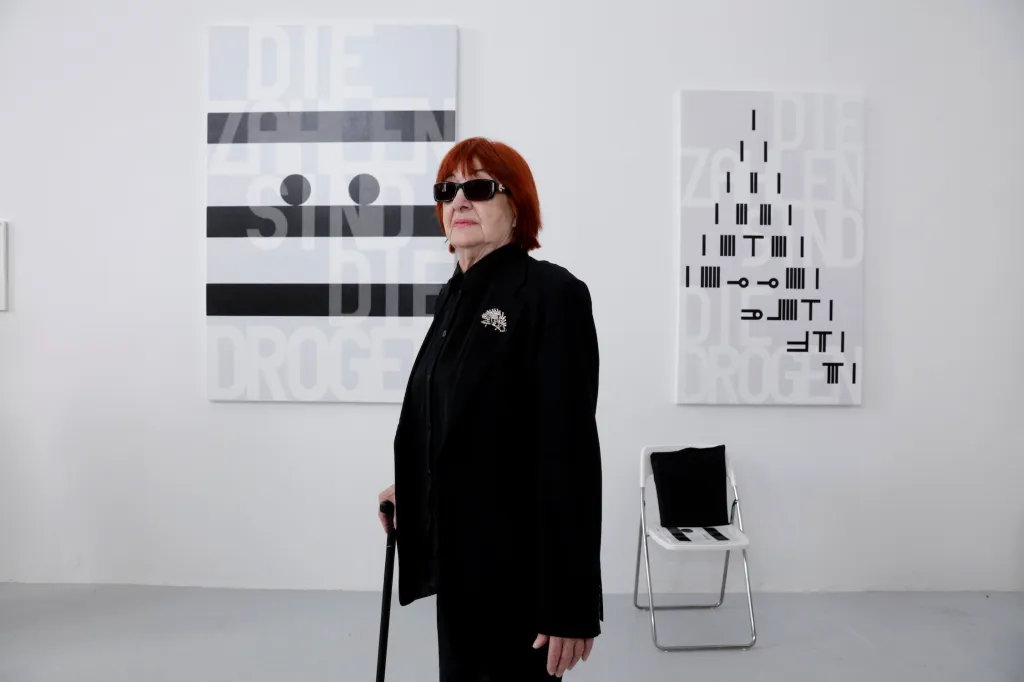
Self-taught German conceptual artist Rune Mields died on June 27 in Cologne, Germany, at the age of 91. Her death was first reported by the German Press Agency.
Born in Münster in 1935, Mields came to art-making in her 30s after completing an apprenticeship as a bookseller. She first gained attention for her “Röhrenbilder” (Pipe Paintings) of the late 1960s and early ’70s, large-format monochrome canvases featuring hyperreal renderings of three-dimensional geometric forms.
“To understand life,” she told the German art and culture magazine Monopol in 2025, “you have to understand mathematics. It describes the fundamental principles of the world.”
By the 1970s, following a move to Cologne, Mields’s interest in mathematics would lead her to her to examine ordering systems across cultures. Over the next 50 years, she produced works that drew from such disparate sources as signs taken from ancient geometry, Baroque music, Paleolithic fertility symbols, Arabic and Persian ornamentation, and Western art history.
“[A]lthough they frequently feature abstract signs, words and numbers,” wrote Noemi Smolik in Frieze in 2015, “the pictures are never conceived in purely conceptual terms, as forms of thought. Instead, her pictures always also have a strong graphic, near ornamental impact.”
Mields participated in Documenta 6 in Kassel, Germany, in 1977. In 2000 she was awarded the Gabriele Münter Prize, Germany’s award for female visual artists over the age of 40, and on the occasion of her 90th birthday last year, the Kunstmuseum Bonn and the Ludwig Forum Aachen gave her solo exhibitions.
Her work is held in the collections of the Museum Ludwig in Cologne; the Kunstmuseum Düsseldorf; the ZKM Karlsruhe; the Busch-Reisinger Museum in Cambridge, Massachusetts; the Nationalgalerie in Berlin; and Kupferstichkabinett Berlin, among other institutions.
Mields remained engaged with mathematical principles until her death. “I’m currently working on a series about the five Platonic solids,” she told Monopol. “I’m particularly interested in the dodecahedron, which represents the fifth Platonic element: the universe. Infinity, of course, remains a lifelong pursuit.”
She will be buried in the Kassel artists’ cemetery in a grave she designed for herself in 1992.
