


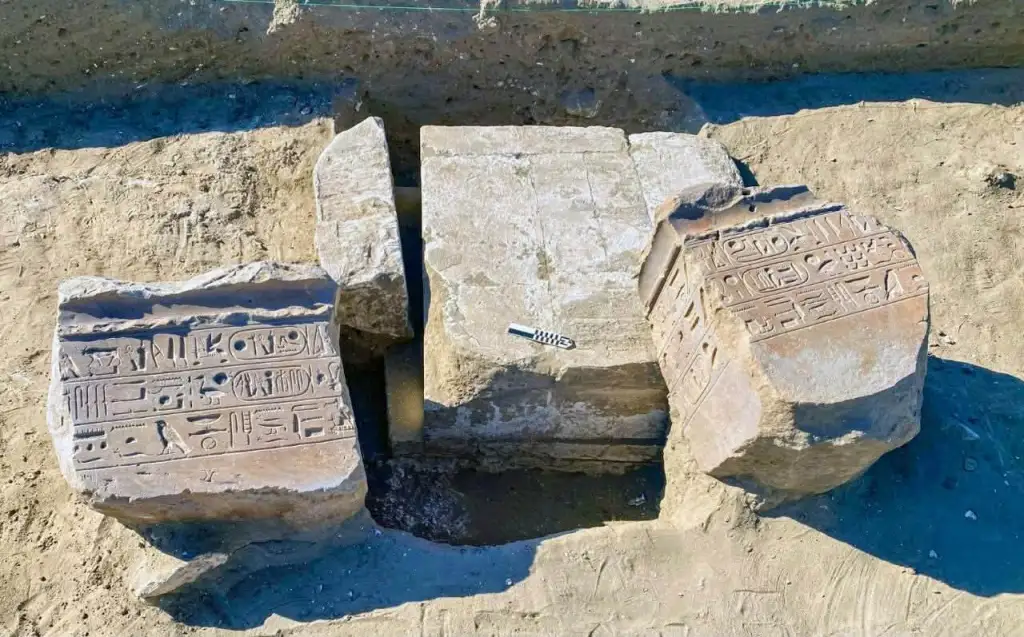
Researchers working at Tel Abu Saify, an archaeological site in Qantara East, near the eastern bank of the Suez Canal in Egypt, have uncovered new evidence linking the site to a lost city known as “Masen.” Egypt’s Ministry of Tourism and Antiquities announced the finds on August 15, and the news was first reported in Ahram.
Mohamed Abdel Badie, head of the Egyptian Antiquities Sector at the Supreme Council of Antiquities, said the discoveries “provide further evidence of the site’s changing functions and its strategic importance.”
The most noteworthy find, according to Hisham Hussein, who oversaw the archaeological mission, is a large sandstone lintel that is broken into two pieces and inscribed on three sides with references to King Ramses II, a 13th-century BCE pharaoh. One of the texts describes restoration work having been done to a statue of Horus, an ancient Egyptian deity, known as “Lord of Masen.”
Hisham El-Leithy, secretary-general of the Supreme Council of Antiquities, told Ahram that further excavation and research is needed in order to definitively confirm the connection.
Tel Abu Saify was first excavated decades ago, and includes ancient military structures, dockyards, mud brick enclosures, and a temple. In addition to the inscribed lintel, the recent archaeological mission also uncovered two roads paved with stones, additional rooms belonging to the site’s temple, and fragments of basalt and jasper statues. Last year’s Tel Abu Saify’s discoveries included housing units, kilns, a defensive trench and a wide, limestone-paved road once lined with trees.
