

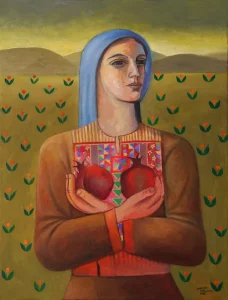





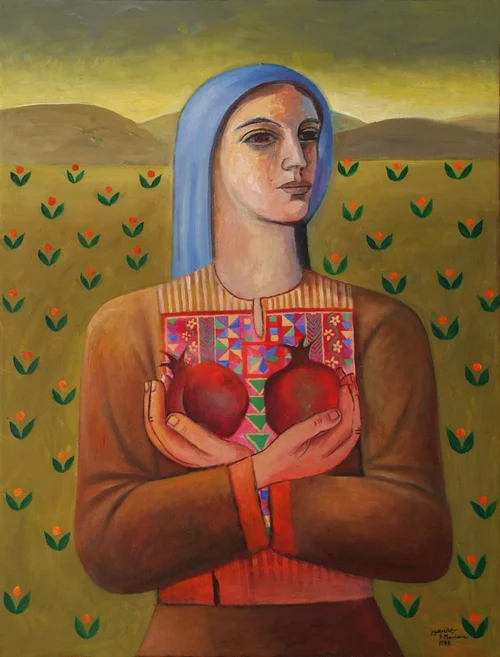
Untitled, 1988
Sliman Mansour
Gallery One
Sliman Mansour, the Palestinian painter whose depictions of farmers, hill villages, and embroidered dress are some of the most widely circulated in modern Arab art, has died at 79. His family announced the death on Monday, August 24th, in a story post on Instagram. He died at his home in Jerusalem. “We lost a father, our source of love, strength, and home,” the family wrote.
The family gave no cause of death, although Al Jazeera reported that Mansour had been ill for some time.
Mansour was born in 1947 in Birzeit, Palestine, north of Ramallah, and studied art and design in Jerusalem, graduating in 1970. He came to prominence in the 1970s as part of a generation of Palestinian painters, writers, and poets who were assembling a visual vocabulary out of land, labor, and household objects.
His best-known painting dates from that decade: a 1973 oil of an elderly porter carrying the city of Jerusalem on his back, usually given in English as The Camel/Carrier of Hardships. Mansour painted several versions of the subject, with a 2005 acrylic version selling for his record auction price of $257,000 in 2015 at Christie’s. Often reproduced, the painting signifies the struggle of the heavy weight of Palestinian history,
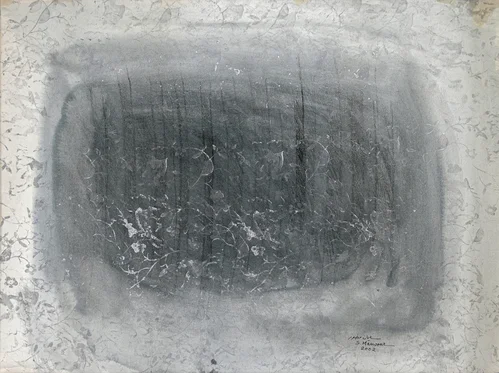

Untitled, 2002
Sliman Mansour
Zawyeh Gallery
Mansour drew on Canaanite, Pharaonic, and Assyrian antiquity as well as Islamic and Arab traditions of calligraphy and geometric ornament in his work. He used these techniques to depict scenes from village life in the hills around his birthplace. Olives and oranges feature as symbols of the land throughout his rich and bold compositions. He often portrayed doves, too, that evoke his hope for peace in the future.
Mansour was also a key figure in the Palestinian art community, co-founding the League of Palestinian Artists, which he led for several years. In the late 1980s, Mansour helped found the New Vision group; after Palestinian artists boycotted Israeli-made art supplies, its members worked instead in mud, straw, wood, leather, henna, and natural dyes. He returned to clay decades later in The Portrait (Portrait of a Man) (2017 and 2019), made in clay and acrylic on wood.
Mansour exhibited widely in the Arab world and internationally, and his work is held in museums and private collections like the Guggenheim Abu Dhabi and the Barjeel Art Foundation in Sharjah, UAE. Among his awards was the UNESCO-Sharjah Prize for Arab Culture, which he received in 2019.


