


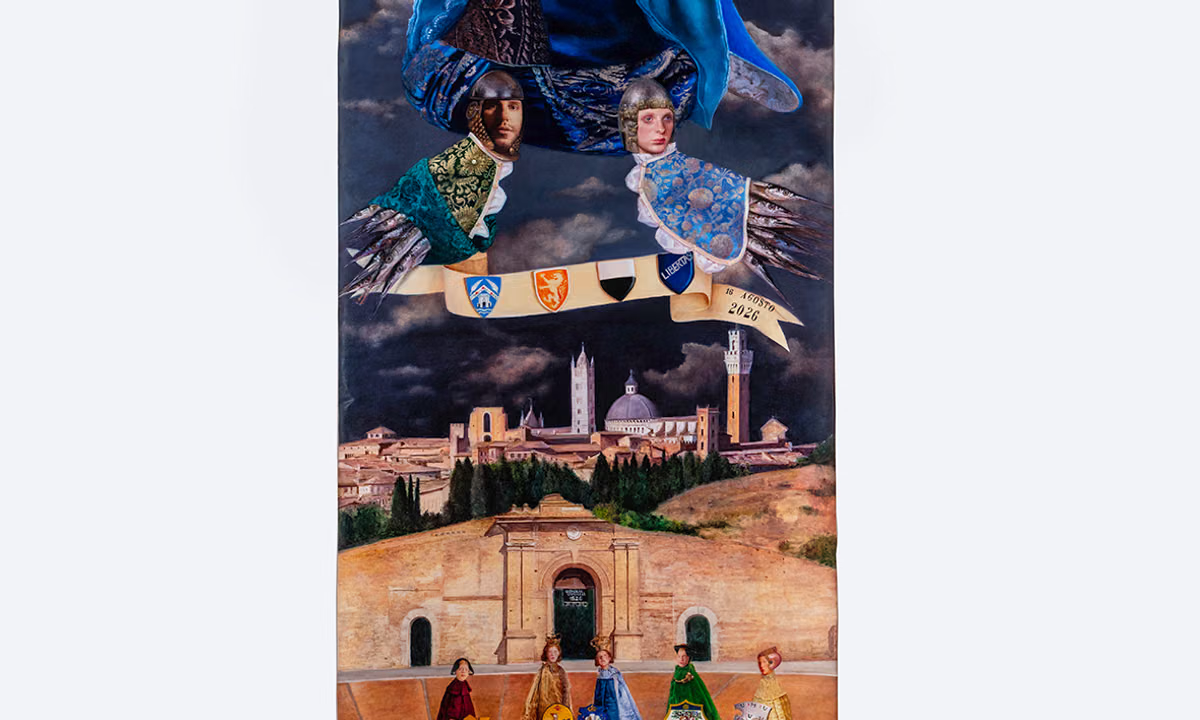
The Romanian artist Teodora Axente has unveiled her design for the drappellone—the silk banner awarded as a prize in the Palio horse race in Siena—following in the footsteps of Jim Dine in 2000 and Fernando Botero in 2002.
The Sienese municipality appoints an artist annually to hand paint the drappellone, a rectangular piece of silk mounted on a black-and-white wooden pole. The contrade—the historic districts in the famed Tuscan city—all compete in the nearly 400-year-old horse race that takes over the city’s 14th-century square, the Piazza del Campo. The drappellone will enter the museum collection of the contrada that wins the race on 16 August.
Axente’s drappellone shows the figure of the Virgin Mary, who dominates the work, placed at the apex of a pyramidal structure looking over the Golden Rose, the gift that Pope Pius II bestowed upon the city of Siena. Axente tells The Art Newspaper: “It is a big responsibility but I feel very lucky as well because it’s such an honour. [The drappellone] really matters to Sienese society—it’s like [the city’s] reflection in the mirror.”
A statement from the Comune di Siena says: “Storm clouds gather in the background [in Axente’s work], evoking the Battle of Camollia of 1526, the historic event to which this Palio is dedicated, while the light radiating from the Virgin transforms the sky into a symbol of hope and rebirth.” The city skyline is represented by depictions of the Palazzo Pubblico, the Torre del Mangia and the Duomo.
“Every year the artists need to respect rules in terms of what to paint and not to paint. And this year it was 500 years of the Battle of Camollia when Florence fought against Siena, which won the battle. Teodora had the very hard task of representing that battle as well,” says Riccardo Freddo, head of museums and institutional relations at London-based Gallery Rosenfeld which represents Axente. At 33, Freddo is the youngest ever “presenter” of the drappellone in Sienese history.
“The drappellone is not simply a work of art: it is a symbol, a witness to the history of Siena, its faith, its identity and its people. Teodora Axente was called upon to engage with centuries of tradition. It is an immense responsibility, but also a rare privilege,” he adds in a statement.
The race takes place on 16 August
Courtesy Comune di Siena
Axente is making her mark in Siena; her current exhibition at Santa Maria della Scala has been extended (until 30 August) while another exhibition of her work has launched at the Museo Civico di Siena during the Palio period (until 27 September). The latter show, curated by Freddo and Michela Eremita, the director of the Museo Civico, juxtaposes Axente’s work with Ambrogio Lorenzetti’s medieval masterpiece, The Allegory and Effects of Good and Bad Government (1338–1339).
Axente tells The Art Newspaper: “The influence of the Byzantine [tradition] is very strong in my work. I wanted to reflect this in contemporary life and try to take the essence of the Byzantine canon, translating it into my language. I admire Velázquez very much but I’m also very influenced by the processes and techniques of Flemish painting.” The artist is due to launch an institutional show in France in 2027 and another major exhibition in Venice in 2028 (venues to be announced).
