


There are few forms of art more intimate than textiles. When we look at them, we imagine how they might feel, move, or hang on our bodies. We picture the distant landscapes in which they were created, and the long-forgotten hands which laboured over them for days and months to conjure intricate abstract designs of startling freshness. They are a window into the communities that created them, with every motif and line signalling a different memory, tradition or identity. Often seen as folk art, these pieces of embroidery and weaving bring together dozens of narrative threads, from Japan to South America. But nowhere is it more fraught with meaning than in Palestine.
Over the decades, Palestinians have lost much of their material and intangible heritage. With the displacement and trauma, traditional Palestinian cross-stitch embroidery known as tatreez took on a new depth of meaning. It was a connection with what had been lost. In Narrative Threads, Joanna Barakat, a Palestinian multi-disciplinary artist, builds on academic research into Palestine’s textile history and the 2023 exhibition Material Power at Kettle’s Yard, Cambridge, to show, in their own words, how 24 Palestinian contemporary artists created new meanings from this heritage.
As one of the contributors, the art historian Wafa Ghnaim, reminds us, these textile traditions in Palestine predate the New Testament. In their 19th-century heyday, rural women embroidered thick clusters of red-and-black geometric flowers on their flowing thobe dresses. The arrangement of lines, the angles, and the species of flora could each hint at a particular use or village of origin, and the embroidery was highly prized across boundaries of class. “Tatreez was once passed from mother to daughter,” writes Ghnaim. “But in the wake of al-Nakba [the displacement of 750,000 Arabs from Mandatory Palestine in 1948], centuries-old intergenerational traditions were severely disrupted owing to… ongoing war, displacement and ethnic cleansing.”
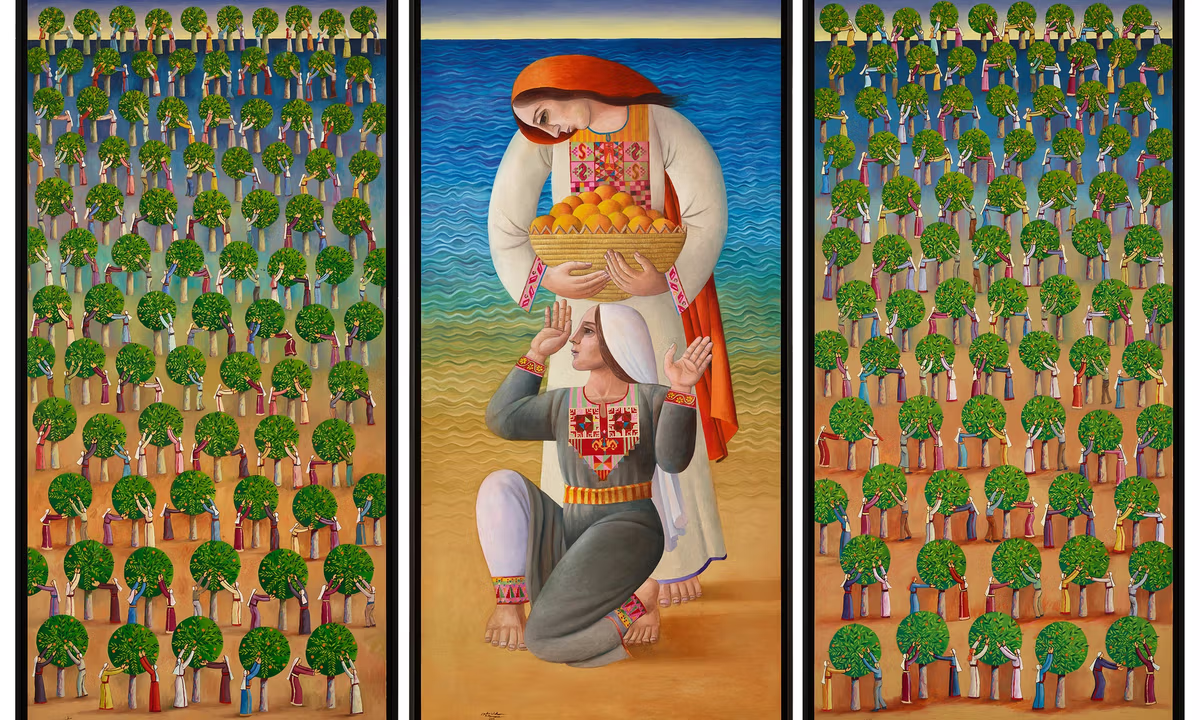
Water Bearer (2018) by Sama Alshaibi, whose work interrogates depictions of women © the artist
Today, the cotton threads and natural dyes of old have been replaced by synthetic commercial products embroidered in circumstances far removed from their roots and no longer associated with specific practices or local identities. These traditions are mostly preserved outside of Palestine, where tatreez has become a self-conscious marker of cultural identity, for example through initiatives like Ghnaim’s Tatreez & Tea events, where women in the diaspora come together to pass on the living practice in “a context that is enlightened by tea, handwork, and storytelling”.
New life for an ancient form
Contemporary artists have breathed new life into Palestinian textiles, picking out a multiplicity of meaning: they are symbols of women’s agency and objectification; of the struggle to preserve a ravaged heritage; and of “the land”—an ever-present character in Palestinian cultural production. By weaving tatreez into their work, these artists have asked what cultural authenticity might mean in a Palestinian context. Narrative Threads showcases the breadth of Palestinian contemporary art as well as the contemporary vitality of this highly traditional visual culture; it recalls the innovative ways that South Asian and Middle Eastern artists have used and honoured Islamic traditions of geometry or Indo-Persian miniature painting in their work.
The painter Sliman Mansour (born 1947) is featured among the visual artists who grew up under Israeli censorship, which prevented them from forming an artists’ union and from depicting nationalist symbols, including references to the Palestinian flag. Mansour turned instead to an idyll of rural life. Tatreez embroidery provided a strikingly enigmatic source of visual interest, mimicking the bold, angular lines of Mansour’s figures and landscape. While some of his works have even incorporated mud, adding an earthy feel to the play of textures and tones, he has depicted textiles with an anthropologist’s eye for detail, preserving the subtle differences, now lost, between embroidery from Gaza, Hebron and Ramallah. But since then, “they lost their accent”, he writes, and the “embroidery is the same”.
Other artists have sought to deconstruct the connotations of textile art in Palestine. Using costumes made by her mother, Sama Alshaibi questions the burden of significance that has been assigned to the female figure: “I wanted to unpack how the female peasant woman came to signify the motherland, while also critiquing Orientalist images [of Palestinian women] as the passive, exotic other.” Focusing on the intimate, sometimes tense, relationship between culture and the body, Alshaibi produced gorgeous, playful black-and-white photogravure images that recall early 20th-century studio portraits—or the work of her near-contemporaries Shadi Ghadirian or Shirin Neshat: traditional female costumes and challenging female postures provoke our reflection.
In different ways, all these artists have engaged with trauma and loss, but they have also created something vital and beautiful. One of the artists, Majd Abel Hamid, exemplifies this by embroidering pieces of cotton before dyeing them blue, in reference to a tradition of mourning now perhaps lost in Palestine: widows “would express their grief by drenching their brightly embroidered dresses in indigo, turning them dark blue. Over time… the indigo would fade and the colourful thread would reappear, reflecting the slow easing of their grief”. The detail encapsulates these artists’ achievement—in Barakat’s words—of “preserving and reclaiming indigeneity, dismantling colonial constructs, and celebrating the beauty and impact of Palestinian embroidery”.
Narrative Threads: Palestinian Embroidery in Contemporary Art by Joanna Barakat, with essays by Tina Sherwell, Wafa Ghnaim and Rachel Dedman, Saqi Books, 304pp, 228 colour illustrations, £35 (hb), published 15 August 2025
• Cyrus Naji is a freelance writer and journalist
