


Total star rating: ★★★½
The works: ★★★★
The show: ★★★
How would Koyo Kouoh have done this? This was the inescapable thought in my head as I negotiated the Central Pavilion in the Giardini and the Arsenale, the two venues for the Venice Biennale’s main exhibition, and their surrounding landscapes. It is also the key consideration for the five curators trusted with bringing the ideas of the Biennale’s artistic director, who died in May 2025, to fruition.
It feels important to say that however closely they collaborated, however deeply they understood their friend, the squadra di Koyo Kouoh (Koyo Kouoh’s team) can only divine so much about the physical presentation of her “vision, plans and desires”, as they put it. The three “advisors”—Gabe Beckhurst Feijoo, Marie Hélène Pereira and Rasha Salti—the editor-in-chief, Siddhartha Mitter, and the assistant to Kouoh, Rory Tsapayi, spent a week with her in Dakar, a month before she died. They thrashed out the artist list, the exhibition structure and design, and considered how Kouoh’s multiple themes and “undercurrent priorities”, as they describe them, would be manifested through the show.
But grappling with the objects and installations, many of them completed since Kouoh’s death, is a different matter—and there is a greater proportion of new art made by the 110 artists in this Biennale that there was in the 2024 exhibition curated by Adriano Pedrosa. Simply, the squadra’s task is impossible.
That said, I left In Minor Keys feeling that Kouoh’s core concepts palpably did emerge through the two venues. A sense of procession abounds, especially in the Arsenale, where the lengthy enfilade of the Corderie, the former rope-making spaces of the shipyard, naturally lends itself to cavalcade. Among the exhibition’s strongest elements is the presence of sentinels who guide us through the exhibition: witnesses to historical trauma whose resistance often finds joyous expression.
Nick Cave’s Amalgam (Origin) (2025) Photo: Marco Zorzanello; Courtesy of La Biennale di Venezia
They begin early in the Giardini with Big Chief Demond Melancon’s Amistad Takeover (2026), a vast orange-feathered “suit”—quite the understatement—made in the Black Masking tradition, whose roots lie in the ceremonial practices brought to the US by enslaved people and informed by encounters with Native Americans. Embedded among the feathers is beadwork depicting the revolt of enslaved people on a Spanish boat in the 19th century. And the sentinels continue right through to the external spaces beyond the Corderie, where the US artist Nick Cave’s Amalgam (Origin) (2025) stands overlooking the Arsenale’s harbour. A vast human-animal-vegetal hybrid body, cast in monochrome bronze, the sculpture is informed by Cave’s career-long project, the “Soundsuits”—exuberant emblems of resistance to racist violence. Based on Cave’s own body, the figure is bedecked in a floral relief, softening its sturdy power stance. From the chest up, the body becomes a tree that hosts a flock of 50 avian species, which Cave calls a “migration hub”, an evocation of community in the face of oppression. Cave’s work is emblematic of Kouoh’s aim to manifest “joy, solace, hope, and transcendence”; to counter tragedy—historic and present-day—with beauty and enchantment.
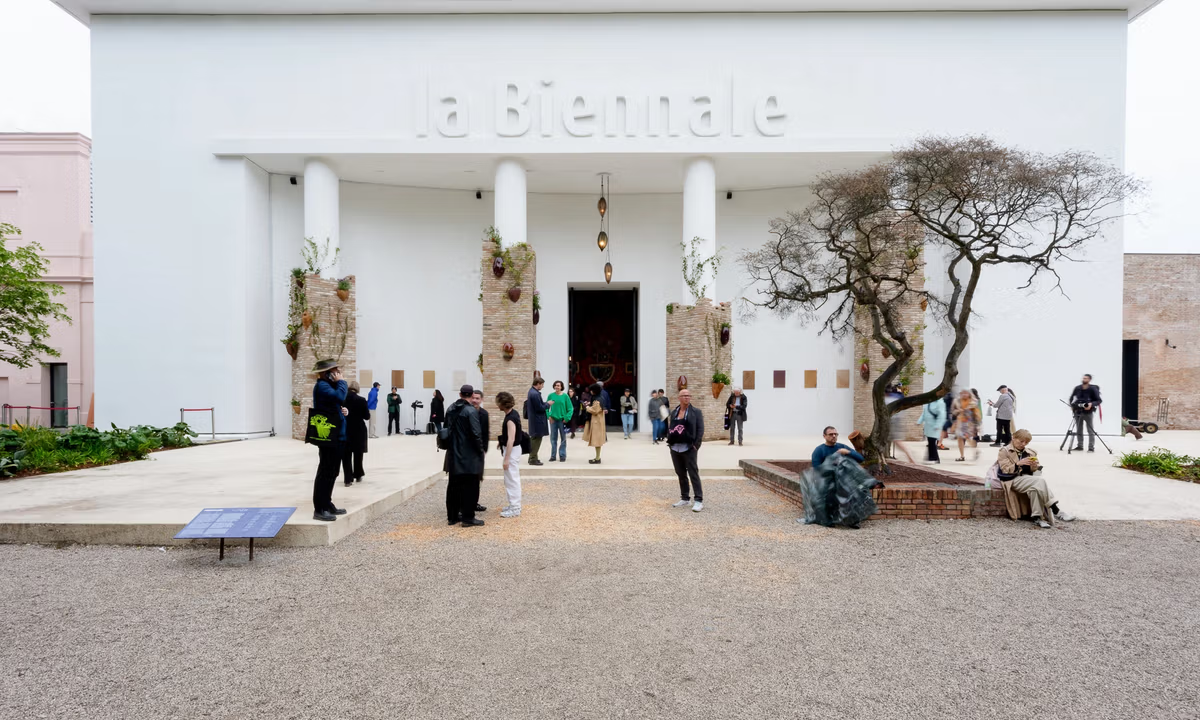
This is palpable even before entering the Central Pavilion: Otobong Nkanga has rewilded the four pristine Modernist cylindrical columns of the white building by clothing them in brick immediately evocative of the fabric of Venice, on which she has hung glass terraria, clay flower pots and wooden bee hotels. The plants, she hopes, will eventually overwhelm the columns.
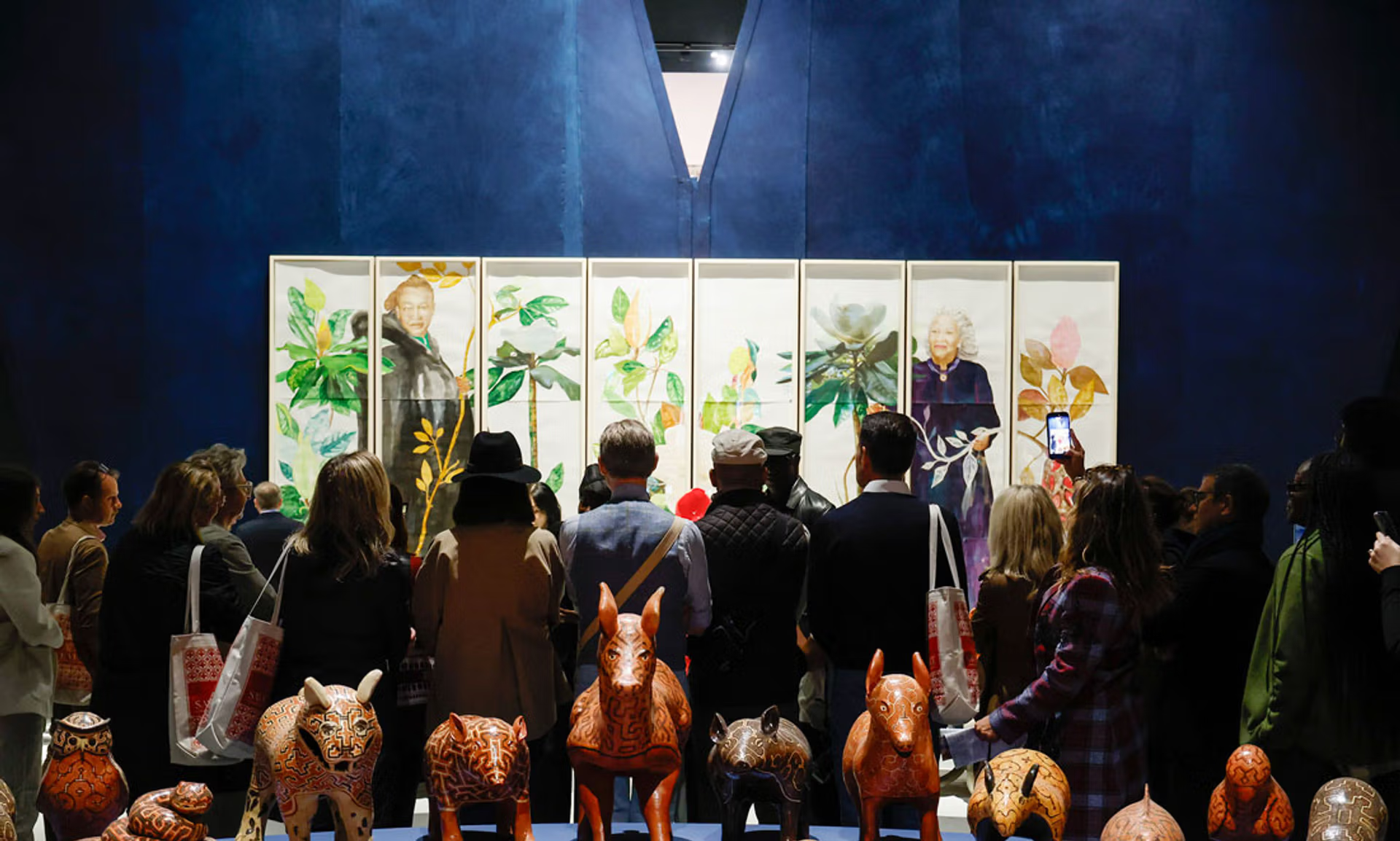
Visitors looking at Maria Magdalena Campos-Pons’s paintings of Koyo Kouoh and Toni Morrison Courtesy of La Biennale di Venezia
Another key Kouoh theme is the garden, the oasis, again as a space not just of life and beauty, but one of defiance—for instance, in the creole gardens of enslaved people. And following Nkanga, plants germinate and proliferate through the show. Close to clusters of magnolias sculpted by Maria Magdalena Campos-Pons, again in glass and ceramic, among other materials, we see Kouoh herself in Campos-Pons’s painting, standing on a branch with the clawed feet of a bird of prey, among the leaves and blooms of magnolias. Alongside her is Toni Morrison, a presiding literary influence on the show, herself given sharp talons.
Among the many other hybrid figures are those by Wangechi Mutu: near Cave’s figure in the Arsenale harbour is SimbiSiren (2026), a marvellous bronze—part mermaid, part sphinx, part Kongo spirit, part Mugumo tree root—whose flippered limbs drape elegantly over a perforated metal base. In the Central Pavilion, meanwhile, is Mutu’s MothersMound (2026), a knoll in the shape of a pregnant body.
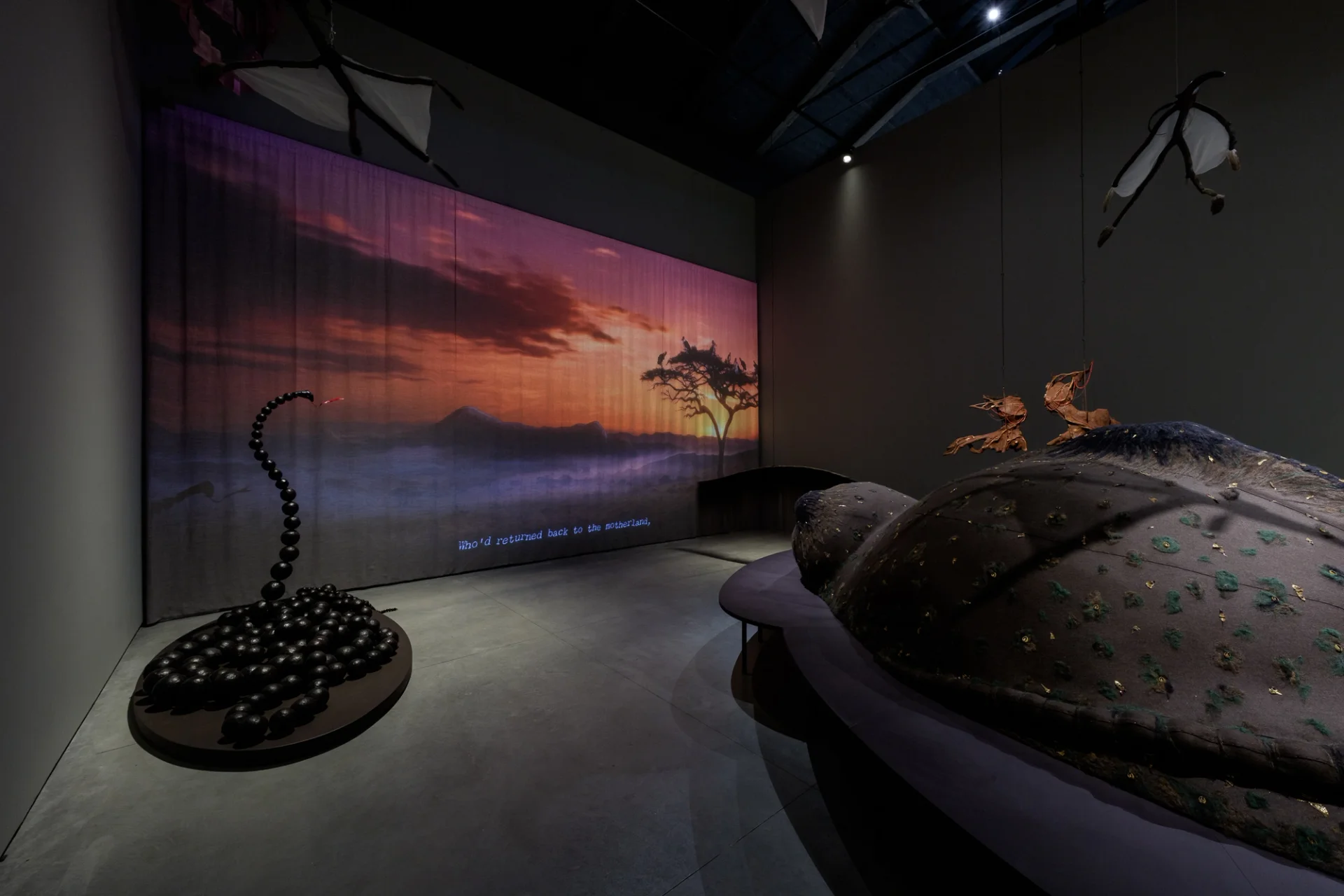
One of the few rooms dedicated to a single artist, in this case showing work by Wangechi Mutu Courtesy of La Biennale di Venezia
MothersMound is the central piece in a room dedicated to Mutu, one of few in the pavilion. As a result of this scarcity of solo spaces, and the emphasis on multi-artist rooms with sometimes confusing or jarring juxtapositions, the Central Pavilion is poorly paced. I fully expected the two late “lodestar artists”— the Senegalese artist Issa Samb, Kouoh’s mentor and the founder of the art collective Laboratoire Agit’Art, and the US artist Beverly Buchanan, the creator of sculpted and drawn “shacks”—to be given dedicated rooms. Instead, their prominence is dulled by dispersal among other artists.
Notable in relation to this approach is the squadra’s description in the Biennale catalogue of Kouoh’s commitment to artists whose practices are “not necessarily uplifted in conventional” exhibition formats and her aim to challenge “the structured frameworks of museums, monographic exhibitions and biennials”. The principle of artists’ practices being interspersed and resurfacing through the show is an admirable one. Sometimes it works beautifully. But a more conventional structure might conversely have uplifted works that get lost in a display that inevitably favours more bombastic language over some quieter practices—ironically, lessening the impact of exactly the minor-key works that the exhibition aims to privilege. The curatorial thesis also makes much of the idea of providing spaces of rest in the exhibition. And while there are welcome carpeted zones with seating, there is little repose provided by the organisation of the art itself.
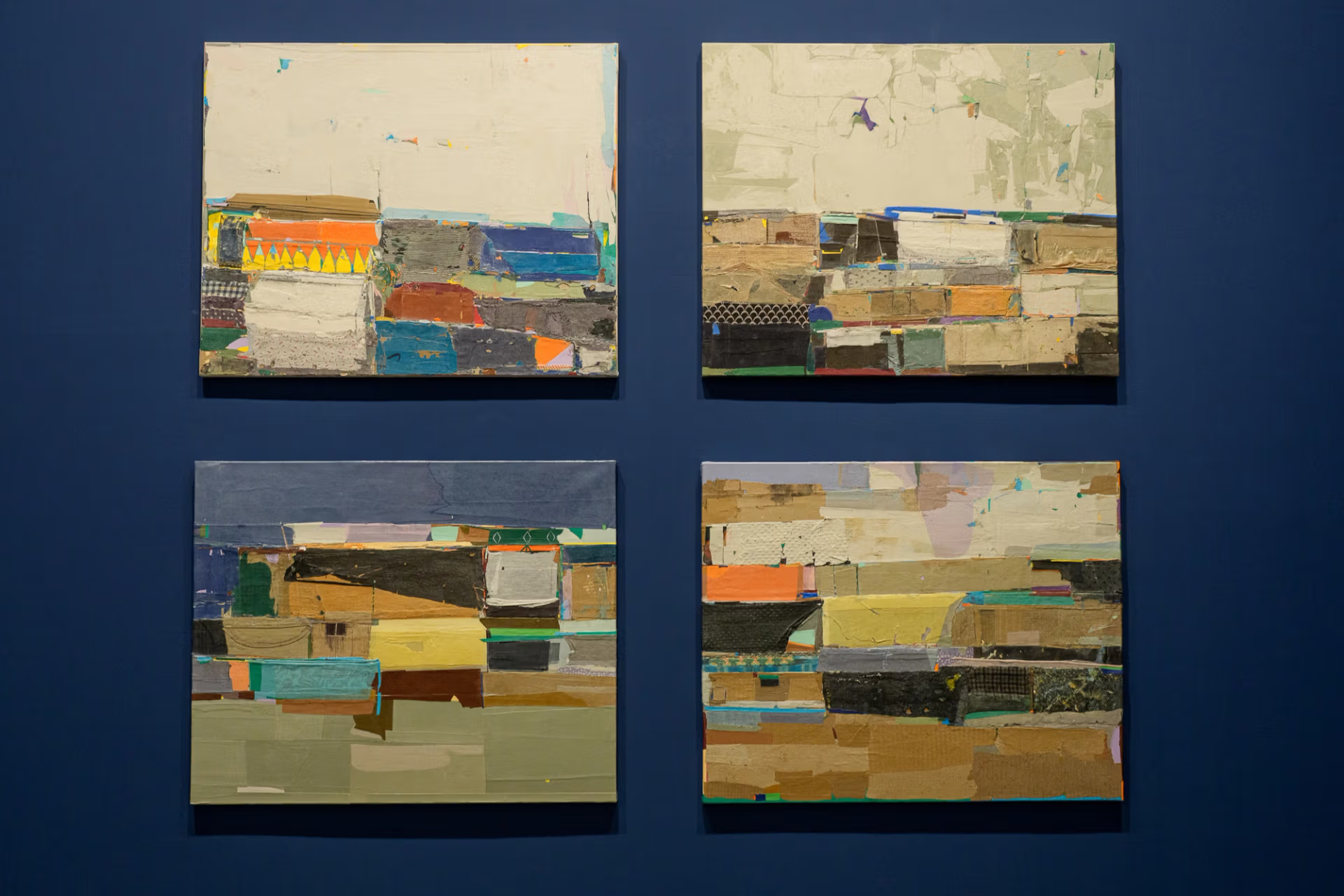
Some of Mohammed Joha’s collages Courtesy of La Biennale di Venezia
Take the Palestinian artist Mohammed Joha, who makes beautiful and tender collages assembled from everyday detritus like discarded paper and fabric. Initially appearing abstract, they in fact allude to the architecture and environment of Gaza. But they, and related watercolours, are shown in several different spaces, when a solo room would have fully honoured their poignancy and provided an apt moment of pause, given the subject.
To extend the musical metaphor in the title, and at the core of Kouoh’s text about the show, we end up with too much cacophony and too little rhythm and syncopation. Kouoh alluded to adopting the mode of a free-jazz ensemble, but free jazz stands or falls by its discipline. Too often, the Central Pavilion feels aimless. That is not to say that there are not compelling passages. I loved the different forms of dense accumulation in the works of Tammy Nguyen, Ebony G. Patterson and Alexa Kumiko Hatanaka, for instance. But the layout lacks the dynamism that would have made many pieces in the show more resonant.
The Arsenale suits this approach better, in that the more ample space allows for more separation and immersion in artists’ works. Again, we see Kouoh’s trauma/exuberance dichotomy play out: in Guadalupe Maravilla’s ICE Age Disease Thrower sculptures, for instance, where the artist retraces his childhood journey as an undocumented immigrant—escaping the Salvadoran Civil War for the US—by gathering objects that are set within woven, distinctly bodily, chairs. They evoke Central American Acapulco furniture, with origins in Mayan hammocks. One object devastatingly reflects Maravilla’s constellation of symbols and references: a beanie hat with animal ears that replicates the one worn by a young child who was infamously detained by immigration and customs enforcement (Ice) officers in the US. The Disease Throwers aim to act as witnesses to, and guardians against, this brutality.
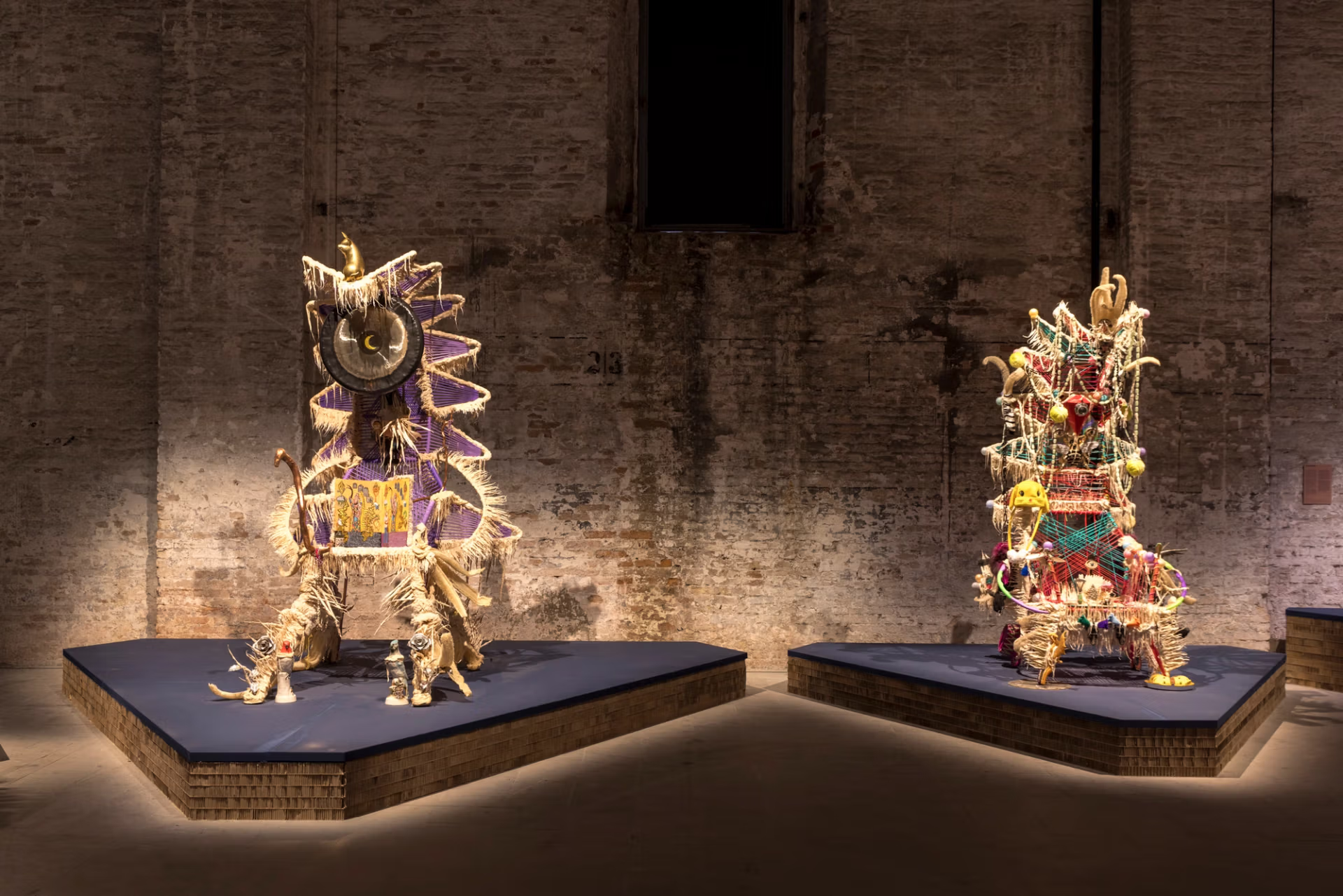
Two of the sculptures from Guadalupe Maravilla’s ICE Age Disease Thrower series Courtesy of La Biennale di Venezia
Stellar, hugely distinctive, spaces dedicated to Laurie Anderson, Kader Attia, Alfredo Jaar, Walid Raad and Rose Salane, among others, all testify to a much tauter dramaturgy through the Arsenale. Although there are wayward or unfocused moments, overall the juxtapositions are more dynamic—not least the pairing of two more hybrid figures, Nicholas Hlobo’s Umrhubuluzi (2010) and Rajni Perera and Marigold Santos’s Efflorescence/The Way We Wake (2023). The former is seemingly part mermaid (again), part lobster, part plant, fashioned in rubber and ribbon; the latter a masked deity in polymer clay, Styrofoam and synthetic hair looming like a mountain at the heart of an archipelago of atolls occupied by outlandish plants.
This is another significance of the keys in Kouoh’s title—the cay, or small island. As a multifaceted concept, the exhibition is enormously rich. It provides countless moments of disquiet and delight. Given that the task of fully embodying Kouoh’s vision as she would have is indeed impossible, it is laudable that many of her ideas for In Minor Keys are still seen and felt—and sometimes sonorously.
• Venice Biennale 2026: In Minor Keys, Giardini and Arsenale, Venice, 9 May-22 November
• Curators: Koyo Kouoh and then realised by Gabe Beckhurst Feijoo, Siddhartha Mit-ter, Marie Hélène Pereira, Rasha Salti and Rory Tsapayi
• Tickets: €30 (concessions available)
