


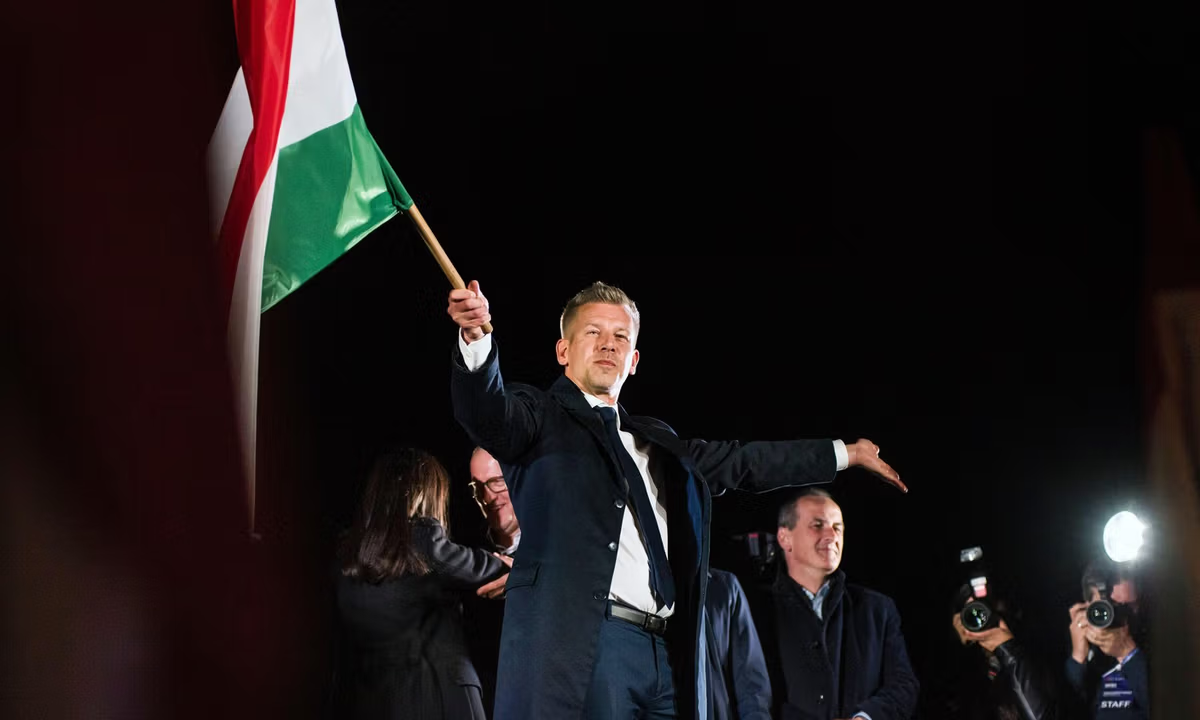
On Sunday evening, Hungary’s long-standing prime minister, Viktor Orbán, was swept from power in a landslide victory for Péter Magyar’s Tisza Party. The result, in what has been seen by some observers as Europe’s most important parliamentary election of 2026, prompted celebrations on the streets of the Hungarian capital, Budapest, and an outpouring of jubilation from many of Europe’s centrist and leftwing leaders.
During his 16 years in power, Orbán cemented himself as one of Europe’s most polarising figures, attracting praise from both the American and European far-right for his self-styled brand of “illiberal democracy”. The EU establishment in Brussels, meanwhile, viewed him as an internal nemesis who opposed the rule of law and facilitated widespread corruption.
While it is too early to say how Hungary’s new government will directly impact the arts, Margit Valkó, the founder of Budapest’s Kisterem gallery, speaks for many of the more progressive members of the art scene when she says: “For sure, we belong to the extremely happy part of the crowd.”
Similarly, the artist János Sugár says: “I feel an enormous sense of relief, seeing that things could go back to normal and [not be] governed by lies and bad taste. Many people must feel this way, it was quite touching to see crowds of people on the streets hugging, crying with happiness, opening champagne, and partying—and not just in Budapest.”
Orbán co-founded Hungary’s Fidesz party in the late 1980s. His politics, like those of his party, shifted from more liberal, anti-communist beginnings to a concerted focus on nationalism and social conservatism, championing the defence of “Christian civilisation”.
While he sustained strong electoral success across the four previous elections, critics viewed him as an authoritarian populist who eroded the independence of key institutions and trampled on LGTBQ+ rights. In particular, the government’s highly controversial 2021 “child protection” law restricted public assemblies seen as promoting LGBTQ+ themes, including Pride marches, and was used in 2023 as grounds to dismiss the director of the Hungarian National Museum.
“Orbán’s cultural policy, in one word,” notes Sugár, “was anti-contemporary, it was uncultivated and opposed everything in which it perceived critical content.”
Magyar is himself a centre-right politician and a former member of Fidesz, so some political analysts have tempered hopes that Hungarian society will now see rapid changes. The new leader has, however, already announced that he plans to suspend Hungary’s state-controlled media, which was controversially overhauled by the Fidesz government to become what Magyar called a “factory of lies”.
For Valkó, a key question is what will now happen to what she describes as the “ideologically burdened” Hungarian Academy of Arts, an institution given significant funding powers by Fidesz that is seen as having been an instrument of the government’s conservative agenda.
More broadly, members of the art scene hope to see increased institutional autonomy, with Attila Pőcze, of Budapest’s Vintage Galéria, explaining, “We strongly hope for dialogue with civil society, the reconstruction of the institutional system of culture and the reinforcement of the capacity and resilience of the independent and critical cultural scene.”
Echoing those hopes, Sugár says: “I hope that small and large institutions will regain their autonomy, international relations can be rebuilt, and (in two words) I expect some vibrancy and bustle.”
