


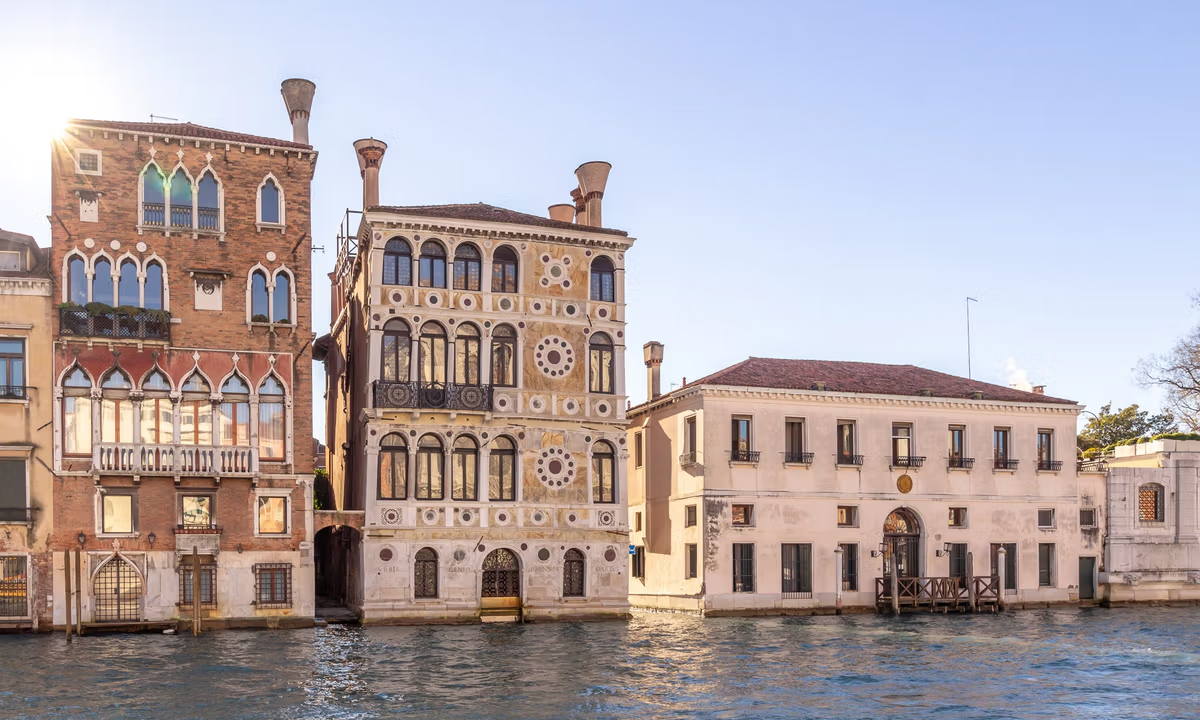
The Venice Biennale has long been a place where art is sold, though its commercial capacity is usually downplayed. As the Biennale is officially a government-subsidised, non-commercial institution, talking about sales—let alone actually doing them on site—is largely frowned upon.
Not so this year, with an unprecedented number of dealers, auction houses and private foundations openly pricing and selling works to the crowds of collectors descending on the city this week, some perhaps spurred on by Italy’s year-old 5% VAT rate on art imports—now Europe’s lowest.
For the first time, Christie’s is hosting an invitation-only selling exhibition in Venice, offering Old Masters such as Lucas Cranach alongside Modern and contemporary giants like Andy Warhol, Louise Bourgeois and Mark Bradford. Prices range from $500,000 to more than $35m. Several works are Venice themed, including a depiction of the city by JMW Turner from 1841 and Édouard Manet’s 1873 view of the Grand Canal, which has been hung alongside a portrait of Laura Dianti by Titian (around 1523). Exhibition viewings are by invitation only (4-10 May).
Giovanni Francesco Barbieri, detto Il Guercino, is on sale at Christie’s
@ Christie’s Images LTD 2026
“It’s a first for us to present a selection of works to many of our most valuable clients who happen to be in town during the vernissage,” says Adrien Meyer, Christie’s global head of private sales. Meyer notes that Venice is also a natural fit for the auction house, given that a large portion of its billionaire owner François Pinault’s collection is housed in the city. Christie’s has also in the past sponsored presentations in the British and Nigerian pavilions.
Ghost Pavilion: A Venice Revealed, as the private selling exhibition is titled, is a nod to past shows by Bourgeois and Bradford, among others, as well as the “colourful history of the building”, Meyer says. Immortalised by Monet in 1908, the Palazzo Ca’ Dario, a Gothic palace remodelled by Giovanni Dario, the secretary to the Venetian Senate who negotiated a peace agreement with the Ottomans in 1479, has since been occupied by countesses, aristocrats, financiers—as well as the manager of rock band The Who. The property is currently on the market with Christie’s Real Estate.
Meyer thinks Venice has the capacity to marry commerce and institutional clout in much the same way that Art Basel has made inroads to Paris—a city chiefly known for its world class museums but with a growing market reputation. “There is a path ahead in Venice to the same effect,” he says. “Commercial and scholarly initiatives can be compatible, especially if we are mindful of the relevance of those different initiatives.”
Private patrons footing the bill
As public funding has dwindled, dealers and private collectors have upped their support for the biennale over the past decade or so, not only footing the bills for the production, transport, installation and staffing of the presentations that take place across the national pavilions and collateral exhibitions (as well as numerous others), but also the lavish dinners and parties that are the hallmark of the vernissage.
As Pace Gallery’s chief executive Marc Glimcher puts it: “There isn’t a good system for funding these things anymore, so dealers are increasingly stepping in. That means they must cover their costs, primarily by selling the art. Some will cover their costs, some won’t. It’s all dependent on the galleries’ ability to support their artists.”
The Venice Biennale did not respond to a request for comment on the growing commercial aspect of the event; it is understood that it is not a requirement for exhibitors to declare whether they intend to sell works while in Italy, where a reduced 5% VAT on art imports and sales has boosted the country’s standing in the global art market. In 2019, Biennale organisers decided to remove art dealers’ names from exhibition labels, suggesting a desire to visibly distance itself from any commercial activity.
The Italian art adviser Barbara Cortina says that “a significant share of transactions” at the Venice Biennale “involves works from the secondary market”—but this year there is a renewed focus on contemporary art. According to research by Artnet News, 90% of artists in the Biennale’s main exhibition are living. It is here, in the primary market, that the 5% VAT becomes a “real incentive”, Cortina says. “In these cases, the 5% rate can meaningfully reduce the final cost for collectors.”
Numerous works are also constructed especially for the biennale, including large-scale, ambitious projects. Some dealers work in tandem with private foundations, particularly when it comes to the costly fabrication of works. The Algerian-born artist Lydia Ourahmane is showing new sculptural installations at the Nicoletta Fiorucci Foundation following a residency at the Venice branch of the organisation, which was founded by the eponymous Rome-born patron in London in 2021. Fiorucci opened the Venice space last year.
Ourahmane’s exhibition has been entirely produced by the foundation, while her gallery, Chantal Crousel, is selling some of the works (prices range from €10,000 to €90,000). Director Philippe Manzone notes that the gallery’s main role is to promote the show, both in the lead up to the Biennale and in the weeks after. He thinks that the commercial and scholarly aspects of the prestigious event can happily coexist, adding: “Commercial activity has been more visible at the Biennale in recent years because it concerned more and more people these past 15 years, but this effect is already decreasing. When an exhibition is of high quality, I believe the commercial activity around it is no longer an issue.”

Mel Ramos, Mysta of the Moon (1963)
Courtesy the estate.
Both secondary and primary market sales are expected as a result of the career survey of West Coast pop art Mel Ramos at Palazzo Bragadin Carabba, which has been organised in collaboration with the artist’s estate and The Mel and Leta Ramos Family Foundation. In press materials sent out ahead of the Biennale, the show was billed as “the largest posthumous display of Ramos’s work in the past decade, featuring nearly 100 works, of which most will be for sale, ranging from $50,000 to $1.8m”. There is also “a large retail shop” on site, featuring limited edition items and 28 lithograph prints starting at $3,500.
The Venezuelan collector Ronald Harrar, who has organised the exhibition in collaboration with the artist’s estate, is upfront about the power of the Biennale as a commercial platform. “We consider Venice, particularly within the framework of the Biennale, to be a uniquely effective platform where institutional discourse and market visibility converge,” he says. “[Our] exhibition is conceived to operate across both registers: as a rigorous curatorial proposition grounded in archival research, and as a mechanism for renewed market engagement.”
Sales from the exhibition will not all directly benefit the Mel and Leta Ramos Family Foundation, says a project spokesperson. “The works in the show are presented in collaboration with the estate of Mel Ramos and participating lenders and collections, with standard primary and secondary market structures applying where relevant. However, a portion of the proceeds from select editions like lithographs and publications will support the foundation and its philanthropic initiatives,” she adds.
Venice, particularly within the framework of the Biennale, to be a uniquely effective platform where institutional discourse and market visibility converge
Venezuelan collector Ronald Harrar
In other instances, artists are in the driving seat. Amin Jaffer, the curator of the India pavilion in the Arsenale, stresses that all the works in the presentation belong to the five artists, which include Sumakshi Singh and Ranjani Shettar, rather than their representative galleries. The India Pavilion is backed by the country’s ministry of culture and two non-profit arts organisations: the Nita Mukesh Ambani Cultural Centre and the Serendipity Arts Foundation.
In Jaffer’s experience, the scholarly and commercial dynamics of the Biennale are not mutually exclusive. As he puts it: “Many Biennale projects are raised and supported by galleries, who increasingly host museum-quality exhibitions that make a meaningful contribution to scholarship and public access.”
Because it is a charity, Nadim Samman says the UK-based Autotelic Foundation that he runs does not sell or engage in any kind of trade. The foundation is showing two exhibitions of works by the Italian artist duo Eva and Franco Mettes—one at the Palazzo Franchetti (until 30 June) and one at Le Cabanon, a private swimming pool on Giudecca island (until 31 May).
Nonetheless, Samman describes “the dance” between public institutions and the market as a complicated one. “And Venice is always a hot mess!” he adds. “I vividly remember entering the British Pavilion some years back and seeing a representative from a certain UK blue chip gallery with papers in hand, on the steps in front, marking down sales of the works inside. It’s worth remembering that the Biennale operated a sales office between 1942 and 1968 to help artists find buyers. It even took a commission!”
Indeed, the biennale’s standing as a powerful, unofficial marketplace that drives the global contemporary art market dates back decades—but, just ten years ago, dealers were reluctant to go on record about the backing they provide for shows and new commissions in Venice, let alone the sales they make. That has patently changed this year. Forget the adage “see it in Venice, buy it at Art Basel”, it’s now a matter of “see it in Venice, buy it in Venice”.
