


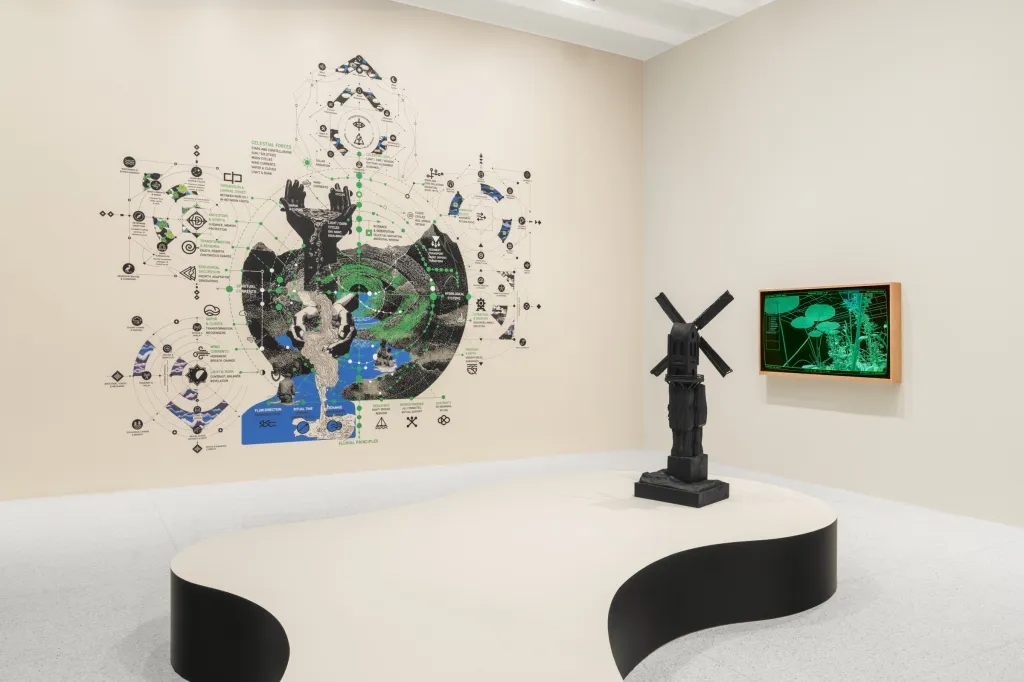
Minneapolis’s Walker Art Center and the artist Olalekan Jeyifous are refuting accusations by some museum visitors that his work was made using generative AI, reports MPR News. Jeyifous, born in Nigeria and living in New York, is also an architect and designer, and uses some of the digital tools that are often employed in those fields. His first museum solo, “Hydricosmic Litanies,” is organized by the Walker’s associate curator for visual arts, Taylor Jasper.
The show, which includes video, sculpture, and soundscapes, draws on African diasporic cosmologies in treating topics like colonization, industrialization, and technological advancement as it impacts our relationship to the environment. It also takes inspiration from Ben Okri’s Booker Prize–winning 1991 novel The Famished Road, which opens, “In the beginning there was a river.” The show imagines communities centered on the Mississippi River, which flows through Minneapolis, and the installation echoes a riverbed, with platforms approximating islands.
“Rivers have long served as lifelines for ecological and cultural balance,” writes the artist in a statement on the Walker’s website, “but colonization and industrialization disrupted these reciprocal relationships, imposing systems of control and exploitation with lasting effects. This tension informs the exhibition’s materials and forms.”
Reddit user stvincentstreet posted an “AI slop alert” on August 15, saying they were “disappointed to see so much AI garbage” in the show, adding, “Nowhere in the exhibit did they let guests know that Jeyifous used AI, which feels so shady and wrong.” The visitor’s confusion could be forgiven if, as they claim in the post, an unnamed Walker staffer, unauthorized to speak publicly, “agreed that AI was clearly used,” adding that “I was told even the ‘sculptures’ in the exhibit were machined from AI-generated 3D models.” Stvincentstreet calls it “sickening” that the museum would put such work on display without noting that AI was used to create it. (The museum did not immediately respond to a request for further comment.)

“Olalekan Jeyifous: Hydricosmic Litanies,” at the Walker Art Center, Minneapolis.
Photo by Eric Mueller
Not so, says the artist.
“For more than two decades, people have asked some version of, ‘How did you make this?’” Jeyifous told MPR. “Those methods are commonplace within the discipline I emerge from, but less familiar to a general museum audience, so there has always been some uncertainty around how my images and objects are produced and that has followed me from the beginning.”
The artist tells MPR that since so much early AI-generated imagery had the feeling of science fiction and speculative world-building, he suspected that his work might be misunderstood. “As AI imagery increasingly entered the broader visual culture, I anticipated that people might begin viewing my work through that lens, and even retroactively framing my earlier work as ‘AI slop,’ which has actually happened.”
“Simply prompting images and presenting the results as my artwork is fundamentally at odds with how I’ve always worked,” said Jeyifous.
Jeyifous has shown his work at prestigious venues such as the Studio Museum in Harlem, the Vitra Design Museum in Weil am Rhein, Germany, and the Guggenheim Bilbao, and his work is in the collections of New York’s Museum of Modern Art, the Art Institute of Chicago, and the San Francisco Museum of Modern Art. He won the Silver Lion for a promising young participant at the 2023 Venice Architecture Biennale.
Speaking to MPR, Henriette Huldisch, the museum’s chief curator and director of curatorial affairs, acknowledged that the artist’s practice is not necessarily entirely free from any involvement of AI. “He uses a range of sophisticated software and tools, many of which have AI embedded within them,” she said, while saying that the artworks are never created from simple prompts. According to MPR News, the artist says that “he uses AI-assisted software selectively, be that Photoshop or 3D modeling.”
“He works extremely iteratively,” Jasper, the show’s curator, told MPR. “Everything goes through multiple stages of reconceptualization, of rendering, of visualization and revisualizing and visualizing again.”
The museum told MPR that it is planning to add some clarifying text on the issue to the show’s wall text this week.
“We’re listening and we’re learning with our visitors,” Huldisch said, “and we are adding language.”
